
What Is Electric Potential?
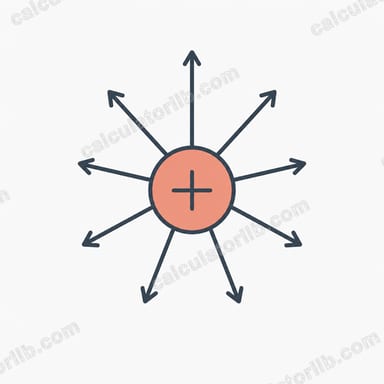
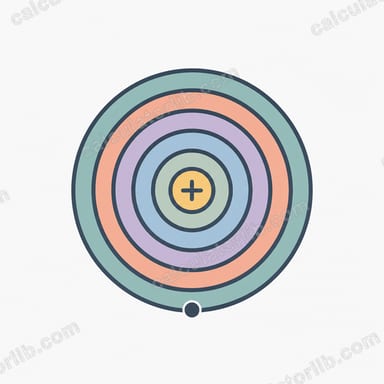
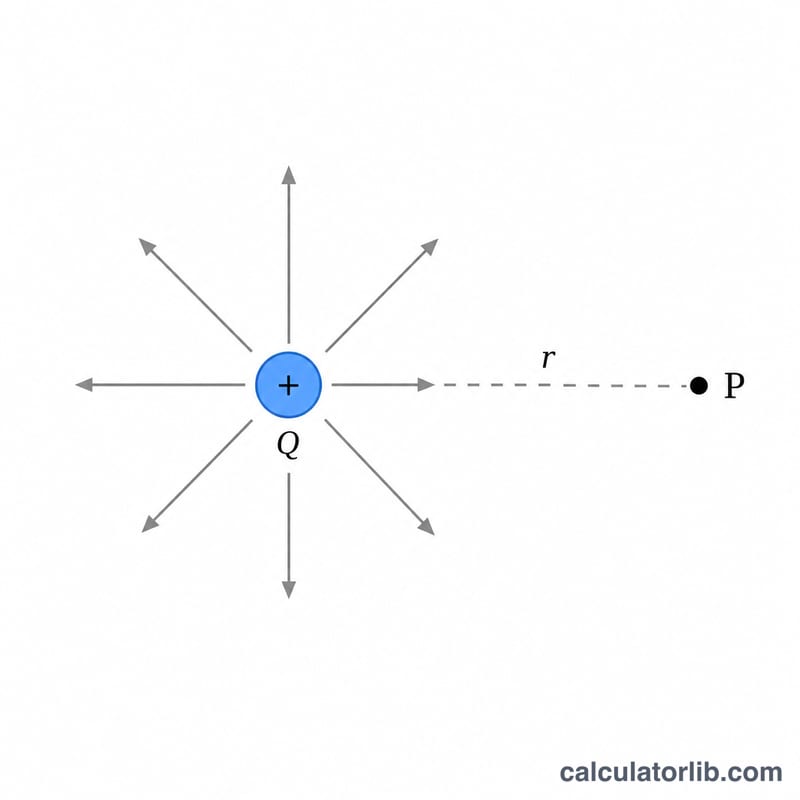
The electric potential (often called voltage) at a point in space is the electric potential energy per unit charge that a test charge would have at that location. For a single point charge Q, the potential at distance r is given by \(V = kQ/r\), where k is the Coulomb constant. This calculator is universal — it relies only on physics constants and works the same everywhere.
How to Use This Calculator
Enter the source charge Q in coulombs (C) and the distance r in meters (m) from that charge to the point where you want the potential. The calculator returns the potential V in volts (V). Positive charges produce a positive potential and negative charges produce a negative potential. Because point-charge potential is a scalar, you do not need a direction.
The Formula Explained
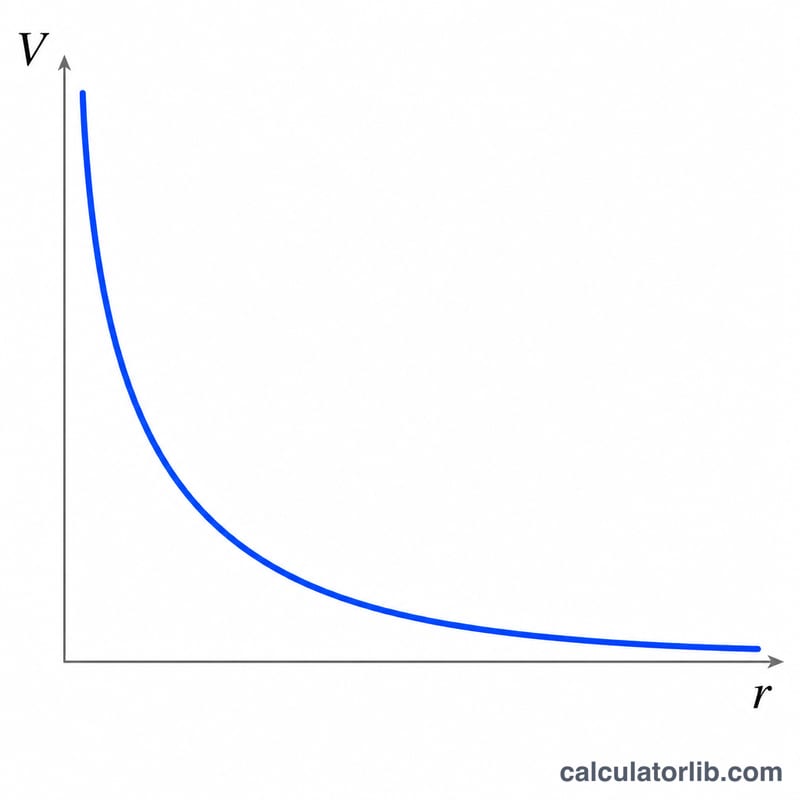
The relationship is $$V = k \cdot \frac{\text{Charge Q (C)}}{\text{Distance r (m)}}$$ Here \(k \approx 8.9876 \times 10^{9}\ \text{N}\cdot\text{m}^2/\text{C}^2\) is the Coulomb constant, Q is the charge, and r is the separation distance. The potential falls off with \(1/r\), so doubling the distance halves the potential. Unlike the electric field (which drops as \(1/r^2\)), the potential decreases more slowly with distance.
Worked Example
Suppose a charge of \(Q = 1\) microcoulomb (\(1 \times 10^{-6}\ \text{C}\)) sits at the origin and you want the potential 1 meter away. Then $$V = \frac{8.9876 \times 10^{9} \times 1 \times 10^{-6}}{1} \approx 8987.55\ \text{volts}$$ At 2 meters the potential would be half: about 4493.78 volts.
FAQ
Is electric potential a vector? No. Potential is a scalar quantity, so contributions from multiple charges simply add algebraically.
What happens at r = 0? The formula diverges to infinity at the location of an ideal point charge, so the calculator returns 0 when distance is zero to avoid an undefined result.
What is the reference point? This formula assumes the potential is zero at infinity, which is the standard convention for an isolated point charge.