
What Is Electric Charge?
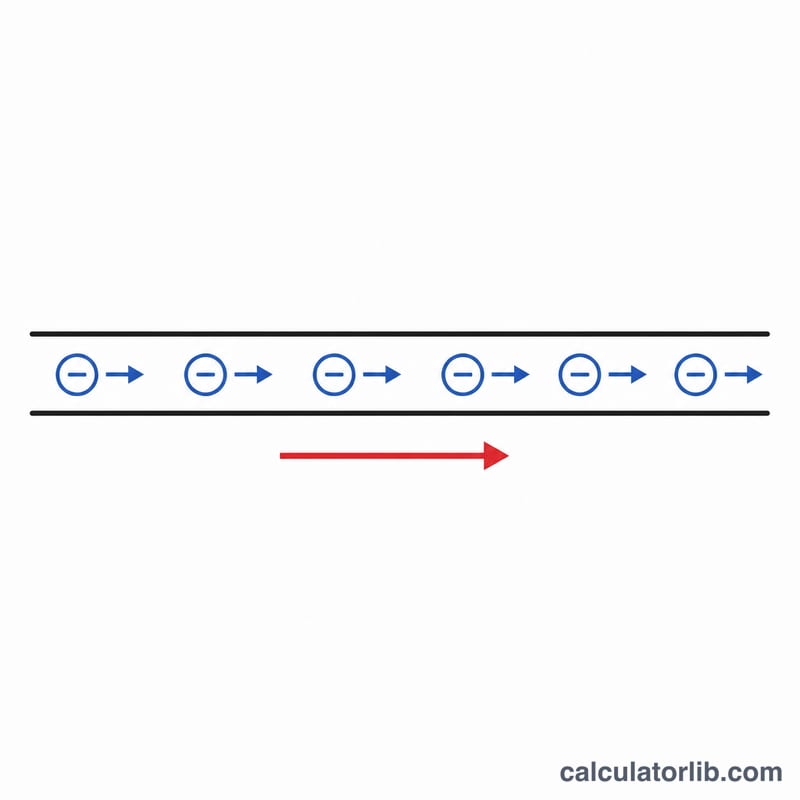
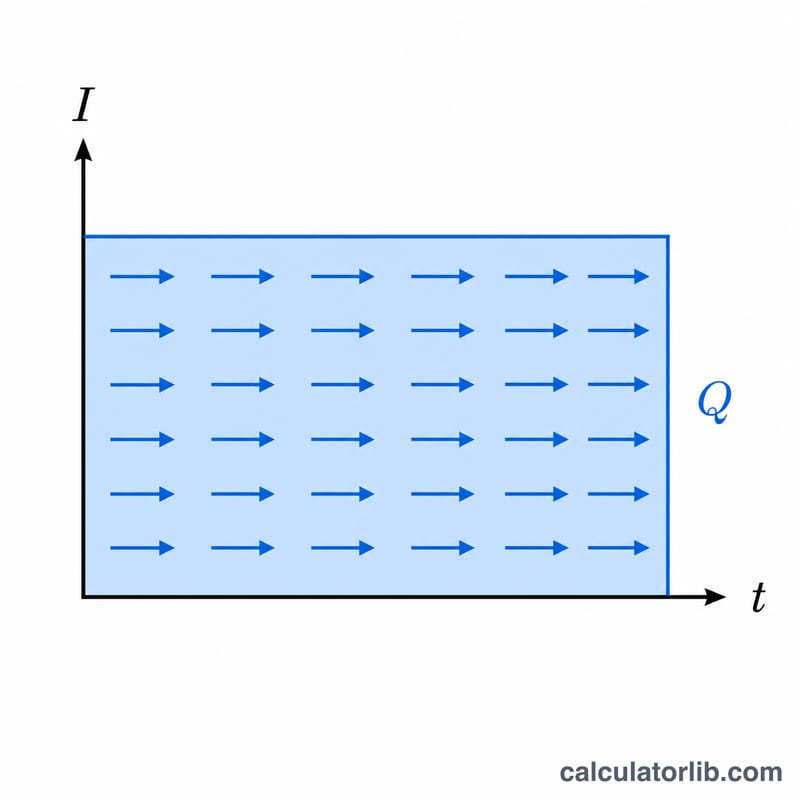
Electric charge (Q) is the total amount of electricity that flows past a point in a circuit. It is measured in coulombs (C). When a steady current flows for a period of time, the charge transferred is simply the current multiplied by the elapsed time. This calculator uses the fundamental relationship $$Q = I \times t$$ where I is the current in amperes and t is the time in seconds.
How to Use This Calculator
Enter the current in amperes (A) and the time in seconds (s). The calculator returns the electric charge in coulombs, plus two handy conversions: the equivalent charge in milliamp-hours (mAh), useful for battery capacity, and the total number of electrons that flowed.
The Formula Explained
The defining equation is $$Q = I \cdot t$$ Because one ampere equals one coulomb per second, multiplying amperes by seconds yields coulombs. To express charge in milliamp-hours, divide by 3.6 (1 mAh = 3.6 C). To count electrons, divide the charge by the elementary charge, \(e = 1.602176634 \times 10^{-19}\) C.
Worked Example
Suppose a current of 2 A flows for 10 seconds. Then $$Q = 2 \times 10 = 20 \text{ coulombs}$$ In milliamp-hours that is \(20 \div 3.6 \approx 5.56\) mAh, corresponding to roughly \(1.25 \times 10^{20}\) electrons.
FAQ
What units should I use? Current in amperes and time in seconds give charge in coulombs. For minutes or hours, convert to seconds first (1 min = 60 s, 1 h = 3600 s).
How do I get milliamp-hours? Divide the coulombs by 3.6, because 1 mAh equals 3.6 coulombs.
Does this assume constant current? Yes. \(Q = I \times t\) holds for a steady (constant) current. For a changing current, charge is the integral of current over time.