
What is Power Factor Correction?
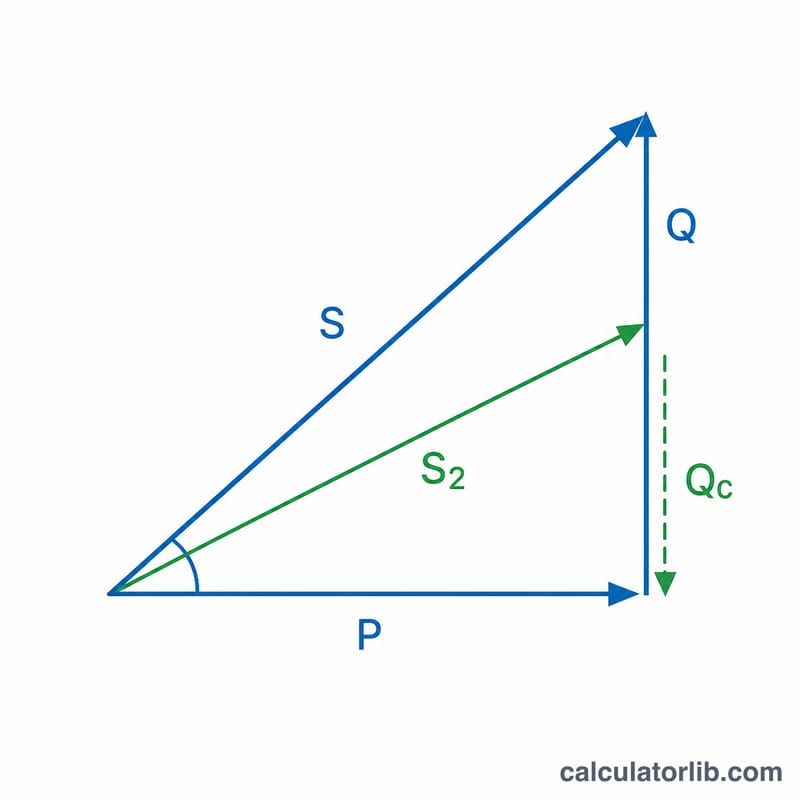
Power factor (PF) measures how effectively electrical power is converted into useful work. A low power factor means more reactive power is drawn, increasing current, losses, and often utility penalties. Power factor correction adds capacitors that supply reactive power locally, raising PF toward unity and reducing the apparent power demand.
How to Use the Calculator
Enter your real power (kW), the current (measured) power factor, the target power factor you want to reach, and the supply voltage and frequency. The tool returns the reactive power (kVAR) the capacitor bank must supply and the equivalent capacitance in microfarads.
The Formula Explained
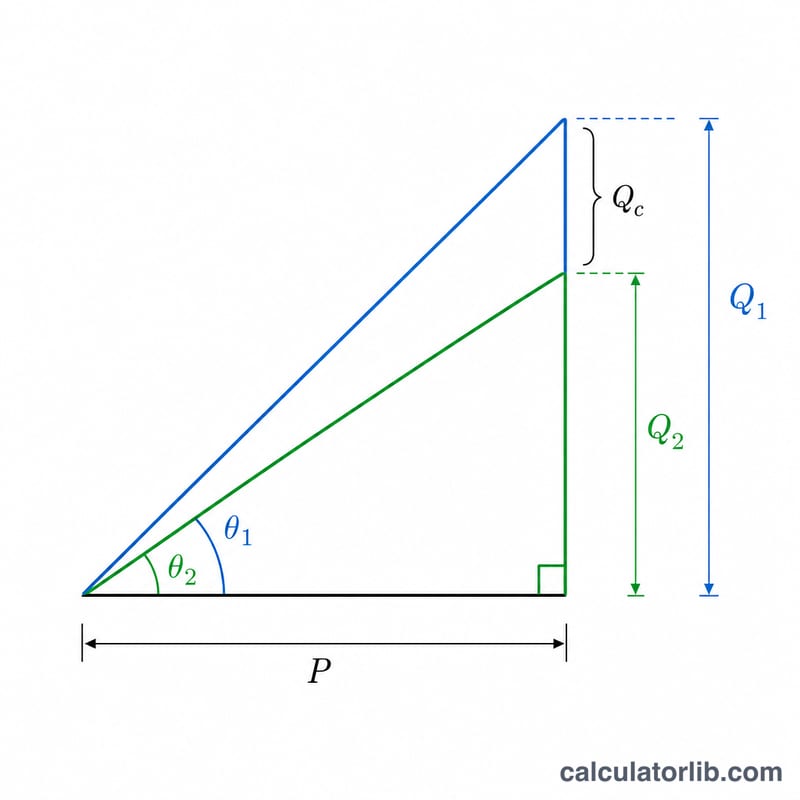
The required reactive compensation is:
\(Q_C = P \cdot (\tan(\varphi_1) - \tan(\varphi_2))\), where \(\varphi = \arccos(\text{PF})\).
Once \(Q_C\) (in VAR) is known, single-phase capacitance is:
$$C = \frac{Q_C}{2\pi \cdot f \cdot V^2}$$
Here \(f\) is the line frequency in Hz and \(V\) is the line voltage in volts.
Worked Example
A 100 kW load at PF 0.70 to be corrected to 0.95 on a 400 V, 50 Hz supply:
\(\tan(\arccos 0.70) = 1.0202\), \(\tan(\arccos 0.95) = 0.3287\). $$Q_C = 100 \times (1.0202 - 0.3287) = 69.15 \text{ kVAR}$$ $$C = \frac{69{,}152}{2\pi \times 50 \times 400^2} = 0.001376 \text{ F} \approx 1375.7\ \mu\text{F}$$
FAQ
Why not correct all the way to 1.0? Over-correction can cause leading power factor and voltage rise; utilities usually require around 0.95.
Is this single-phase or three-phase? The capacitance formula shown is the single-phase equivalent for the given V. For three-phase, divide \(Q_C\) by 3 per phase and use phase voltage.
What units does it use? Power in kW, voltage in volts, frequency in Hz; results in kVAR and µF.