
What Is the Lorentz Factor?
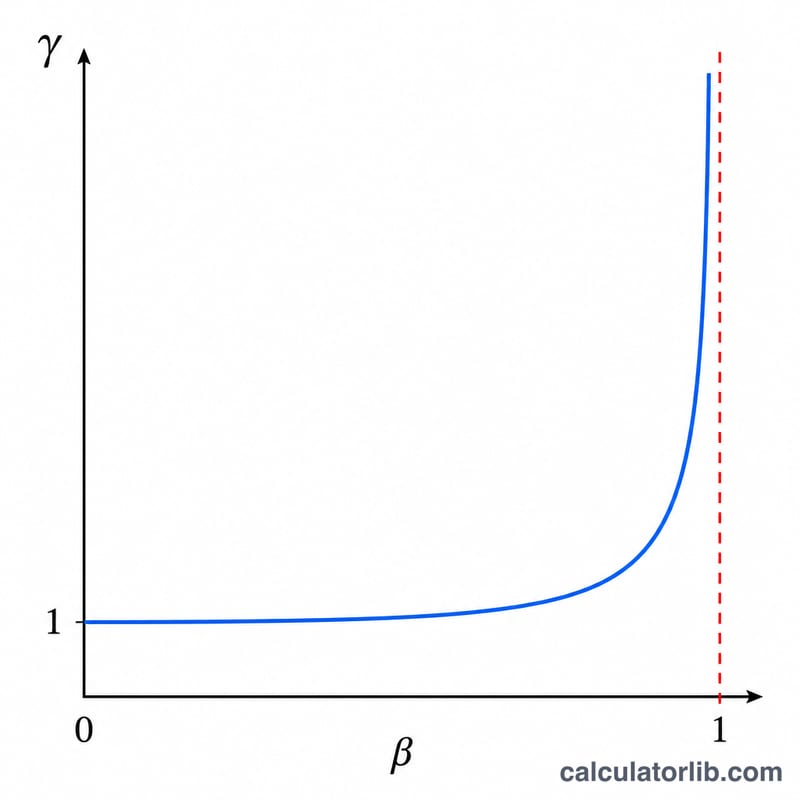
The Lorentz factor, denoted by the Greek letter gamma (\(\gamma\)), is a central quantity in Einstein's special theory of relativity. It quantifies how much time, length, and relativistic mass change for an object moving at velocity v relative to an observer. At everyday speeds \(\gamma\) is essentially 1, so relativistic effects are negligible — but as v approaches the speed of light c (≈ 299,792,458 m/s), \(\gamma\) grows without bound.
How to Use This Calculator
Enter the object's velocity and choose a unit: a fraction of c (for example 0.9 means 90% of light speed), metres per second, kilometres per second, or kilometres per hour. The calculator converts your input to m/s, computes \(\beta = v/c\), and returns \(\gamma\) along with the time-dilation factor (\(\gamma\)) and length-contraction factor (\(1/\gamma\)). Velocities at or above c are physically impossible, so the tool flags them instead of returning a value.
The Formula Explained
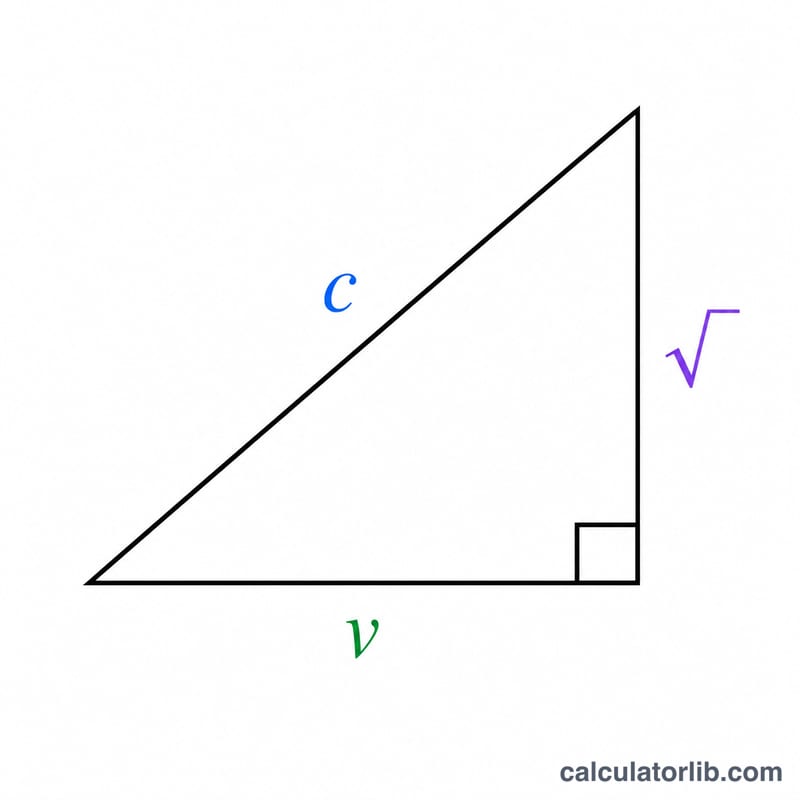
The Lorentz factor is $$\gamma = \dfrac{1}{\sqrt{1 - \dfrac{v^{2}}{c^{2}}}}.$$ The ratio \(\beta = v/c\) is the speed as a fraction of light speed, so the formula can be written $$\gamma = \dfrac{1}{\sqrt{1 - \beta^{2}}}.$$ As \(\beta \to 1\), the term inside the square root \(\to 0\) and \(\gamma \to \infty\). Moving clocks run slow by a factor of \(\gamma\) (time dilation), and moving lengths shrink along the direction of motion by \(1/\gamma\) (length contraction).
Worked Example
Suppose a spaceship travels at \(v = 0.6c\), so \(\beta = 0.6\) and \(\beta^{2} = 0.36\). Then \(1 - 0.36 = 0.64\), and \(\sqrt{0.64} = 0.8\). Therefore $$\gamma = \frac{1}{0.8} = 1.25.$$ A clock on the ship ticks 1.25 times slower than a stationary clock, and the ship appears contracted to \(1/1.25 = 0.8\) (80%) of its rest length.
FAQ
Can the Lorentz factor be less than 1? No. \(\gamma\) is always \(\geq 1\), equalling exactly 1 only when \(v = 0\).
What happens at the speed of light? \(\gamma\) becomes infinite, which is why massive objects cannot reach c — it would require infinite energy.
Is the Lorentz factor the same as relativistic mass increase? Relativistic mass equals \(\gamma\) times the rest mass, so yes, the same \(\gamma\) governs that increase.