
What is a Voltage Divider?
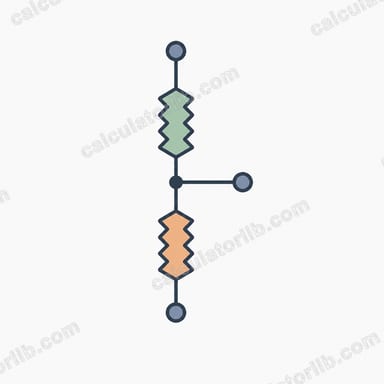
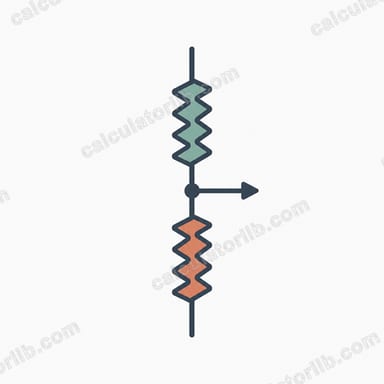
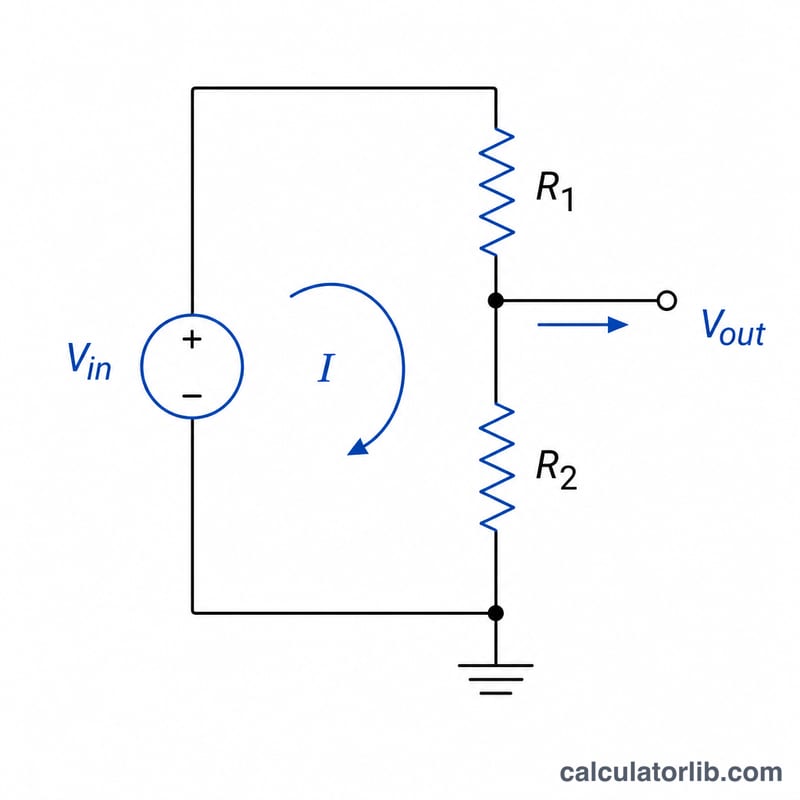
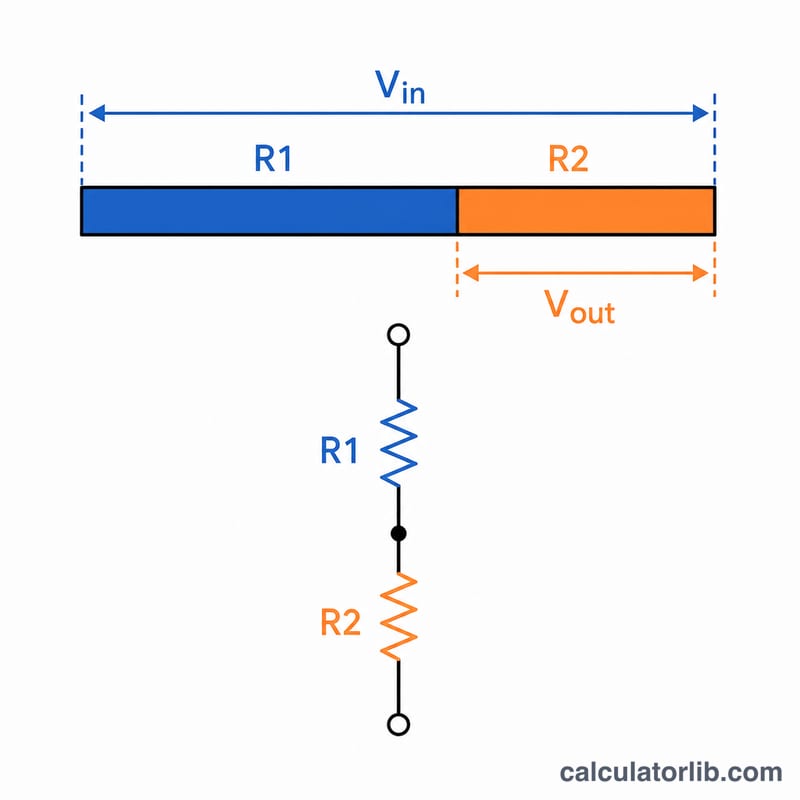
A voltage divider is one of the most fundamental circuits in electronics. Two resistors, R1 and R2, are connected in series across an input voltage Vin. The output voltage Vout is taken across R2. By Kirchhoff's voltage law, the same current flows through both resistors, and the input voltage is split between them in proportion to their resistances.
How to Use This Calculator
Enter the input voltage (Vin in volts), the top resistor R1 in ohms, and the bottom resistor R2 in ohms. The calculator instantly returns the output voltage across R2, the loop current in milliamps, the total series resistance, and the total power dissipated by the divider in milliwatts.
The Formula Explained
The core relationship is $$V_{out} = \text{V}_{in} \cdot \frac{\text{R2}}{\text{R1} + \text{R2}}$$ The denominator \((\text{R1} + \text{R2})\) is the total resistance the source sees. The fraction \(\frac{\text{R2}}{\text{R1}+\text{R2}}\) is the proportion of the total voltage that appears across R2. The loop current is \(I = \frac{\text{V}_{in}}{\text{R1} + \text{R2}}\), and the total power is \(P = \text{V}_{in} \cdot I\).
Worked Example
Suppose Vin = 12 V, R1 = 1000 Ω and R2 = 2000 Ω. Total resistance is 3000 Ω. \(V_{out} = 12 \times \frac{2000}{3000} = 8 \text{ V}\). The loop current is \(\frac{12}{3000} = 0.004 \text{ A} = 4 \text{ mA}\). Total power is \(12 \times 0.004 = 0.048 \text{ W} = 48 \text{ mW}\).
FAQ
Does the load affect the output? Yes. This calculator assumes an ideal, unloaded divider. Any load resistance connected across R2 lowers the effective R2 and reduces Vout.
Why is power important? Knowing the total power lets you choose resistors with adequate wattage ratings so they do not overheat.
Can I swap R1 and R2? Swapping changes which resistor the output is measured across, so Vout will change unless the resistors are equal.