
What Is RMS Voltage?
RMS (Root Mean Square) voltage is the effective value of an alternating-current (AC) waveform. It represents the equivalent DC voltage that would deliver the same average power to a resistive load. For a pure sine wave, the RMS voltage is directly related to the peak voltage by a simple constant factor, making conversion quick and reliable.
How to Use This Calculator
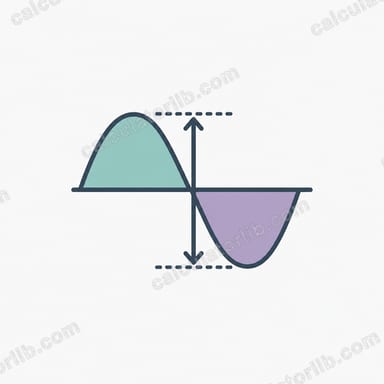
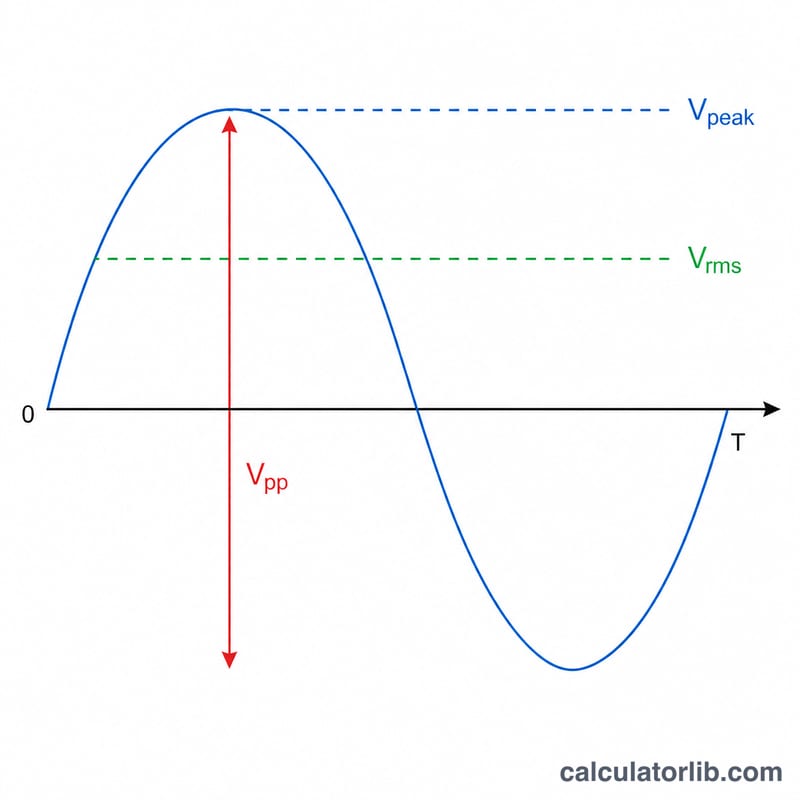
Enter the peak voltage (Vpeak) — the maximum instantaneous voltage of your sine wave — and the calculator returns the RMS voltage along with the peak-to-peak voltage. This is handy for oscilloscope readings, audio engineering, power supply design, and electronics coursework.
The Formula Explained
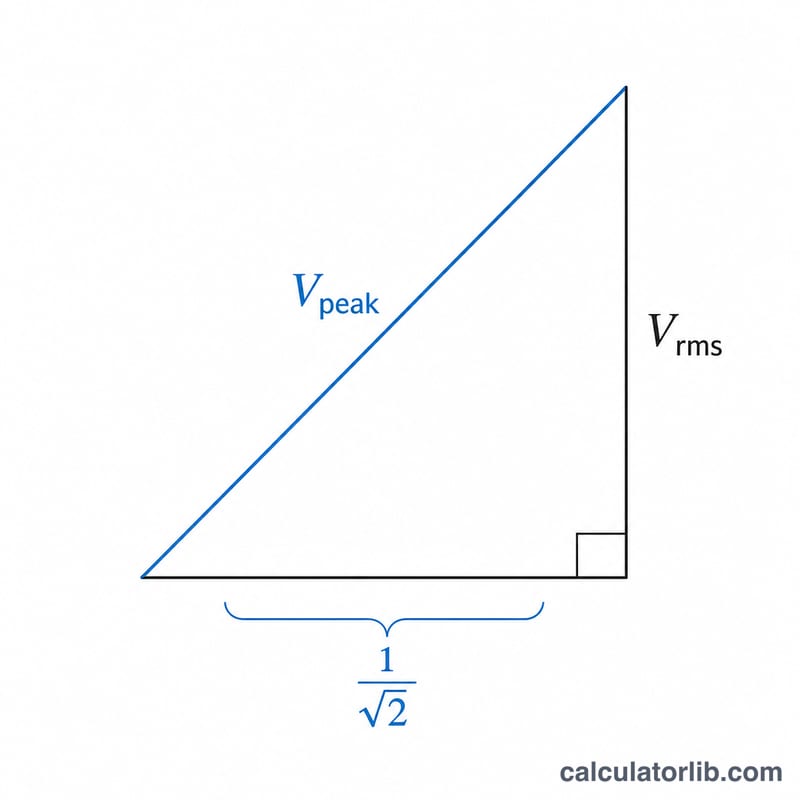
For a sinusoidal signal, the relationship is:
$$V_{rms} = \frac{V_{peak}}{\sqrt{2}} \approx 0.7071 \times V_{peak}$$
The \(\sqrt{2}\) factor comes from integrating the square of the sine function over a full cycle and taking the square root of the mean. The peak-to-peak voltage is simply twice the peak: $$V_{pp} = 2 \times V_{peak}$$ Note this RMS formula applies specifically to sine waves; other waveforms (square, triangle) use different crest factors.
Worked Example
Suppose your oscilloscope shows a peak voltage of 10 V. Then:
$$V_{rms} = \frac{10}{\sqrt{2}} = \frac{10}{1.41421} \approx 7.071 \text{ V}$$
$$V_{pp} = 2 \times 10 = 20 \text{ V}$$
FAQ
Why is mains voltage given as RMS? The familiar 120 V or 230 V mains figures are RMS values, because RMS reflects the real power-delivering capability of the AC supply.
What is the peak of 230 V RMS mains? \(V_{peak} = 230 \times \sqrt{2} \approx 325\) V.
Does this work for square waves? No. For an ideal square wave Vrms equals Vpeak. This calculator assumes a pure sine wave.