
What is the Langevin function?
The Langevin function is defined as \(L(x) = \coth(x) - \frac{1}{x}\), where \(\coth(x)\) is the hyperbolic cotangent. It first appeared in Paul Langevin's classical theory of paramagnetism, where it describes the average magnetization of an ensemble of freely rotating magnetic dipoles in an external field. The same function shows up in Langevin-Debye theory of dielectric polarization and in the statistical mechanics of freely jointed polymer chains, where it relates chain extension to applied tension. Mathematically, it is the J approaching infinity limit of the Brillouin function.
How to use this calculator
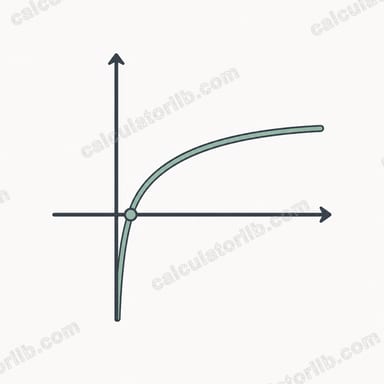
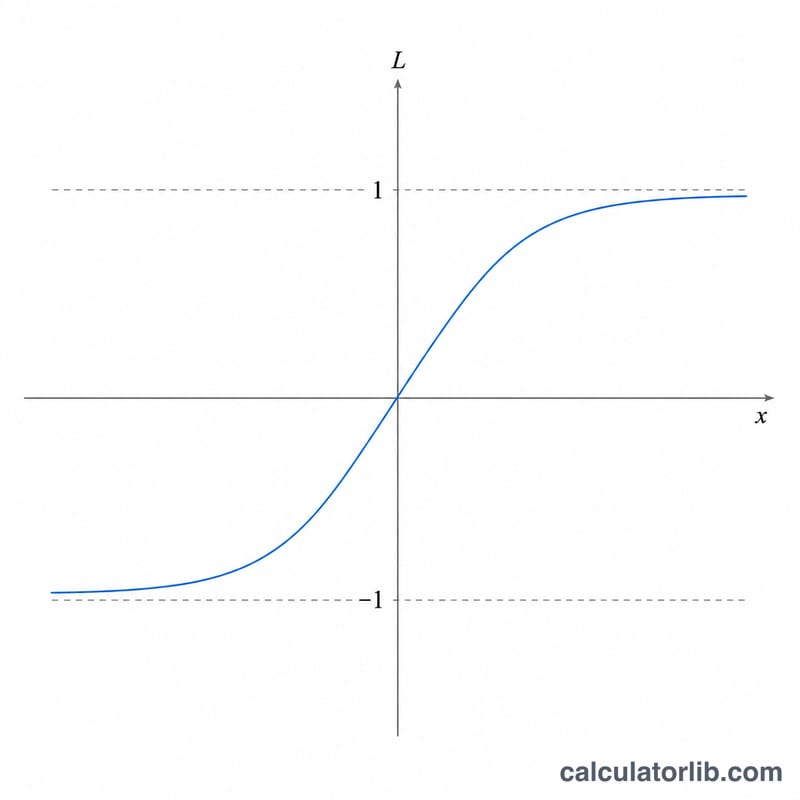
Enter any real number for the argument \(x\) — positive, negative, or zero — and the calculator returns \(L(x)\). The function is odd, so \(L(-x) = -L(x)\), and its output always lies strictly between -1 and 1. As \(x\) grows large the value saturates toward +1 (or -1 for large negative \(x\)), reflecting full alignment of the dipoles.
The formula explained
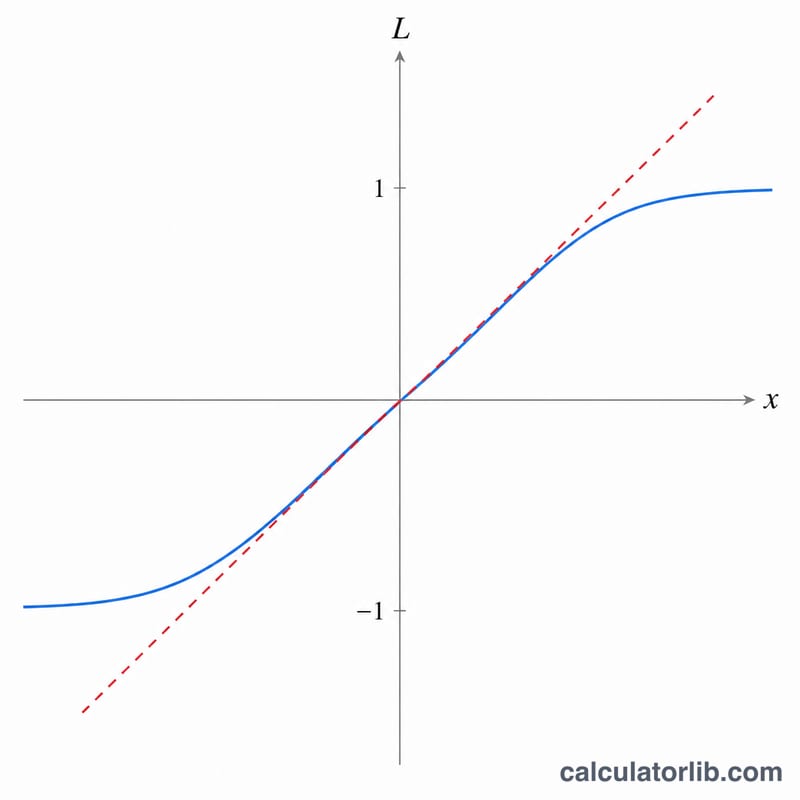
$$L(x) = \coth(x) - \frac{1}{x}$$ with \(\coth(x) = \frac{\cosh(x)}{\sinh(x)} = \frac{e^x + e^{-x}}{e^x - e^{-x}}\). At \(x = 0\) both terms diverge, but their difference has a removable singularity equal to 0. Because directly subtracting two large numbers near zero causes catastrophic cancellation, this tool switches to the Taylor series \(L(x) \approx \frac{x}{3} - \frac{x^3}{45} + \frac{2x^5}{945}\) when \(|x|\) is tiny, giving the well-known slope of \(\frac{1}{3}\) at the origin.
Worked example
For \(x = 1\): \(\cosh(1) = 1.5430806348\) and \(\sinh(1) = 1.1752011936\), so \(\coth(1) = 1.3130352855\). Then $$L(1) = 1.3130352855 - 1 = 0.3130352855$$ For a small argument \(x = 0.1\), the series gives \(\frac{0.1}{3} - \frac{0.001}{45} \approx 0.0333111\), matching the direct evaluation.
FAQ
Why is \(L(0) = 0\)? Both \(\coth(x)\) and \(\frac{1}{x}\) blow up at \(x = 0\), but they cancel; the limit of their difference is exactly 0, with the function rising linearly at slope \(\frac{1}{3}\).
What is the range of \(L(x)\)? The Langevin function is monotonically increasing with range \((-1, 1)\); it approaches but never reaches the asymptotes \(\pm 1\).
How does it relate to the Brillouin function? The Brillouin function \(B_J(x)\) reduces to the Langevin function in the limit J approaching infinity, the classical continuous-spin case.