
What is the Solenoid Magnetic Field Calculator?
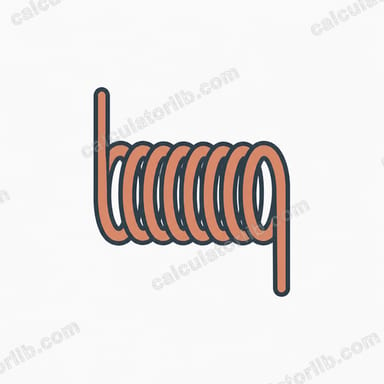
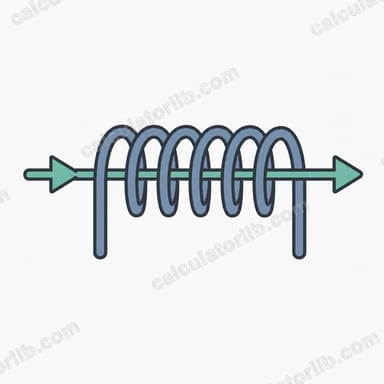
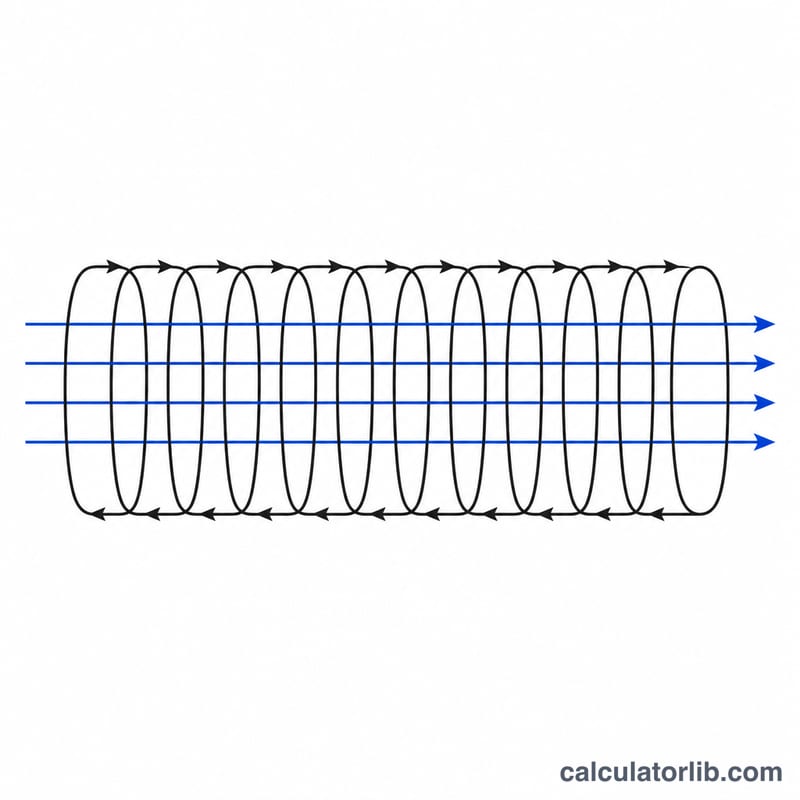
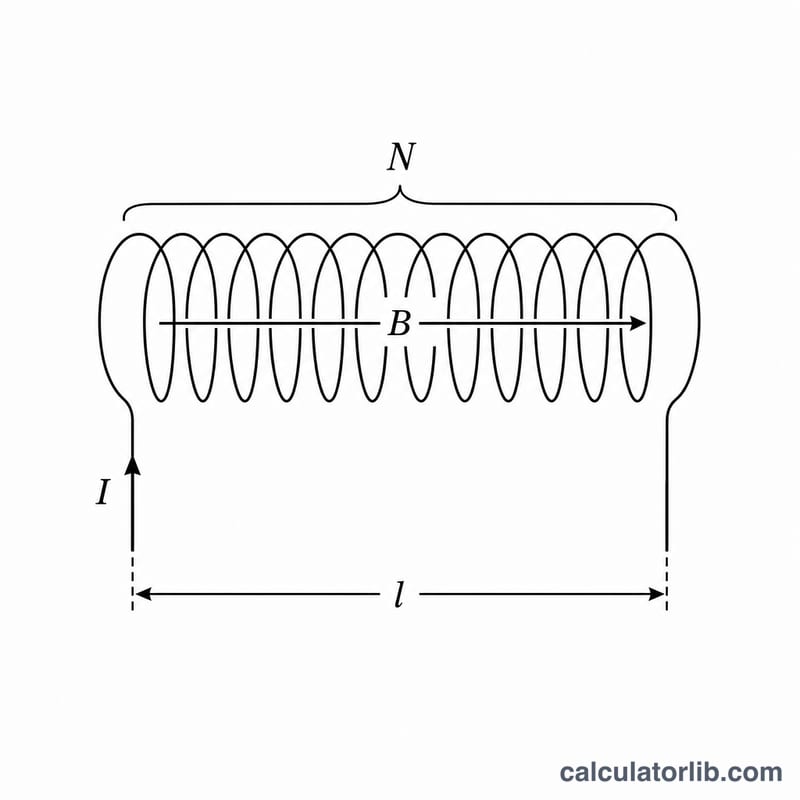
A solenoid is a long coil of wire that produces a nearly uniform magnetic field along its central axis when an electric current flows through it. This calculator finds the magnitude of that internal magnetic field, \(B\), from three quantities you can measure directly: the number of turns of wire (\(N\)), the current (\(I\)), and the length of the coil (\(l\)). Results are given in tesla, millitesla and gauss so they fit whatever scale your project uses.
How to use it
Enter the total number of turns of wire, the current in amperes, and the physical length of the solenoid in metres. Press calculate to see the field strength inside the coil along with the turns-per-metre value. The formula assumes an ideal, tightly wound solenoid that is much longer than its diameter, where the field is uniform inside and negligible outside.
The formula explained
The field is given by $$B = \frac{\mu_0 \cdot \text{Turns }(N) \cdot \text{Current }(I)}{\text{Length }(l)}$$ where \(\mu_0 = 4\pi \times 10^{-7}\ \text{T}\cdot\text{m/A}\) is the permeability of free space. The ratio \(N/l\) is the number of turns per metre (\(n\)), so the equation is often written \(B = \mu_0 n I\). Doubling the current or the turn density doubles the field; lengthening the coil while keeping \(N\) fixed weakens it.
Worked example
Suppose a solenoid has \(N = 200\) turns over a length of \(l = 0.5\ \text{m}\) carrying \(I = 2\ \text{A}\). Then \(n = 200 / 0.5 = 400\ \text{turns/m}\), and $$B = \frac{(4\pi \times 10^{-7})(200)(2)}{0.5} \approx 0.001005\ \text{T}$$ or about \(1.005\ \text{mT}\) (\(10.05\) gauss).
FAQ
Does the wire diameter matter? Only indirectly — it limits how many turns fit per metre. The formula uses \(N\) and \(l\) directly.
What if there is an iron core? Replace \(\mu_0\) with \(\mu = \mu_0 \mu_r\), where \(\mu_r\) is the relative permeability of the core, which can increase \(B\) by hundreds or thousands of times.
Is the field really uniform? It is nearly uniform deep inside a long solenoid; near the ends it weakens and bulges outward.