What this calculator does
This tool computes the magnetic field strength B at a perpendicular distance r from a long, straight conductor carrying a steady current I. The magnetic field forms concentric circles around the wire, and its magnitude follows directly from Ampère's law. This is a universal physics calculation — the result is given in SI units (teslas).
How to use it
Enter the current flowing through the wire in amperes (A) and the perpendicular distance from the center of the wire in meters (m). The calculator returns the field in teslas (T) and the more practical microteslas (µT). The formula assumes an infinitely long, thin wire and a point in vacuum or air.

The formula explained
The magnetic field is given by:
$$B = \frac{\mu_0 \, I}{2\pi \, r}$$
Here \(\mu_0 = 4\pi \times 10^{-7} \approx 1.25664 \times 10^{-6}\ \text{T}\cdot\text{m/A}\) is the permeability of free space. The field is directly proportional to the current and inversely proportional to the distance — doubling the current doubles the field, while doubling the distance halves it.
Worked example
A wire carries \(I = 10\ \text{A}\) and we measure at \(r = 0.05\ \text{m}\) (5 cm). Then $$B = \frac{1.25664 \times 10^{-6} \times 10}{2\pi \times 0.05} = \frac{1.25664 \times 10^{-5}}{0.31416} = 4.0 \times 10^{-5}\ \text{T} = 40\ \mu\text{T}.$$ That is roughly the strength of Earth's own magnetic field.

Magnetic Field at Different Currents and Distances
The table uses the Biot–Savart result for a long straight wire, \(B = \frac{\mu_0 I}{2\pi r}\), with \(\mu_0 = 4\pi \times 10^{-7}\) T·m/A. This simplifies to \(B = 2\times10^{-7}\,I/r\) tesla, or equivalently \(B = 0.2\,I/r\) µT with r in metres. Values are in microteslas (µT).
| Current | r = 1 cm | r = 5 cm | r = 10 cm | r = 50 cm | r = 1 m |
|---|---|---|---|---|---|
| 1 A | 20 µT | 4 µT | 2 µT | 0.4 µT | 0.2 µT |
| 10 A | 200 µT | 40 µT | 20 µT | 4 µT | 2 µT |
| 100 A | 2000 µT | 400 µT | 200 µT | 40 µT | 20 µT |
| 1000 A | 20,000 µT | 4000 µT | 2000 µT | 400 µT | 200 µT |
Scaling rules: B is directly proportional to current and inversely proportional to distance. Doubling r halves B, and doubling I doubles B.
Example substitution: for I = 10 A and r = 0.05 m, \(B = \frac{4\pi\times10^{-7}\times 10}{2\pi\times 0.05} = 4\times10^{-5}\) T = 40 µT.
Interpreting Your Result
These reference points help put a computed field in context:
- Earth's magnetic field: about 25–65 µT at the surface, depending on location.
- Household appliances: typically around 0.01–1 µT at a distance of tens of centimetres, though fields are higher very close to the device.
- ICNIRP exposure reference levels (50/60 Hz magnetic fields, general public): 200 µT in the 2010 guidelines, and 100 µT (50 Hz) in the 1998 guidelines.
Limits of the formula:
- The result is for a DC or instantaneous current in an idealised, infinitely long, thin straight wire. Real wires have finite length, bends and return conductors.
- Nearby return currents (for example, the other conductor of a cable pair) partly cancel the field, so the real field is often much smaller than this single-wire value.
- For AC, entering the RMS current gives the RMS magnitude of the field. The peak field is about 1.414 times larger for a sinusoidal current.
- The formula applies outside the wire, so r should be larger than the wire radius. Nearby magnetic materials can also change the field.
This page gives physics information only and is not health or safety advice.
Magnetic Field Unit Conversions
The tesla (T) is the SI unit of magnetic flux density. The gauss (G) is a CGS unit still common for weak fields.
| Unit | Equivalent |
|---|---|
| 1 T | 1000 mT = 106 µT = 109 nT = 10,000 G |
| 1 G | 100 µT = 0.1 mT |
| 1 mG | 0.1 µT |
| 1 µT | 10 mG = 0.01 G |
Example rows
| Tesla | Microtesla | Gauss | Milligauss |
|---|---|---|---|
| 0.00004 T | 40 µT | 0.4 G | 400 mG |
| 0.0002 T | 200 µT | 2 G | 2000 mG |
| 0.0000002 T | 0.2 µT | 0.002 G | 2 mG |
Earth's field of about 25–65 µT corresponds to roughly 0.25–0.65 G, so it is often quoted as about 0.5 G.
FAQ
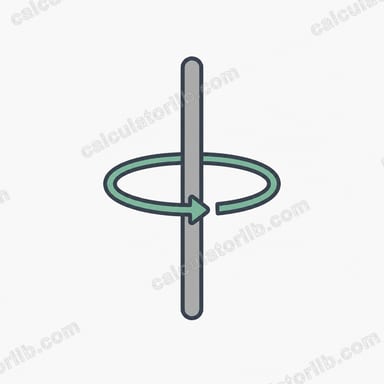
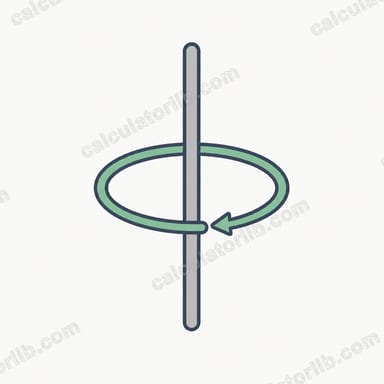
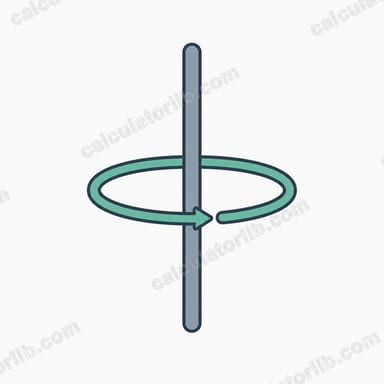
What direction does the field point? The field circles the wire; use the right-hand rule — point your thumb along the current and your fingers curl in the field direction.
Does this work inside the wire? No. This formula applies outside the wire. Inside a uniform wire the field grows linearly with radius instead.
Why teslas and microteslas? Practical fields near wires are tiny fractions of a tesla, so microteslas (\(1\ \mu\text{T} = 10^{-6}\ \text{T}\)) are easier to read.