
What Is Magnetic Permeability?
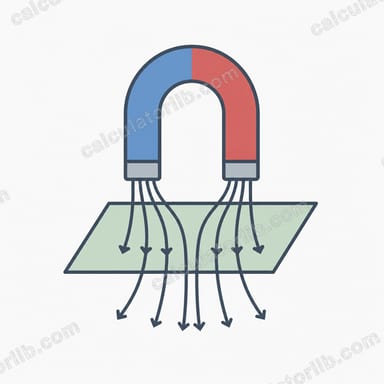
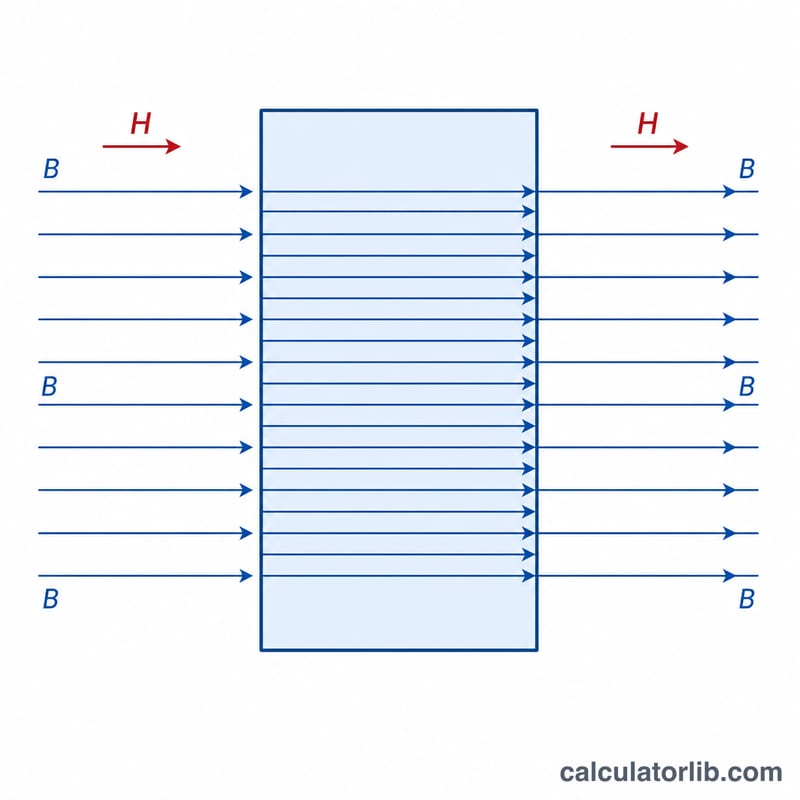
Magnetic permeability (\(\mu\)) measures how easily a material supports the formation of a magnetic field within itself. It is defined as the ratio of magnetic flux density B (measured in tesla, T) to the applied magnetic field strength H (measured in amperes per meter, A/m). A higher permeability means a material concentrates magnetic flux more readily, which is why iron and other ferromagnetic materials make excellent transformer cores.
How to Use This Calculator
Enter the magnetic flux density B in tesla and the magnetic field strength H in amperes per meter. The calculator divides B by H to return the absolute permeability \(\mu\) in henries per meter (H/m). It also computes the dimensionless relative permeability \(\mu_r\) by dividing your result by the permeability of free space, \(\mu_0 \approx 1.25663706212\times10^{-6}\) H/m.
The Formula Explained
The governing equation is $$\mu = \frac{\text{B (T)}}{\text{H (A/m)}}$$ Because B grows in proportion to H for linear materials, the slope of the B–H curve gives the permeability. For nonlinear materials such as ferromagnets, \(\mu\) varies with H, so this calculator gives the permeability at the specific operating point you enter. Relative permeability is found with $$\mu_r = \frac{\mu}{\mu_0},$$ telling you how many times more permeable the material is than empty space.

Worked Example
Suppose a material reaches a flux density of \(B = 1.0\) T under a field strength of \(H = 1000\) A/m. Then $$\mu = \frac{1.0}{1000} = 0.001 \text{ H/m}.$$ The relative permeability is $$\mu_r = \frac{0.001}{1.25663706212\times10^{-6}} \approx 795.77$$ — meaning this material is roughly 796 times more permeable than free space.
FAQ
What units does the result use? Absolute permeability is in henries per meter (H/m); relative permeability is dimensionless.
What is \(\mu_0\)? The permeability of free space (vacuum), approximately \(1.2566\times10^{-6}\) H/m, used as the baseline for relative permeability.
Why is \(\mu_r\) greater than 1 for iron? Ferromagnetic materials align their internal magnetic domains with the applied field, dramatically increasing the flux density and thus the permeability above that of vacuum.