
What Is the Spin-Only Magnetic Moment?
The spin-only magnetic moment is a value used in inorganic and coordination chemistry to estimate the magnetic behavior of transition metal ions and their complexes. It depends only on the number of unpaired electrons (n) in the species, ignoring any contribution from orbital angular momentum. The result is expressed in Bohr magnetons (μB), the natural unit of magnetic moment.
How to Use This Calculator
Enter the number of unpaired electrons (n) for your ion or complex. The calculator instantly returns the predicted spin-only magnetic moment. To find n, work out the d-electron configuration and arrange the electrons in the relevant crystal-field splitting diagram (high-spin or low-spin), then count the singly-occupied orbitals.
The Formula Explained
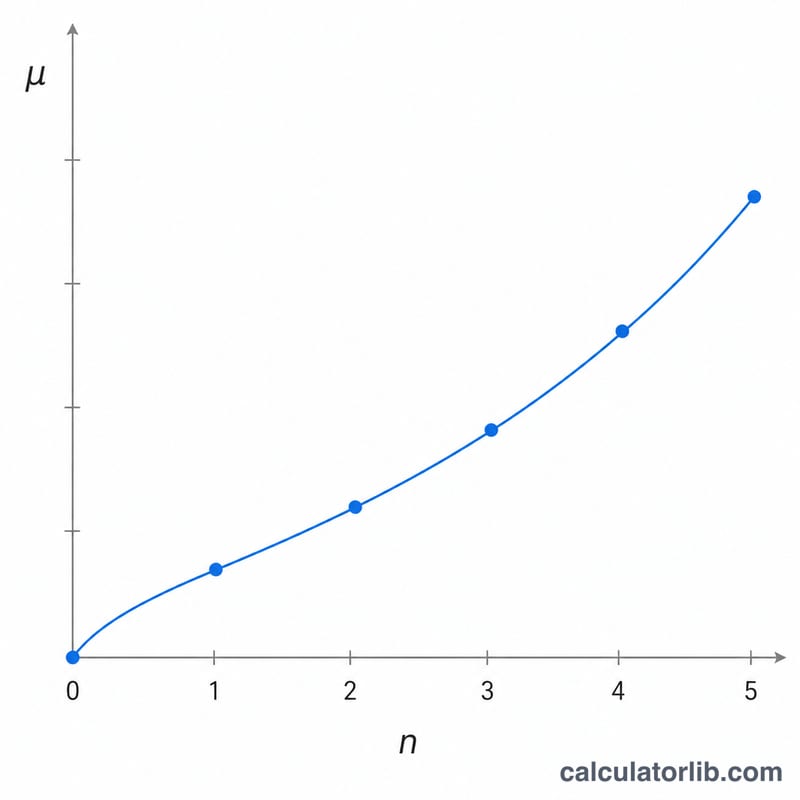
The spin-only formula is $$\mu = \sqrt{\text{n}\left(\text{n} + 2\right)}\ \text{BM}$$ It derives from the general expression \(\mu = \sqrt{4S(S+1)}\) where S is the total spin quantum number and \(S = n/2\). Substituting gives the compact form in terms of n. Because it neglects orbital contributions, it works best for first-row transition metals with quenched orbital angular momentum.
Worked Example
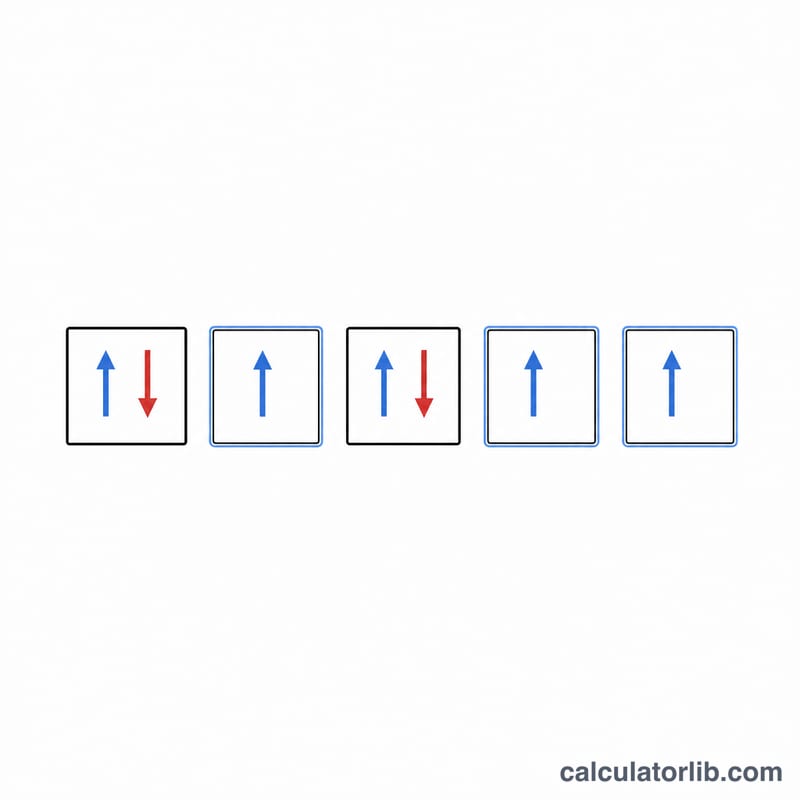
Consider a high-spin Fe3+ ion (d5) with 5 unpaired electrons. $$\mu = \sqrt{5 \times (5 + 2)} = \sqrt{35} \approx 5.92\ \mu_{B}$$ This matches typical experimental values for many high-spin iron(III) complexes.
FAQ
Why is my calculated value different from experiment? The spin-only formula ignores orbital angular momentum and spin-orbit coupling, so measured values—especially for second/third-row metals—can deviate.
What is a Bohr magneton? It is a physical constant (\(\approx 9.274 \times 10^{-24}\ \text{J/T}\)) used as the unit of magnetic moment at the atomic scale.
How do I know n for a given complex? Determine the metal's oxidation state, its d-electron count, and whether the ligand field is strong (low-spin) or weak (high-spin), then count unpaired electrons.