
What is the moment of inertia?
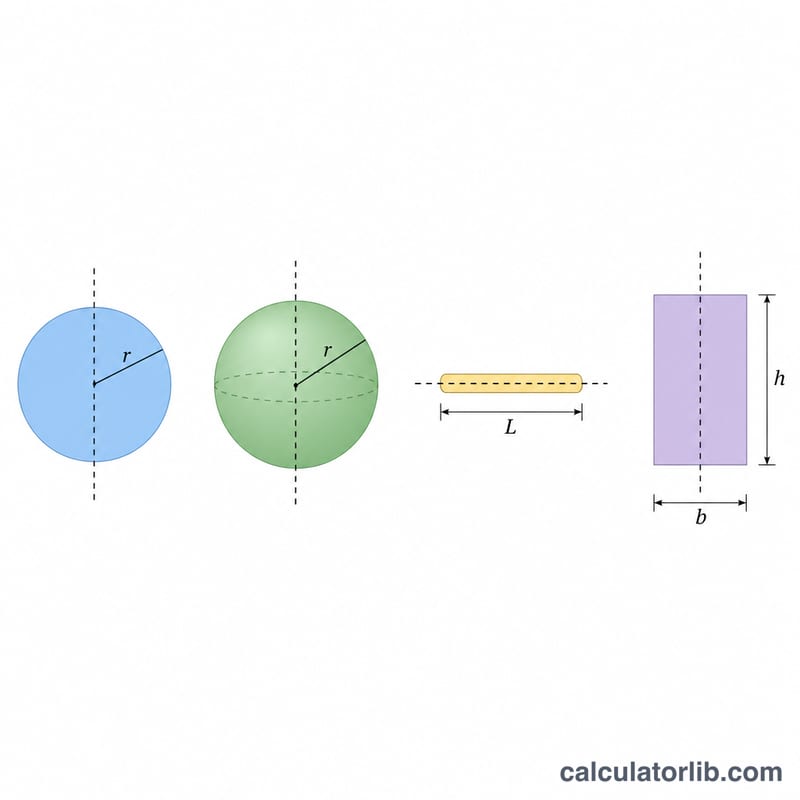
The moment of inertia measures an object's resistance to rotational acceleration about an axis — the rotational analogue of mass. For solid bodies it is the mass moment of inertia (units kg·m²) used in dynamics, while in structural engineering the area moment of inertia or second moment of area (units m⁴) describes a cross-section's resistance to bending. This calculator covers four of the most common cases: a solid disk or cylinder, a solid sphere, a thin rod, and a rectangular area.
How to use it
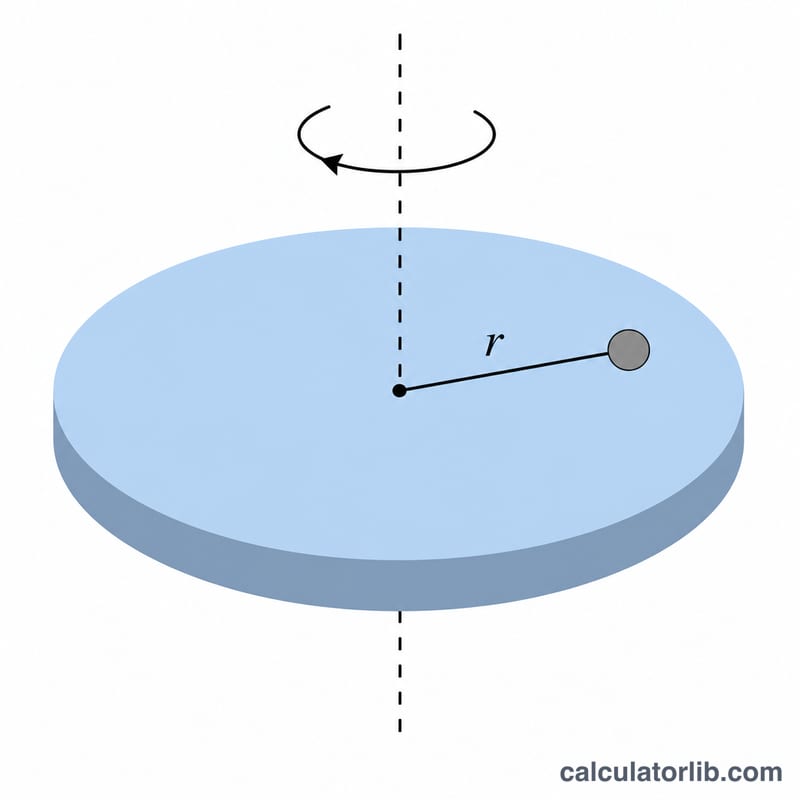
Pick the shape, then enter only the values it needs. A disk and sphere require mass and radius; a rod requires mass and length; a rectangle requires its base width and height. The calculator applies the matching standard formula and reports the result in the appropriate units.
The formulas
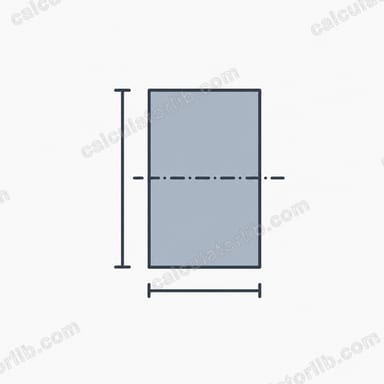
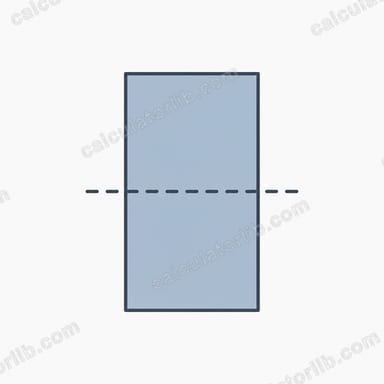
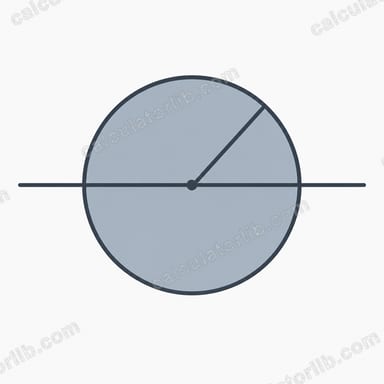
Solid disk/cylinder about its central axis: $$I = \tfrac{1}{2}\,m\,r^{2}$$ Solid sphere about a diameter: $$I = \tfrac{2}{5}\,m\,r^{2}$$ Thin rod about its center: $$I = \tfrac{1}{12}\,m\,L^{2}$$ Rectangular cross-section about its centroid (area moment): $$I = \frac{b\,h^{3}}{12}$$ where b is the width and h is the height in the bending direction.
Worked example
A solid disk of mass 10 kg and radius 0.5 m: $$I = \tfrac{1}{2} \times 10 \times 0.5^{2} = \tfrac{1}{2} \times 10 \times 0.25 = 1.25\ \text{kg}\cdot\text{m}^{2}$$ A rectangular beam 0.1 m wide and 0.2 m tall: $$I = \frac{0.1 \times 0.2^{3}}{12} = \frac{0.1 \times 0.008}{12} = 0.0000667\ \text{m}^{4}$$
FAQ
Why different units for the rectangle? The rectangle uses the area moment of inertia (no mass involved), so its units are m⁴ rather than kg·m².
Does cylinder use the same formula as a disk? Yes — a solid cylinder about its long central axis has the same \(I = \tfrac{1}{2}mr^{2}\) regardless of length.
What axis do these assume? Each formula assumes rotation about the axis stated: central axis (disk/cylinder), a diameter (sphere), the center (rod), and the centroidal axis (rectangle).