
What It Is
The area moment of inertia (also called the second moment of area) describes how the cross-sectional area of a beam is distributed relative to a reference axis. It is a key property in structural and mechanical engineering because it directly governs a beam's resistance to bending — a larger moment of inertia means greater stiffness and less deflection under load. This calculator computes the moment of inertia of a solid rectangular section about both centroidal axes.
How to Use It
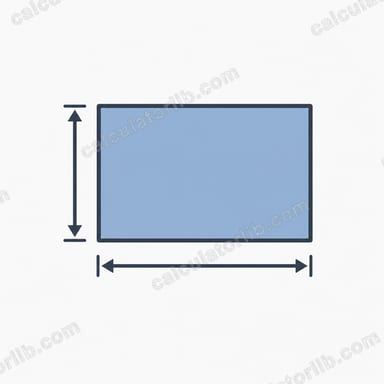
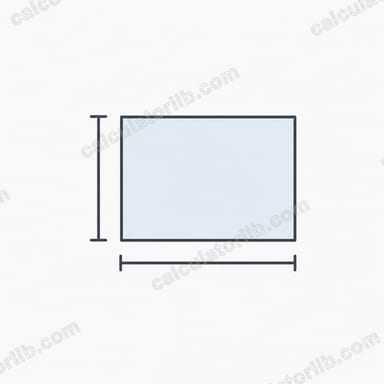
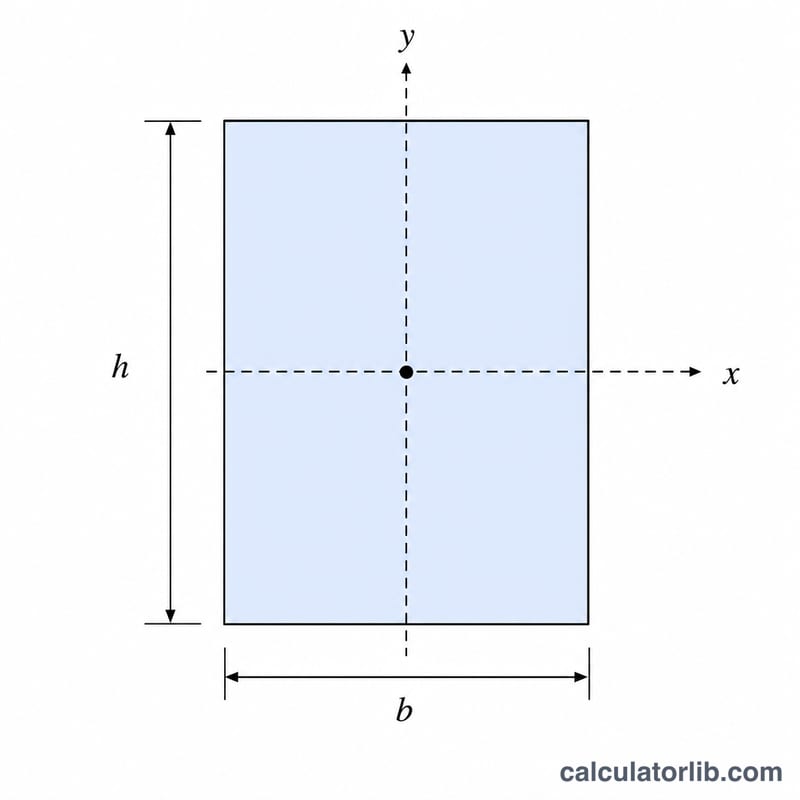
Enter the width b and the height h of the rectangle in millimetres. The calculator instantly returns Ix (bending about the horizontal x-axis), Iy (bending about the vertical y-axis), and the cross-sectional area. The results are expressed in mm⁴. Note that orientation matters: the axis with the larger dimension cubed yields the larger moment of inertia, which is why beams are placed with their tall dimension vertical.
The Formula Explained
For a rectangle of width b and height h, the centroidal moments of inertia are:
$$I_x = \frac{\text{Width } b \cdot \text{Height } h^{3}}{12}$$and
$$I_y = \frac{\text{Height } h \cdot \text{Width } b^{3}}{12}$$The cube term shows why height has an outsized effect on stiffness about the x-axis: doubling h increases Ix by a factor of eight, while doubling b only doubles it.
Worked Example
Take a rectangle with \(b = 50\) mm and \(h = 100\) mm. Then
$$I_x = \frac{50 \times 100^{3}}{12} = \frac{50{,}000{,}000}{12} \approx 4{,}166{,}666.67 \text{ mm}^4$$and
$$I_y = \frac{100 \times 50^{3}}{12} = \frac{12{,}500{,}000}{12} \approx 1{,}041{,}666.67 \text{ mm}^4$$The area is \(50 \times 100 = 5{,}000\) mm².
FAQ
What are the units? Moment of inertia has units of length to the fourth power. Enter dimensions in mm to get results in mm⁴, or in cm for cm⁴.
Is this the polar moment of inertia? No. This gives the rectangular (planar) second moments Ix and Iy. The polar moment J equals Ix + Iy for the same section.
Does this account for hollow sections? No — this is for a solid rectangle. For a hollow rectangle, subtract the inner rectangle's moment of inertia from the outer.