
What This Calculator Does
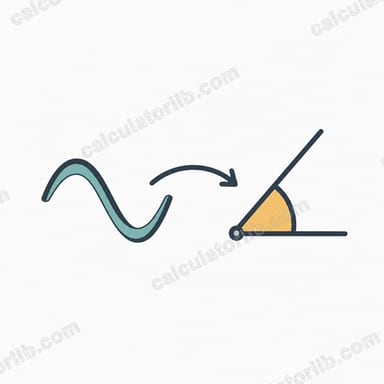
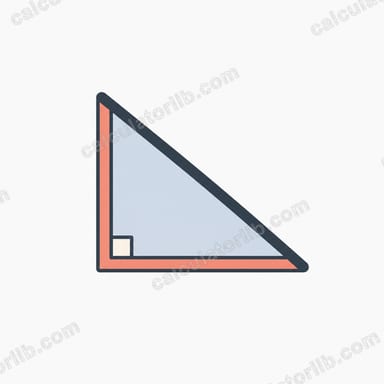
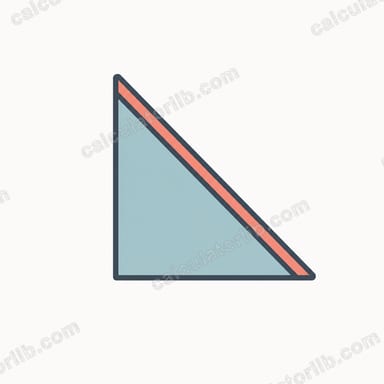
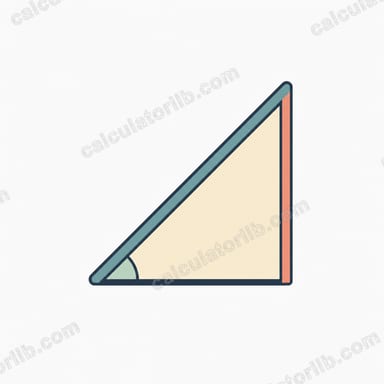
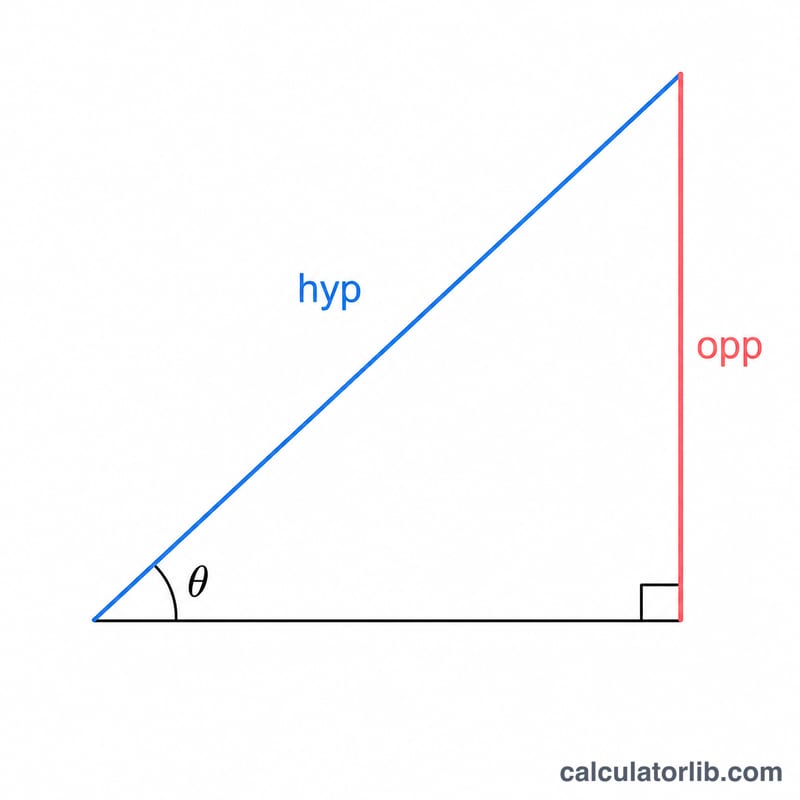
This tool computes the sine of an angle in a right triangle using the classic ratio \(\sin(\theta) = \text{opposite} \div \text{hypotenuse}\). Once it has the sine value, it also runs the inverse sine (arcsine) to give you the actual angle \(\theta\) in both degrees and radians. It is a universal trigonometry tool — no country or unit system is assumed.
How to Use It
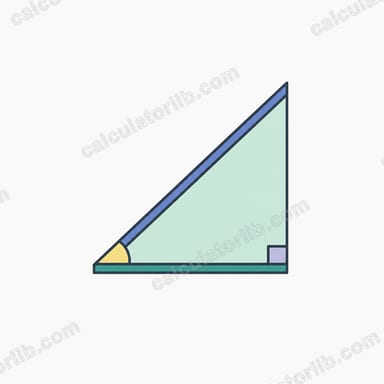
Enter the length of the side opposite the angle you care about, and the length of the hypotenuse (the longest side, opposite the right angle). The lengths can be in any consistent unit since only their ratio matters. Press calculate to see \(\sin(\theta)\) plus the angle. Remember the hypotenuse is always the largest side, so the opposite should never exceed it — otherwise the ratio is outside the valid range \([-1, 1]\) and no real angle exists.
The Formula Explained
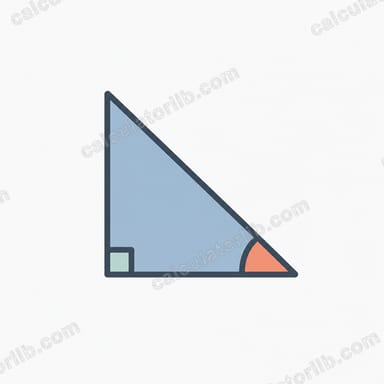
In a right triangle, the sine of a non-right angle is defined as the ratio of the side opposite that angle to the hypotenuse:
$$\sin(\theta) = \frac{\text{Opposite}}{\text{Hypotenuse}}$$Because sine outputs a value between -1 and 1, you can reverse the process with arcsine:
$$\theta = \arcsin\!\left(\frac{\text{Opposite}}{\text{Hypotenuse}}\right)$$Multiplying the radian answer by \(180/\pi\) converts it to degrees.
Worked Example
Suppose the opposite side is 3 and the hypotenuse is 5. Then
$$\sin(\theta) = \frac{3}{5} = 0.6$$Taking the arcsine, \(\theta = \arcsin(0.6) \approx 36.87°\), or about \(0.6435\) radians. This is the famous 3-4-5 right triangle.
FAQ
What if opposite is larger than hypotenuse? That is geometrically impossible in a right triangle; the calculator cannot return a real angle because sine only spans -1 to 1.
Do the units matter? No — sine is a pure ratio, so as long as both sides use the same unit the result is identical.
How do I get degrees instead of radians? The calculator shows both; \(\text{degrees} = \text{radians} \times (180 / \pi)\).