
What this calculator does
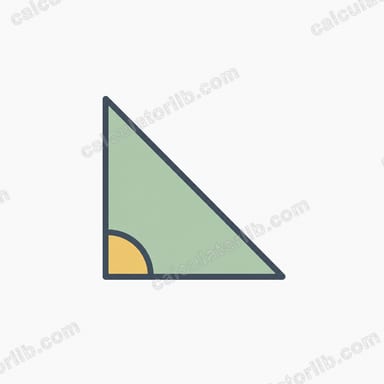
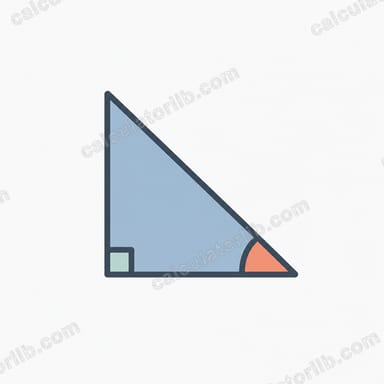
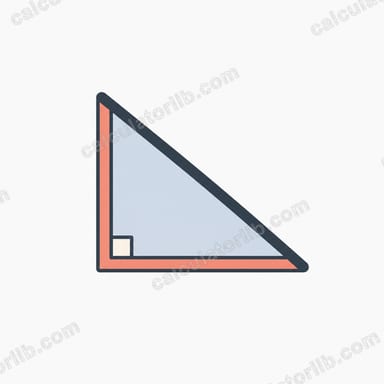
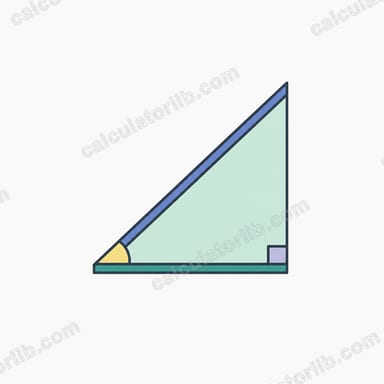
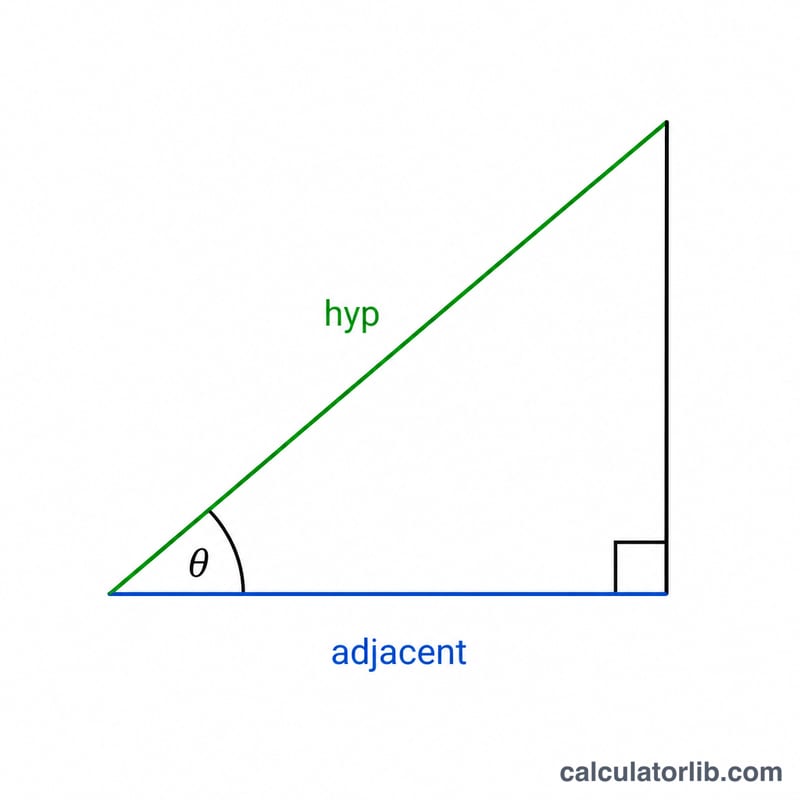
In any right triangle, the cosine of an acute angle θ is defined as the length of the side adjacent to that angle divided by the hypotenuse (the longest side, opposite the right angle). This tool computes cos(θ) directly from those two measurements and also returns the angle θ itself in both degrees and radians using the inverse cosine function.
How to use it
Enter the length of the side adjacent to your angle and the length of the hypotenuse, then read off the result. The adjacent and hypotenuse can be in any consistent unit (cm, m, inches) because cosine is a ratio — the units cancel out. The hypotenuse should be the largest side; if adjacent exceeds hypotenuse the ratio is clamped to the valid range [-1, 1] before the angle is computed.
The formula explained
The core relationship is $$\cos\theta = \frac{\text{Adjacent}}{\text{Hypotenuse}}$$. To find the angle, we invert it: $$\theta = \arccos\left(\frac{\text{Adjacent}}{\text{Hypotenuse}}\right)$$. Arccosine returns a value between 0 and 180 degrees (0 to \(\pi\) radians), which covers every valid right-triangle angle.
Worked example
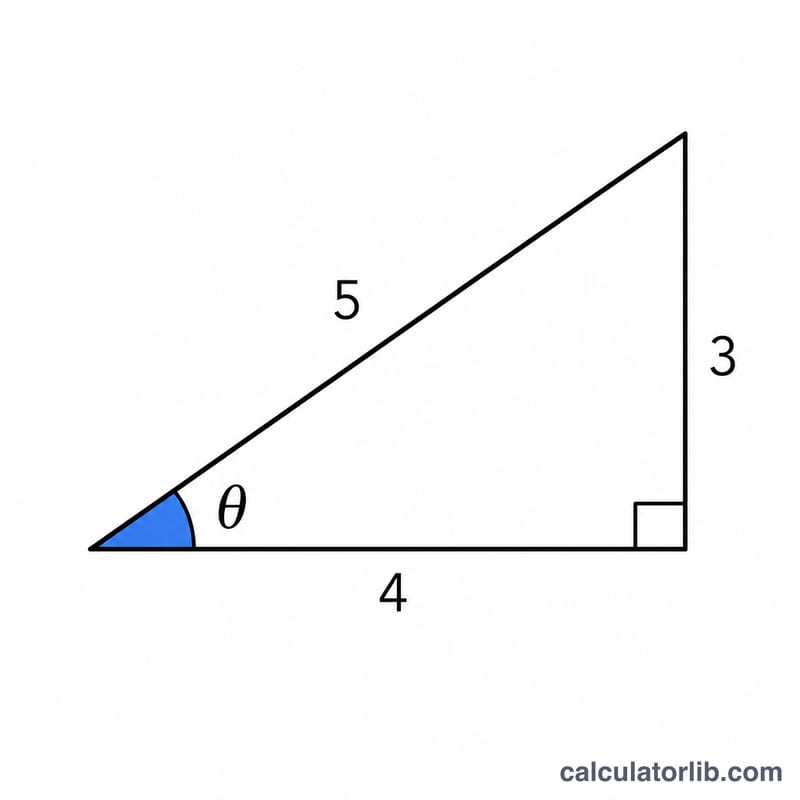
Suppose the adjacent side is 4 and the hypotenuse is 5. Then $$\cos\theta = \frac{4}{5} = 0.8.$$ Taking the inverse cosine, $$\theta = \arccos(0.8) \approx 36.8699°,$$ which is about \(0.6435\) radians. This is one of the angles in the classic 3-4-5 right triangle.
FAQ
Why must the hypotenuse be the longest side? By definition the hypotenuse is opposite the right angle and is always the longest side, so adjacent/hypotenuse is at most 1, keeping cosine valid.
What if I get cos(θ) = 1? A cosine of 1 means the angle is 0°, which happens when the adjacent side equals the hypotenuse — a degenerate (flat) triangle.
How do I convert radians to degrees? Multiply radians by \(180/\pi\). This calculator already provides both for you.