
What This Calculator Does
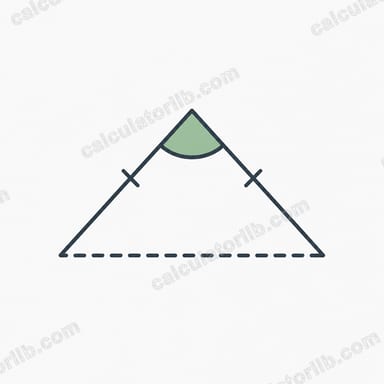
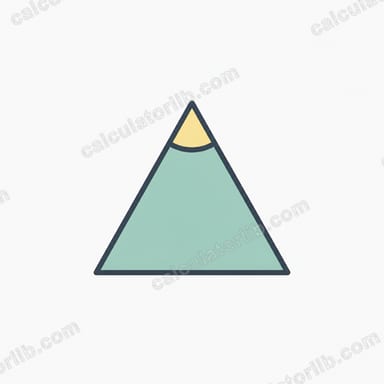
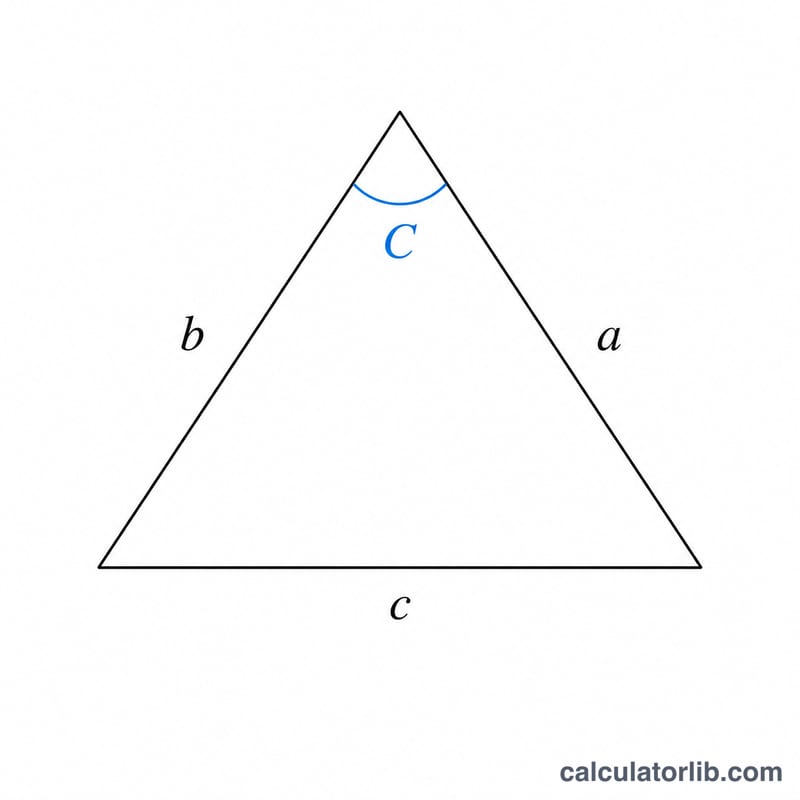
The Law of Cosines Angle Calculator finds an interior angle of any triangle when you know all three side lengths. Given sides a, b, and c, it returns angle C — the angle opposite side c — in both degrees and radians. This is the inverse use of the law of cosines and works for any triangle (acute, right, or obtuse).
How to Use It
Enter the three side lengths. Make sure side c is the one directly across from the angle you want to find; sides a and b are the two sides that form that angle. Units can be anything (cm, m, inches) as long as all three match. To find a different angle, simply re-enter the sides so the unknown angle's opposite side is in the c slot.
The Formula Explained
The law of cosines states \(c^2 = a^2 + b^2 - 2ab\cdot\cos(C)\). Solving for the cosine gives \(\cos(C) = \frac{a^2 + b^2 - c^2}{2ab}\), and taking the inverse cosine yields the angle: $$C = \arccos\!\left(\frac{a^2 + b^2 - c^2}{2ab}\right)$$ When \(a^2 + b^2 = c^2\), the cosine is zero and \(C = 90^\circ\), recovering the Pythagorean theorem.
Worked Example
For a triangle with a = 5, b = 6, c = 7: $$\cos(C) = \frac{25 + 36 - 49}{2\cdot 5\cdot 6} = \frac{12}{60} = 0.2$$ Then \(C = \arccos(0.2) \approx 1.36944\) radians \(\approx\) 78.46°.
FAQ
Which angle does this find? Angle C, the one opposite side c. Rearrange your inputs to find any other angle.
What if the sides can't form a triangle? If one side is longer than the sum of the other two, the cosine falls outside [−1, 1]; the calculator clamps it so the result stays valid, but the inputs are not a real triangle.
Does it work for right triangles? Yes — when \(a^2 + b^2 = c^2\), you'll get exactly 90°.