
What this calculator does
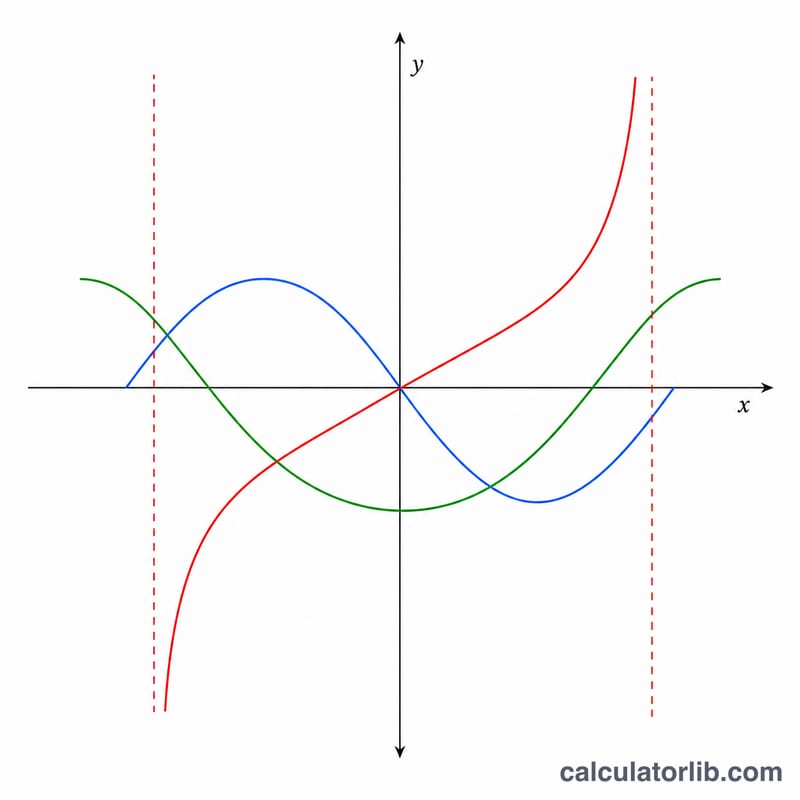
This tool computes the three primary trigonometric functions — sine, cosine and tangent — for any angle θ you enter. You can supply the angle in degrees (the everyday unit, where a full turn is 360°) or in radians (the natural mathematical unit, where a full turn is \(2\pi \approx 6.2832\)). It is useful for trigonometry homework, engineering, physics, surveying and any work that involves triangles, waves or rotations.
How to use it
Type the angle into the box, choose whether it is measured in degrees or radians, and read the results. The hero box shows \(\sin(\theta)\); the table below shows \(\cos(\theta)\) and \(\tan(\theta)\). When \(\cos(\theta)\) is zero — for example at 90° or 270° — the tangent is reported as undefined, because dividing by zero has no value.
The formula explained
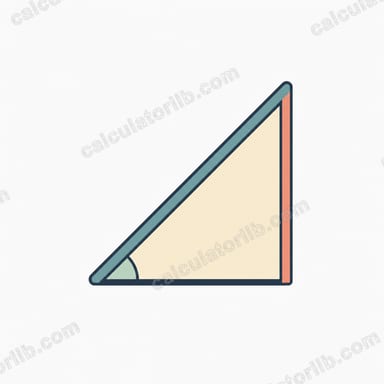
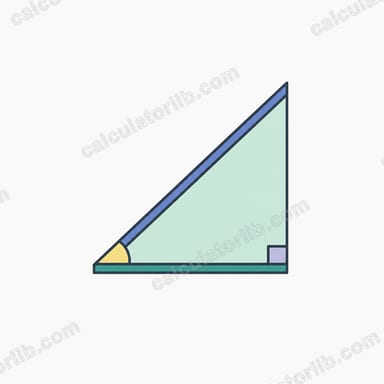
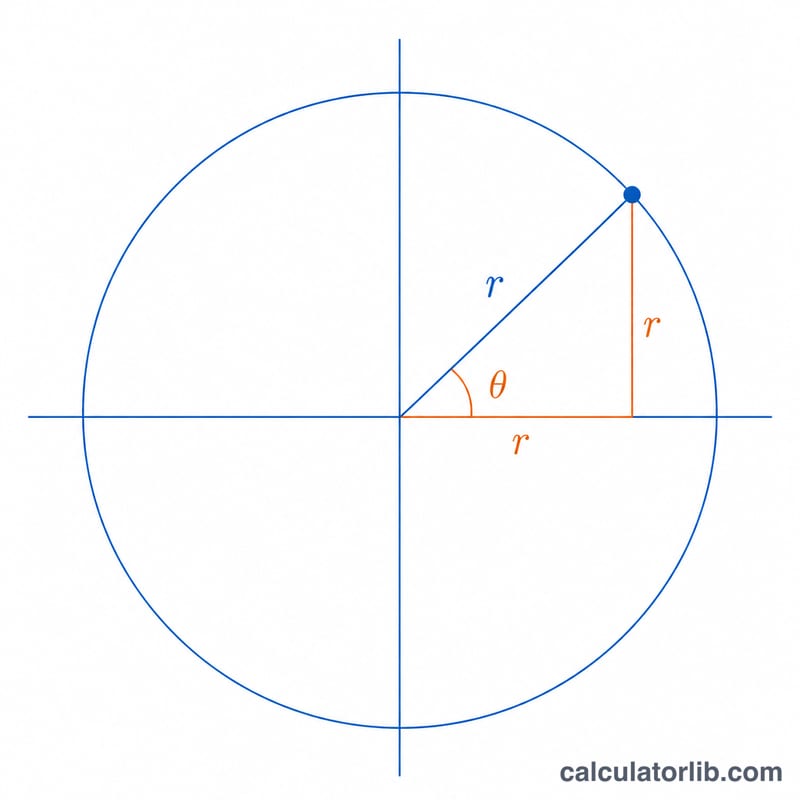
For a right triangle, sine is the ratio of the opposite side to the hypotenuse, cosine is the adjacent side over the hypotenuse, and tangent is the opposite over the adjacent. These extend to any angle through the unit circle, where the point at angle θ has coordinates \((\cos\theta, \sin\theta)\). The tangent is their quotient: $$\tan(\theta) = \frac{\sin(\theta)}{\cos(\theta)}$$ Internally, degree inputs are converted to radians with $$\theta_{\text{rad}} = \theta_{\text{deg}} \times \frac{\pi}{180}$$ before evaluation.
Worked example
Take θ = 30°. Converting, $$30 \times \frac{\pi}{180} = 0.5236 \text{ rad}$$ Then \(\sin(30°) = 0.5\), \(\cos(30°) \approx 0.866025\), and $$\tan(30°) = \frac{0.5}{0.866025} \approx 0.577350$$ The calculator returns exactly these values.
FAQ
Why is tan(90°) undefined? Because \(\cos(90°) = 0\) and tangent divides by cosine; division by zero is undefined.
Can I use negative angles? Yes. Negative angles simply rotate clockwise, and the functions behave accordingly (e.g. sin is odd, cos is even).
What is one radian in degrees? One radian \(\approx 57.2958°\), since \(180° = \pi\) radians.