
What This Calculator Does
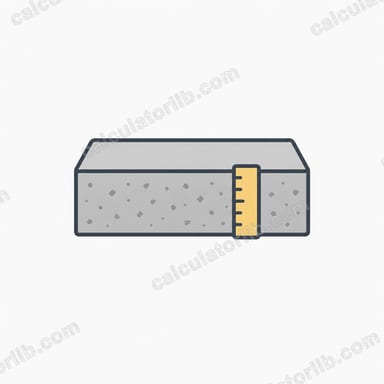
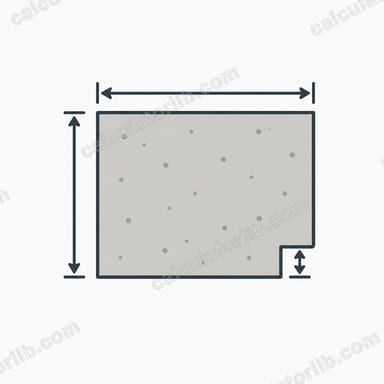
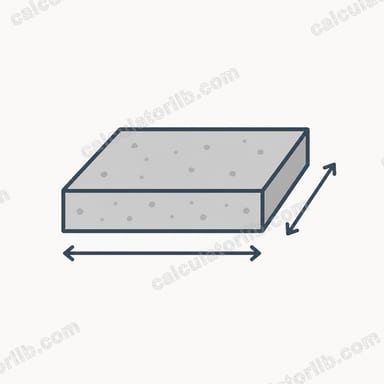
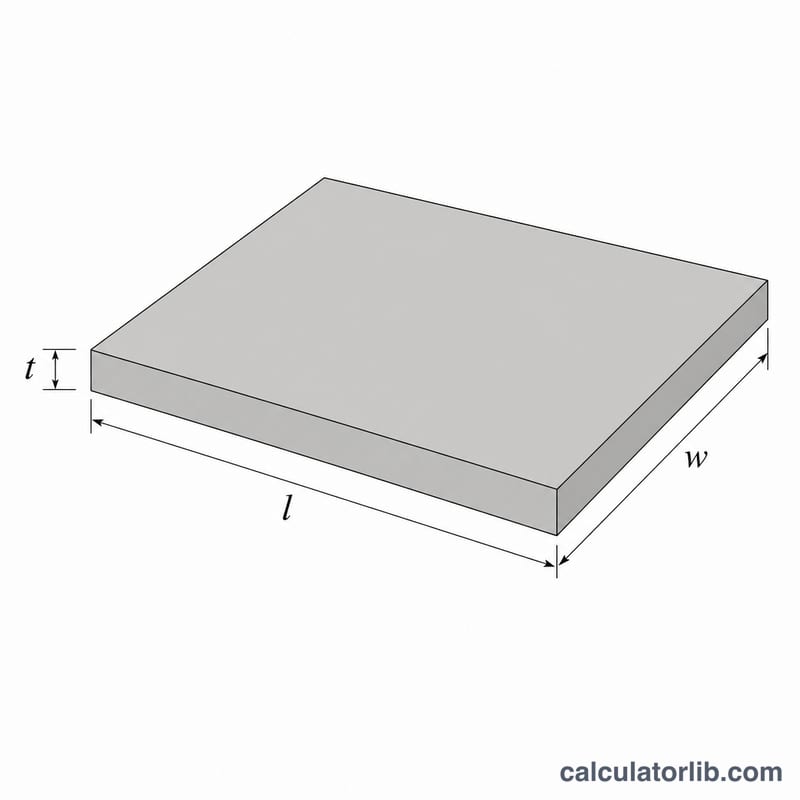
This tool estimates how much concrete you need to pour a flat, rectangular slab — such as a patio, driveway section, shed base, or garage floor. Enter the slab's length and width in feet and its thickness in inches, and it returns the volume in cubic yards (the unit concrete is ordered by) as well as cubic feet.
How to Use It
Measure the slab area. Enter the Length and Width in feet, then enter the Thickness in inches (4 inches is typical for patios and walkways; 6 inches for driveways). Click calculate to see the cubic yards required. Concrete is usually sold in fractions of a cubic yard, so round up and add a waste allowance of about 5–10%.
The Formula Explained
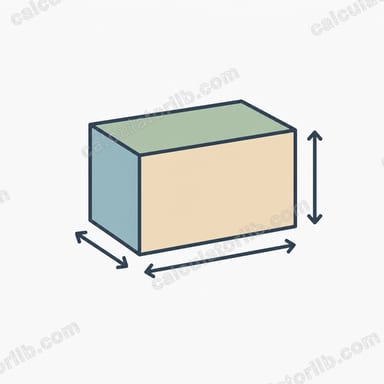
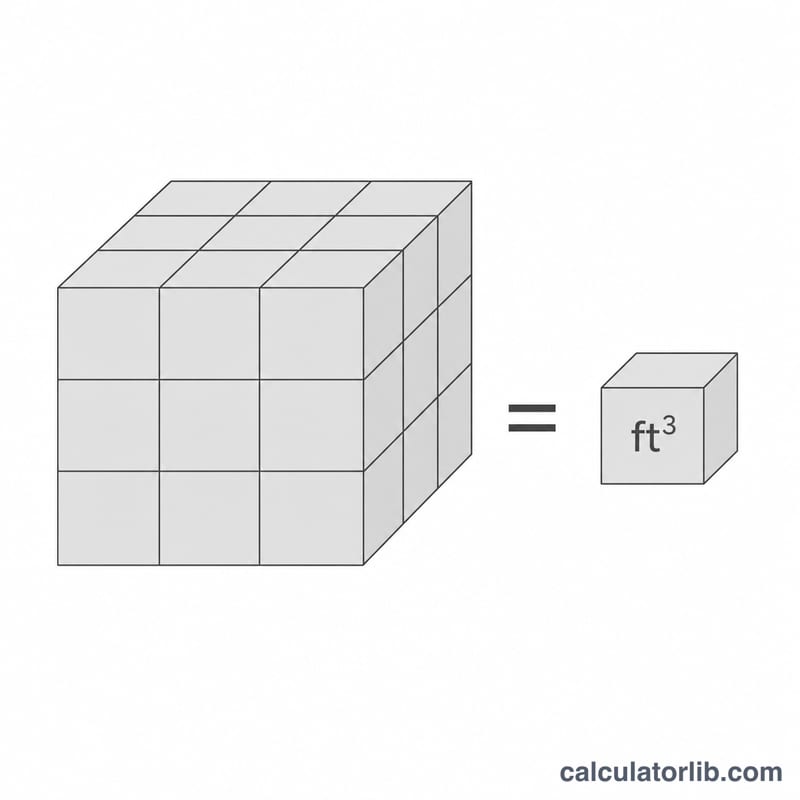
Volume is simply length \(\times\) width \(\times\) thickness, with every dimension in the same unit. Because slabs are measured in feet but thickness is usually given in inches, we first convert thickness to feet by dividing by 12. The resulting cubic feet are then divided by 27 (since 1 cubic yard = 3 ft \(\times\) 3 ft \(\times\) 3 ft = 27 cubic feet) to get cubic yards:
$$V = \frac{\text{Length (ft)} \times \text{Width (ft)} \times \dfrac{\text{Thickness (in)}}{12}}{27}$$
Worked Example
Suppose you are pouring a 10 ft \(\times\) 10 ft patio that is 4 inches thick. Convert thickness: \(4 \div 12 = 0.333\) ft. Volume in cubic feet = \(10 \times 10 \times 0.333 = 33.33\) ft³. Divide by 27: \(33.33 \div 27 \approx 1.23\) cubic yards. Order about 1.35 cubic yards to allow for spillage and uneven subgrade.
FAQ
How much extra should I order? Add 5–10% to cover spillage, uneven ground, and form deflection.
Why cubic yards? Ready-mix concrete suppliers price and deliver by the cubic yard, so converting from cubic feet makes ordering straightforward.
What thickness should I use? 4 inches is standard for patios and sidewalks; 5–6 inches for driveways and areas carrying vehicle loads.