
What this calculator does
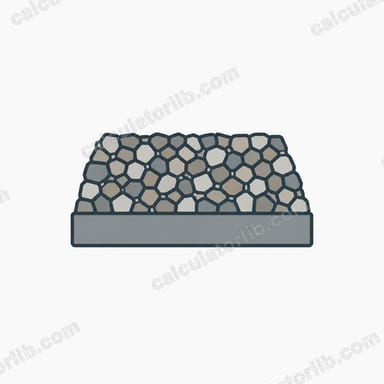
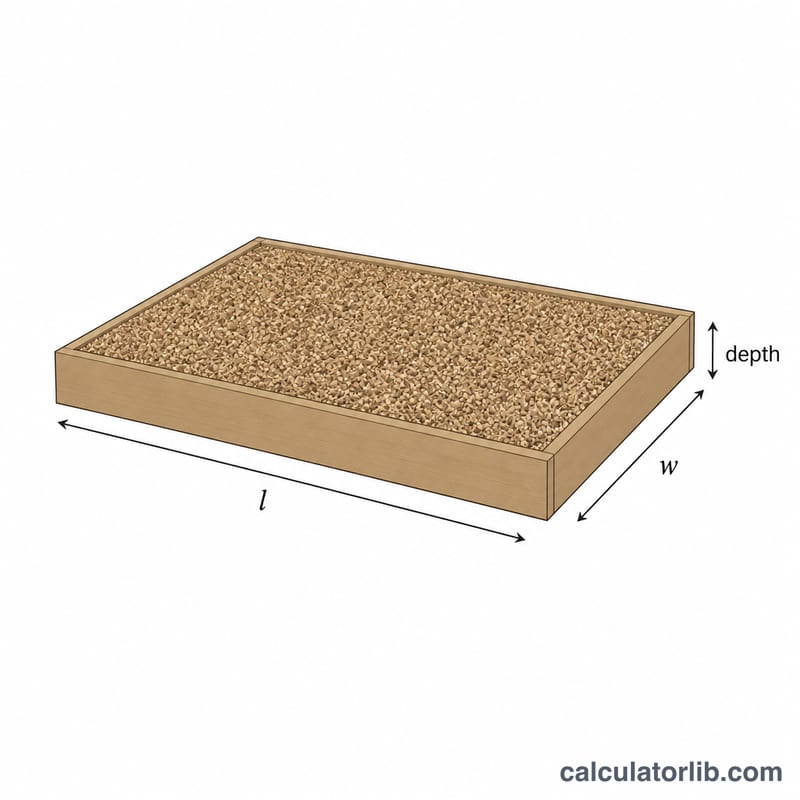
This Rectangle Gravel/Mulch Volume Calculator tells you how much loose material — gravel, mulch, sand, topsoil or decorative stone — you need to cover a rectangular area to a chosen depth. The answer is given in cubic yards, the unit most landscaping suppliers use for bulk deliveries, along with the equivalent in cubic feet.
How to use it
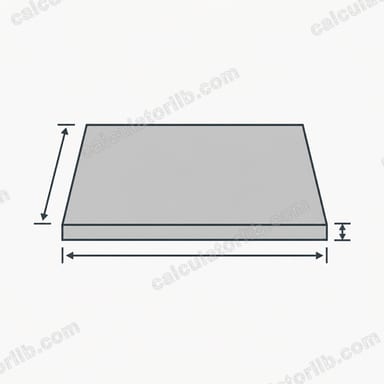
Measure the length and width of your bed, path or driveway in feet, and decide how deep you want the material. Enter the length and width in feet and the depth in inches, then read off the cubic yards needed. A typical mulch layer is 2–3 inches, while gravel paths are often 3–4 inches deep.
The formula explained
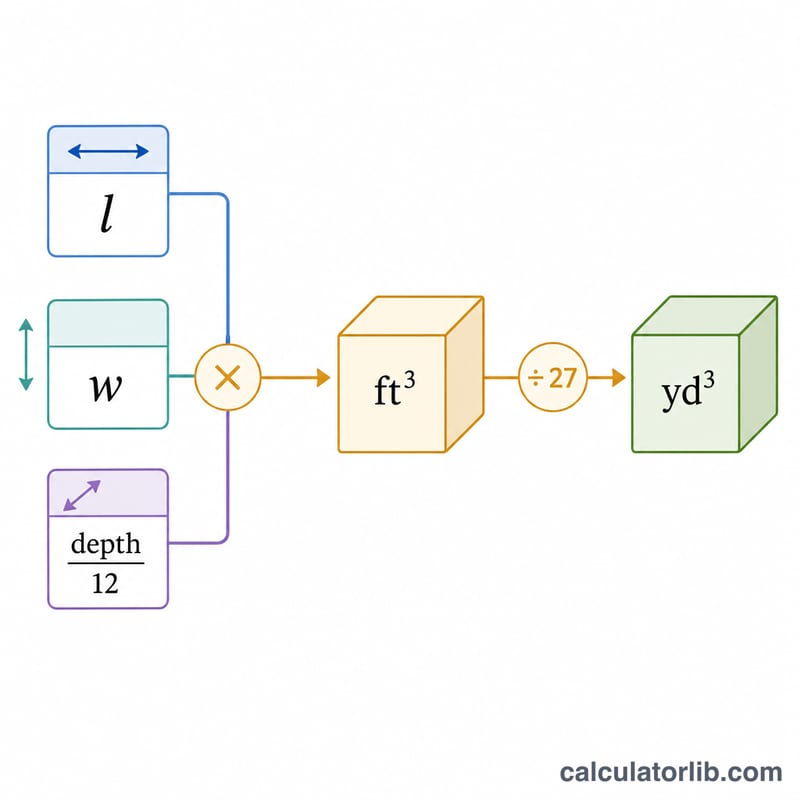
Volume is simply length \(\times\) width \(\times\) depth. Because depth is usually shallow, we enter it in inches and convert to feet by dividing by 12. The result is in cubic feet, which we divide by 27 (there are 27 cubic feet in a cubic yard) to get cubic yards:
$$\text{Volume (yd}^3) = \frac{\text{Length (ft)} \times \text{Width (ft)} \times \dfrac{\text{Depth (in)}}{12}}{27}$$
Worked example
Suppose you have a flower bed 20 ft long and 10 ft wide and want 3 inches of mulch. Depth in feet = \(3 \div 12 = 0.25\) ft. Volume = \(20 \times 10 \times 0.25 = 50\) cubic feet. Cubic yards = \(50 \div 27 \approx 1.85\) cubic yards. Order 2 cubic yards to allow for settling.
FAQ
How many cubic feet are in a cubic yard? Exactly 27 (\(3\,\text{ft} \times 3\,\text{ft} \times 3\,\text{ft}\)).
Should I round up my order? Yes — material compacts and there is always some waste, so rounding up 10–15% is wise.
Does this work for sand or topsoil? Yes, the volume math is identical for any material that fills a space; only the weight per yard differs.