
What This Mulch Calculator Does
This calculator tells you how much mulch (or any loose landscaping material such as bark, compost, soil or gravel) you need to cover a garden bed to a chosen depth. It works for square, rectangular, circular and triangular beds and reports the volume in cubic yards, cubic feet and cubic meters. You can also estimate cost using a bulk price per volume or a per-bag price. Because it is pure geometry and unit conversion, it works anywhere and supports both US customary and metric units.
How to Use It
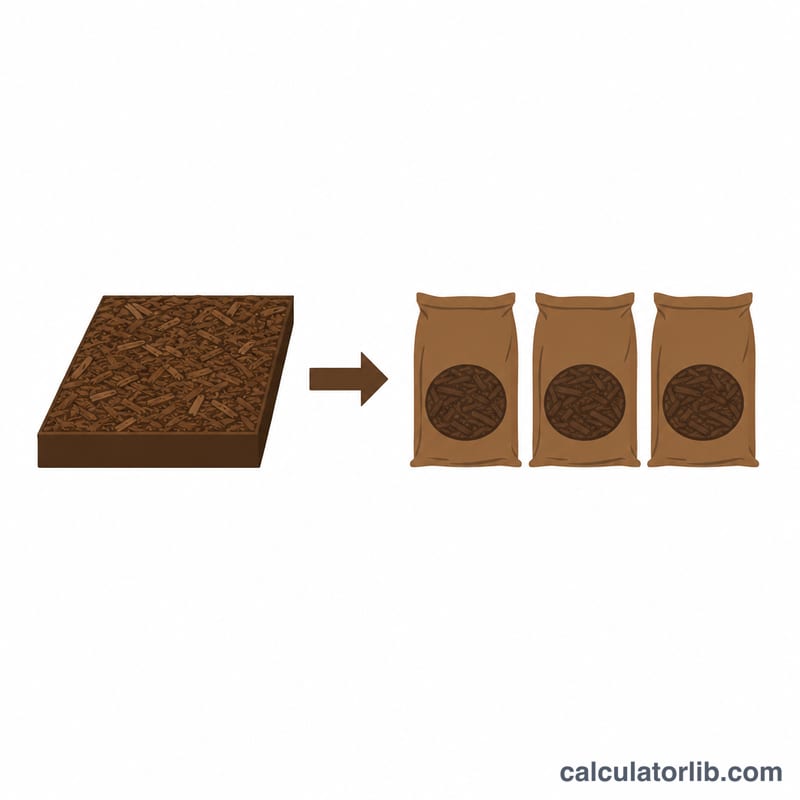
Pick your bed shape, enter the dimensions and their units, then set the mulch depth (a typical mulch layer is 2 to 4 inches; 6 inches is a generous fresh layer). Optionally add a price: choose Bulk and enter a price per cubic yard/foot/meter, or choose Bagged and enter the price per bag and how many cubic feet each bag holds. Bags are always rounded up because you cannot buy a partial bag.
The Formula Explained
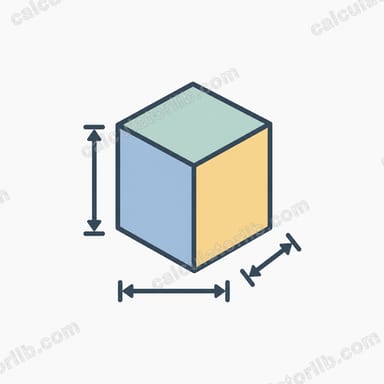
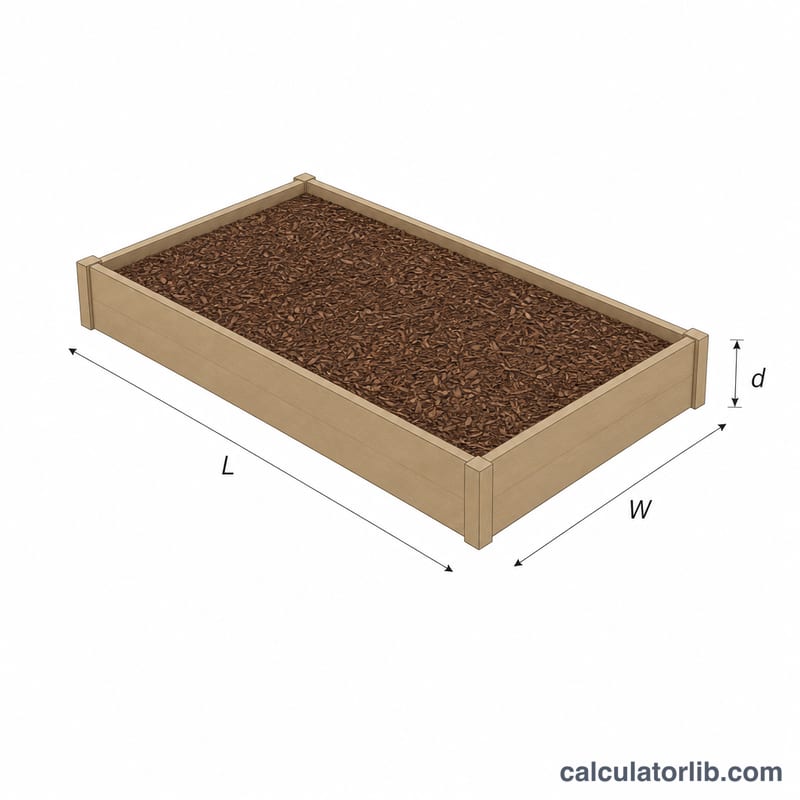
First every length is converted to meters. The 2D bed area is computed with the matching shape formula (rectangle: \(A = L \times W\); circle: \(A = \pi r^2\); triangle: \(A = \frac{1}{2} \times \text{base} \times \text{height}\)). Volume in cubic meters is area × depth. That volume is then converted: divide by \(0.028316846592\) for cubic feet and by \(0.764554857984\) for cubic yards (equivalently, cubic feet ÷ 27).
$$V = A \times d, \quad A = L \times W$$$$V_{yd^3} = \frac{V_{m^3}}{0.764554857984} = \frac{V_{ft^3}}{27}$$
Worked Example
A 10 ft × 10 ft rectangular bed at 6 in depth: \(L = W = 3.048\) m, depth = \(0.1524\) m. Area = \(9.290304\) m², volume = \(1.4158\) m³ = \(50\) ft³ = \(1.85\) yd³. At a bulk price of $40 per cubic yard the cost is about $74. Using 2 ft³ bags you would need \(\lceil 50 / 2 \rceil = 25\) bags.
FAQ
How deep should mulch be? Two to four inches suppresses weeds and retains moisture without smothering roots.
How many bags are in a cubic yard? One cubic yard equals 27 cubic feet, or about 13.5 standard 2-cubic-foot bags.
Can I use it for soil or gravel? Yes — the math is identical for any loose material measured by volume.