
What this calculator does
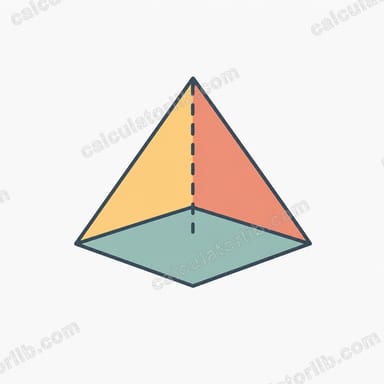
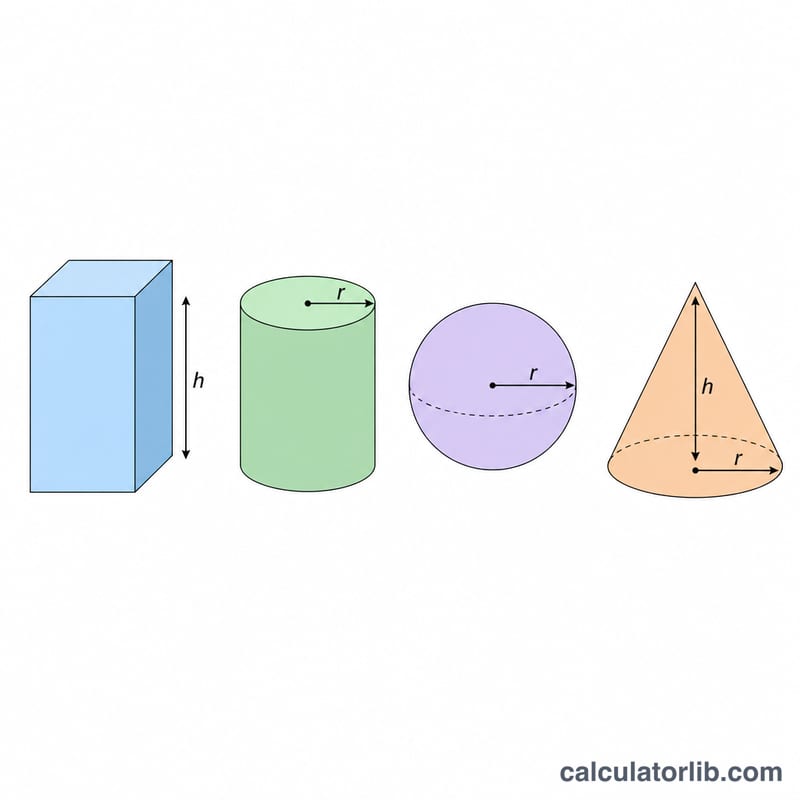
This Cubic Feet Calculator finds the volume of common storage and construction shapes - a room, box, storage unit, tank, plain area, or a selectable 3D geometric shape such as a cube, cylinder, capsule, triangular prism, pyramid, sphere, hemisphere, cone, or conical frustum. It reports the result in cubic feet plus equivalent cubic inches, cubic yards, cubic meters, US gallons, US quarts, and liters. It can multiply by a quantity and, optionally, estimate a total material or space cost. This is a pure geometry and unit-conversion tool, so it applies identically everywhere; the currency symbol is cosmetic only and performs no exchange-rate conversion.
How to use it
Choose a shape, then enter only the dimensions that shape needs. Each linear dimension has its own unit dropdown (inch, foot, yard, mm, cm, meter) - every length is converted to feet before the shape formula is applied, so the primary answer is always in cubic feet. Set a quantity to multiply identical shapes. To estimate cost, enter a price, a "per" base, and the cost unit (cubic feet, cubic yard, cubic meter, gallon, quart, or liter).
The formula explained
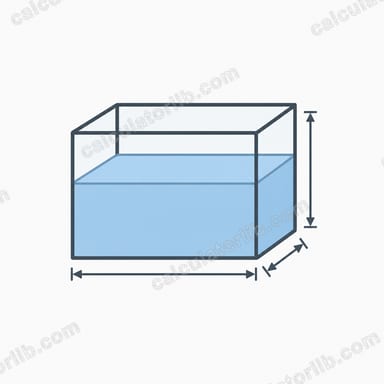
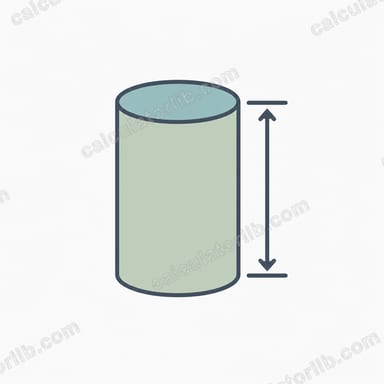
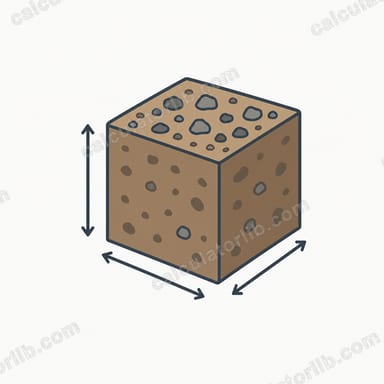
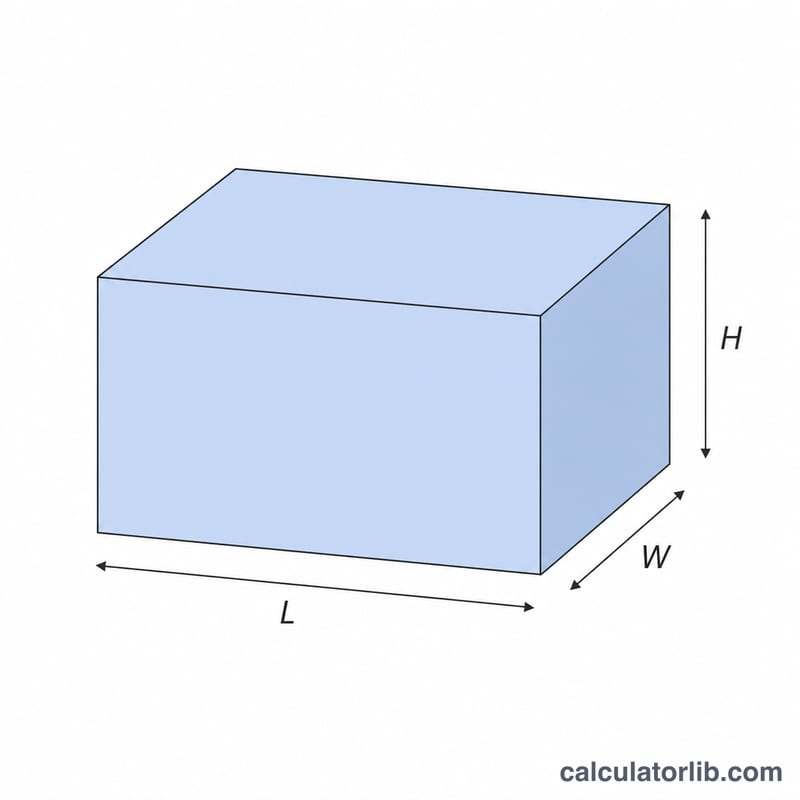
For a rectangular prism (room, box, storage, tank), volume is \(V = l \times w \times h\). A cube is side cubed. A cylinder is \(\pi \times r^2 \times h\), a sphere is \(\frac{4}{3} \times \pi \times r^3\), a cone is \(\frac{1}{3} \times \pi \times r^2 \times h\), and a conical frustum is \(\frac{1}{3} \times \pi \times h \times (r_1^2 + r_1 \times r_2 + r_2^2)\). The total volume equals the single-shape volume times the quantity:
$$V_{\text{ft}^3} = \text{shape formula in feet} \times \text{quantity}$$
Other units come from fixed constants: \(1\ \text{ft}^3 = 1728\ \text{in}^3 = \frac{1}{27}\ \text{yd}^3 = 0.0283168\ \text{m}^3 = 7.48052\ \text{US gal} = 28.3168\ \text{L}\).
Worked example
A box measuring 4 ft x 3 ft x 2 ft has a single volume of \(4 \times 3 \times 2 = 24\ \text{ft}^3\). With a quantity of 2, the total is
$$48\ \text{ft}^3 = 82{,}944\ \text{in}^3 = 1.7778\ \text{yd}^3 = 1.3592\ \text{m}^3 = 359.07\ \text{US gal} = 1{,}359.2\ \text{L}$$
If the price is $5 per 1 cubic yard, the total cost is \(5 \times 1.7778 = \$8.89\).
FAQ
Can I mix units? Yes. Each dimension has its own unit, so you can combine inches, feet, and meters freely.
What does "Area (sq ft)" mean? Enter a footprint already measured in square feet plus a height; \(\text{volume} = \text{area} \times \text{height}\).
Does the currency convert money? No. The symbol is display only; the cost math uses your raw price and the chosen volume unit.