
What this calculator does
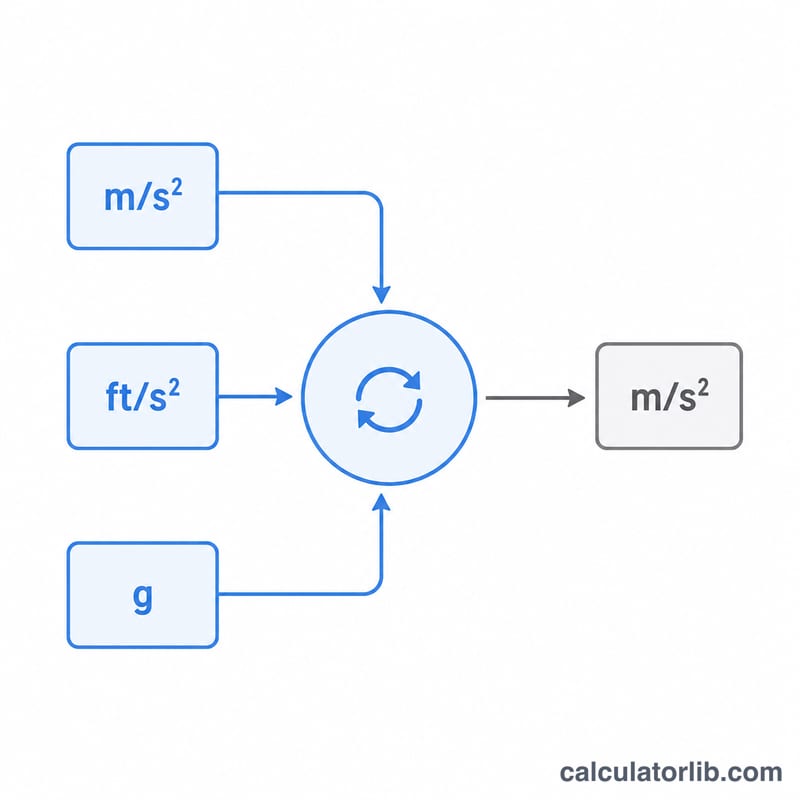
This tool converts a single acceleration value from one unit to another among 18 widely used acceleration units, including meter per second squared (m/s2), foot per second squared (ft/s2), standard gravity (g, denoted gn), galileo (Gal), knot per second, and various mixed units such as mile per hour per second. It is universal and not tied to any country or jurisdiction.
How to use it
Enter the value you want to convert, choose the source unit in the "From" dropdown, and the target unit in the "To" dropdown. The calculator returns the converted value plus the exact single multiplier you can reuse for the same pair of units.
The formula explained
Every supported unit has a fixed factor-to-SI: the number you multiply by to obtain meters per second squared. The conversion first normalizes the input to SI (value times the source factor), then divides by the target factor. Algebraically this collapses to a single multiplier equal to the source factor divided by the target factor: $$\text{result} = \text{value} \times \dfrac{f_{from}}{f_{to}}$$ Because no listed unit has a zero factor, division is always safe.
Worked example
Convert 1 m/s2 to ft/s2. The source factor is 1 and the target factor is 0.3048, so the multiplier is \(1 / 0.3048 = 3.2808399\). The result is $$1 \times 3.2808399 = 3.2808399 \text{ ft/s}^2$$ Another example: 9.80665 m/s2 to gravity (gn) gives multiplier \(1 / 9.80665 = 0.10197162\) and a result of exactly 1 gn.
Acceleration Unit Conversion Factors (to m/s²)
Acceleration is the rate of change of velocity, with SI unit metre per second squared (m/s²). To convert any acceleration to m/s², multiply by the factor below. To convert from m/s² to a unit, divide by that unit's factor. The general relationship used by the converter is:
$$\text{Result} = \text{Value} \times \frac{f_{\text{from}}}{f_{\text{to}}}$$
where each \(f\) is the unit's value in m/s² shown in the table.
| Unit | Symbol | Factor (m/s² per unit) |
|---|---|---|
| Metre per second squared | m/s² | 1 (exact) |
| Centimetre per second squared | cm/s² | 0.01 (exact) |
| Kilometre per second squared | km/s² | 1000 (exact) |
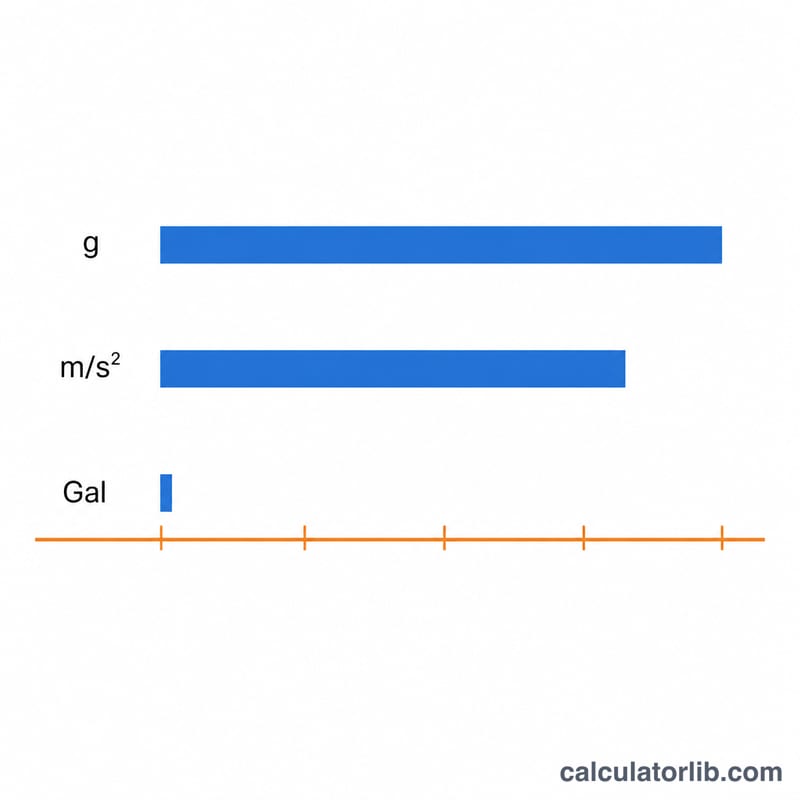
| Gal (galileo) | Gal | 0.01 (exact) |
| Standard gravity | g (gn) | 9.80665 (exact) |
| Foot per second squared | ft/s² | 0.3048 (exact) |
| Foot per hour per second | ft/(h·s) | 0.0000846667 |
| Foot per minute per second | ft/(min·s) | 0.00508 (exact) |
| Inch per second squared | in/s² | 0.0254 (exact) |
| Inch per hour per second | in/(h·s) | 0.00000705556 |
| Inch per minute per second | in/(min·s) | 0.000423333 |
| Mile per second squared | mile/s² | 1609.344 (exact) |
| Mile per hour per second | mph/s | 0.44704 (exact) |
| Kilometre per hour per second | km/(h·s) | 0.277778 |
| Knot per second | kn/s | 0.514444 |
| Metre per second per second | m/s/s | 1 (exact) |
Notes: "Gal" and cm/s² are numerically identical (both 0.01 m/s²). Standard gravity \(g_n = 9.80665\) m/s² is fixed by international convention. The hour- and minute-based mixed units express how velocity (in ft/h, in/min, etc.) changes per second.
FAQ
What is standard gravity? Standard gravity (gn) equals \(9.80665 \text{ m/s}^2\), the conventional acceleration of free fall used in physics and engineering.
Can I convert negative values? Yes. Negative values represent deceleration; the sign passes through the conversion unchanged.
What is a galileo (Gal)? The galileo is a CGS unit of acceleration equal to \(0.01 \text{ m/s}^2\), commonly used in gravimetry and geophysics.