
What this calculator does
The Road Base Fill Volume, Weight and Cost Calculator estimates how much road base or sub-base material you need for a road, driveway, or parking lot. From the surface dimensions and a base depth it computes the fill volume (in cubic meters, cubic yards and cubic feet), the material weight, and an optional cost. It is a universal geometry + density tool, so it works in any country; the listed densities are typical published engineering reference values.
How to use it
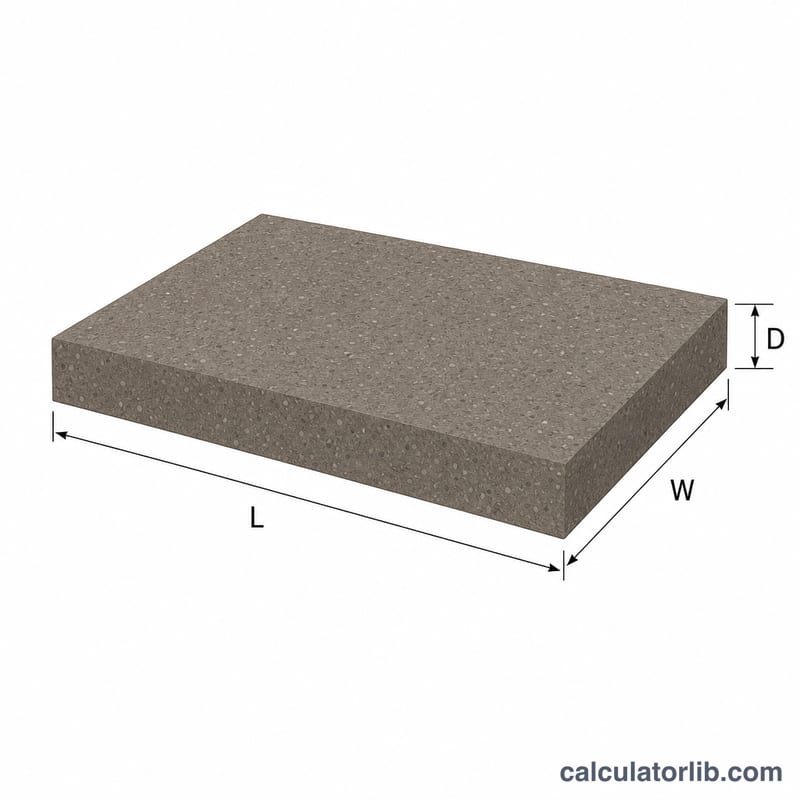
Pick the shape that matches your project. Roadway and Rectangle multiply length by width; Circle treats the Length field as the diameter (area = \(\pi \times r^2\)); Triangle uses Length as base and Width as height (area = \(\tfrac{1}{2} \times \text{base} \times \text{height}\)). Enter each dimension and choose its unit — you can mix miles, feet and inches, which is common in roadway work, because everything is converted to meters internally. Choose a material to set the density, or pick Custom and supply a supplier figure. Add a compaction allowance (typically 5–30%) and a waste/overrun allowance (typically 5–15%), then optionally enter a unit price to get a cost.
The formula explained
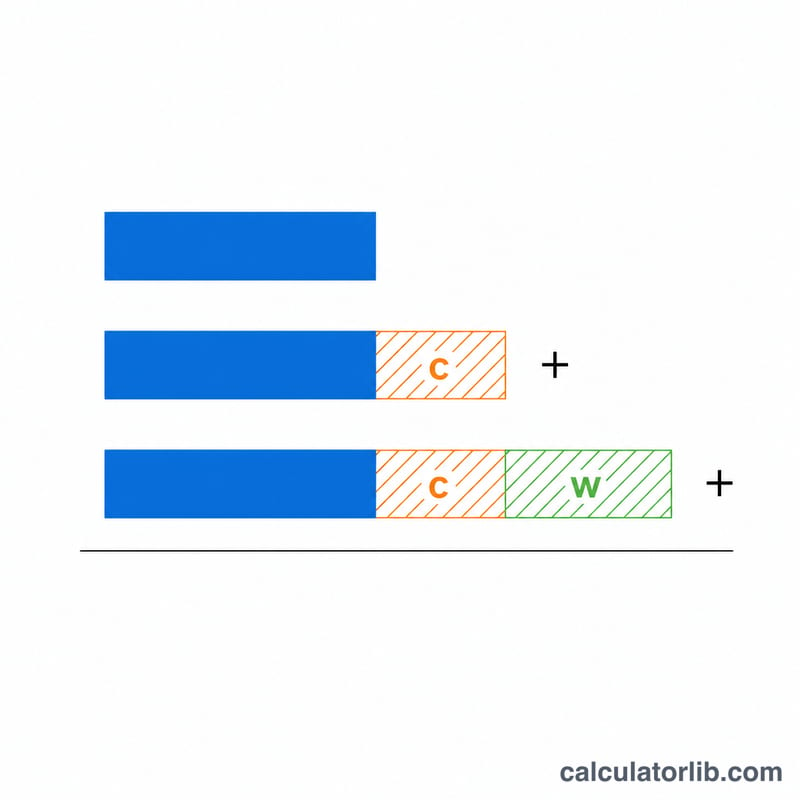
First each dimension is converted to meters. The surface area A is found from the chosen shape, and the base volume is \(V_0 = A \times D\). The adjusted volume multiplies by \(\left(1 + \tfrac{c}{100}\right)\) and \(\left(1 + \tfrac{w}{100}\right)\) to add extra material.
$$V = A \times D \times \left(1 + \tfrac{c}{100}\right)\left(1 + \tfrac{w}{100}\right)$$Weight = volume x density.
$$W_{kg} = V \times \rho$$Cost = price x volume expressed in the chosen price unit (1 cubic yard = 0.764554857984 m³, 1 cubic foot = 0.028316846592 m³).
Worked example
A 0.5 mile roadway, 20 ft wide, 6 in deep of loose gravel (1520 kg/m³) with 10% compaction and 5% waste: \(L = 804.672 \text{ m}\), \(W = 6.096 \text{ m}\), \(D = 0.1524 \text{ m}\). Area = 4,905.28 m³... base volume 747.56 m³, adjusted \(\times 1.155 = 863.44 \text{ m}^3\) (1,129.3 yd³). Weight = \(863.44 \times 1520 = 1{,}312{,}423 \text{ kg}\) (1,446.7 US tons). At $30/yd³ the cost is about $33,880.
FAQ
Why add a compaction percentage? Loose material settles and compresses when rolled, so you must order more than the finished volume.
Are the densities exact? No — bulk density varies with moisture and gradation. Use the Custom option with a supplier figure for a precise weight.
Can I mix units? Yes. Each dimension has its own unit selector and all values are normalized to SI meters before any multiplication.