
What is the Weight to Volume Calculator?
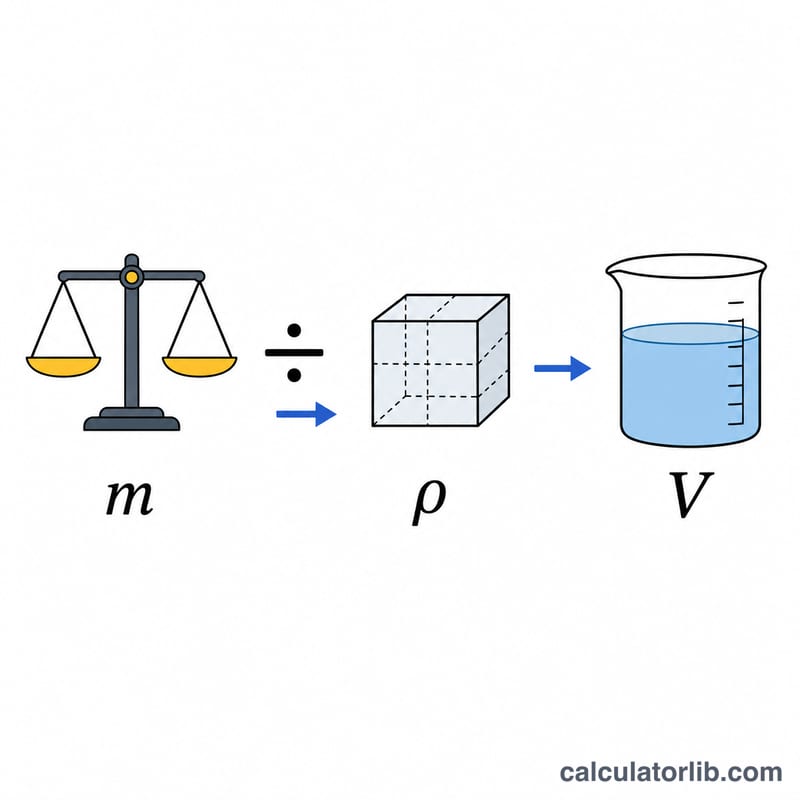
This tool converts a known weight (mass) into a volume using the substance's density. Because mass and volume are linked by density, you cannot convert one to the other without knowing how dense the material is. The calculator applies the universal relationship \(V = m / \rho\) and works for any substance — water, milk, oil, flour, metals or chemicals — as long as you supply the correct density.
How to use it
Enter the mass and choose its unit (grams, kilograms, milligrams, pounds or ounces). Then type the density in grams per milliliter (g/mL), which is identical to grams per cubic centimeter (g/cm³). Water is exactly 1 g/mL, milk is about 1.03, vegetable oil about 0.92, and honey roughly 1.42. The result shows volume in milliliters, liters and cubic centimeters.
The formula explained
The core equation is \(V = m / \rho\), where V is volume, m is mass and ρ (rho) is density. The calculator first converts your mass to grams, then divides by the density in g/mL. Since 1 g/mL = 1 g/cm³, the milliliter result equals the cubic-centimeter result, and dividing by 1000 gives liters.
Worked example
Suppose you have 500 g of vegetable oil with a density of 0.92 g/mL. $$V = \frac{500}{0.92} = 543.48 \text{ mL}$$ or about 0.543 liters. For water, 1 kg = 1000 g divided by 1 g/mL gives exactly 1000 mL — which is why a liter of water weighs a kilogram.
FAQ
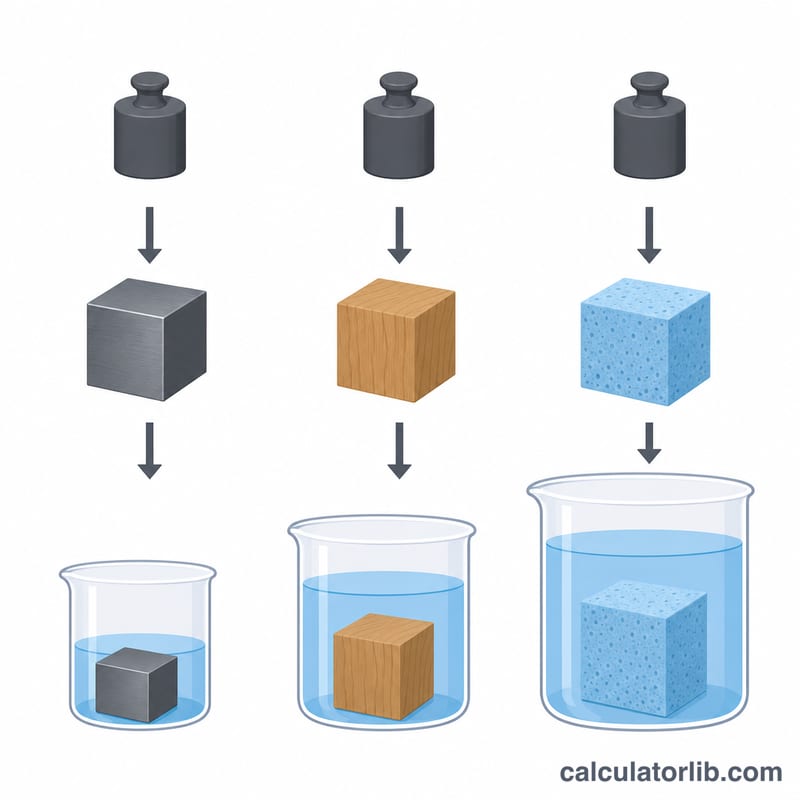
Why do I need density? Mass and volume only match when density is known; a kilogram of feathers and a kilogram of lead occupy very different volumes.
Is g/mL the same as g/cm³? Yes — one milliliter equals one cubic centimeter, so the two units are interchangeable.
Where do I find a substance's density? Density tables and material datasheets list it; for cooking ingredients many reference charts give approximate values at room temperature.