
What Is the Volume of a Cylinder?
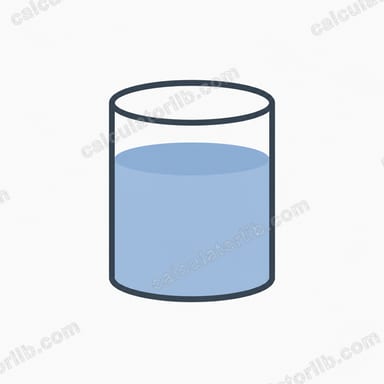
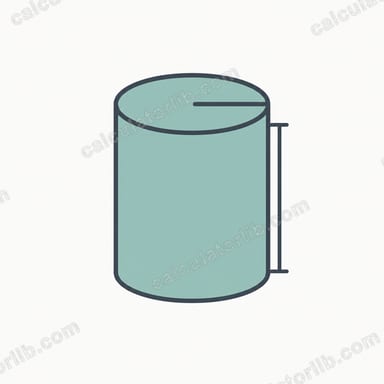
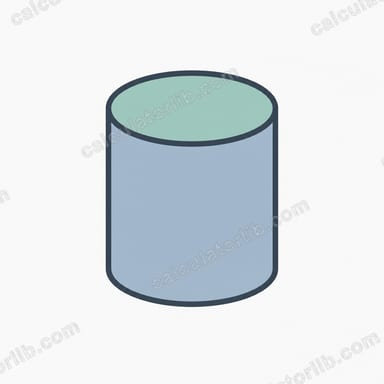
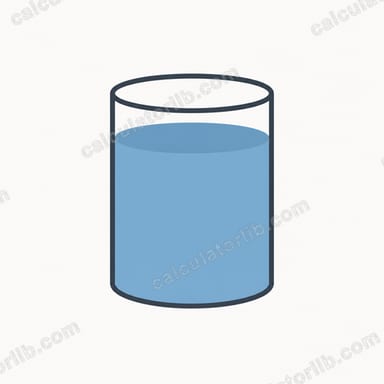
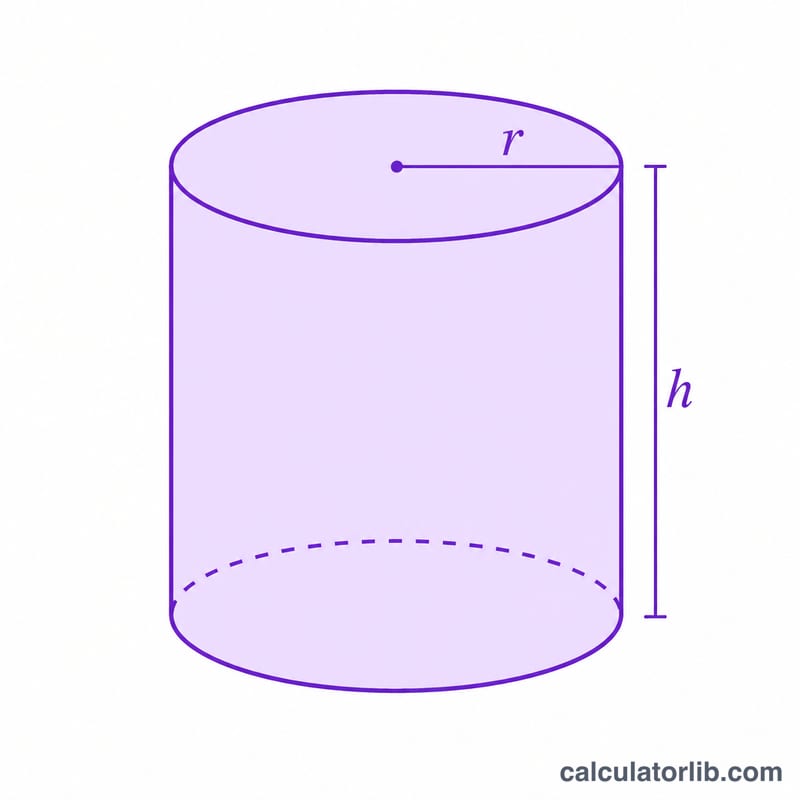
A cylinder is a three-dimensional solid with two parallel circular bases connected by a curved surface. Its volume measures how much space it occupies — useful for sizing tanks, pipes, cans, columns, and barrels. This calculator uses the standard formula \(V = \pi \cdot r^{2} \cdot h\), where r is the radius of the circular base and h is the height (or length) of the cylinder.
How to Use This Calculator
Enter the radius of the base and the height of the cylinder in the same unit of measurement (e.g. both in centimeters or both in inches). The result is returned in cubic units. The tool also reports the base area (\(\pi \cdot r^{2}\)) and the total surface area for convenience.
The Formula Explained
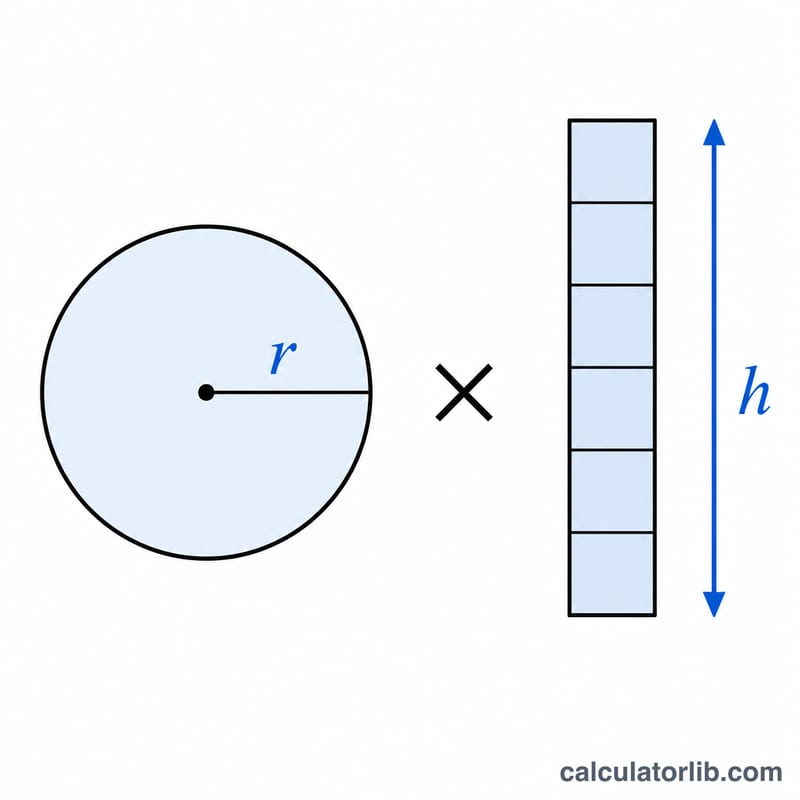
The base of a cylinder is a circle with area \(\pi \cdot r^{2}\). Multiplying that area by the height stacks it through the full length of the solid, giving $$V = \pi \cdot r^{2} \cdot h$$. Because the radius is squared, doubling the radius quadruples the volume, while doubling the height only doubles it.
Worked Example
Suppose a cylinder has a radius of 5 units and a height of 10 units. The base area is \(\pi \times 5^{2} = 25\pi \approx 78.54\) square units. Multiplying by the height: $$V = 25\pi \times 10 = 250\pi \approx 785.40 \text{ cubic units}.$$
FAQ
What units does the result use? Cubic units of whatever length unit you entered. If you input centimeters, the volume is in cubic centimeters (cm³).
I only know the diameter — what do I do? Divide the diameter by 2 to get the radius, then enter that value.
Does this work for a hollow pipe? Not directly. For a pipe, compute the outer-radius volume and subtract the inner-radius volume.