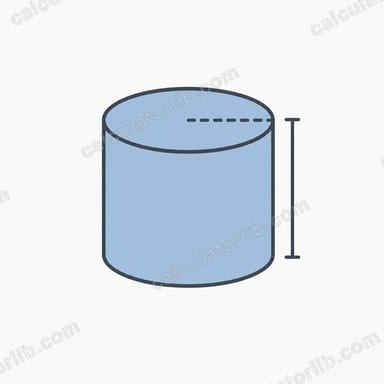

What is the Circle to Cylinder Volume Calculator?
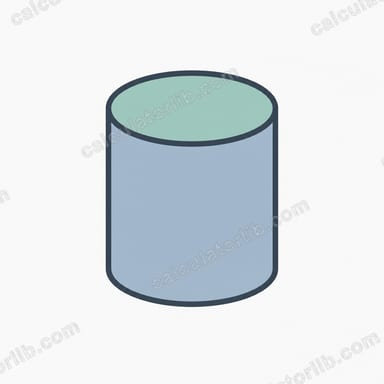
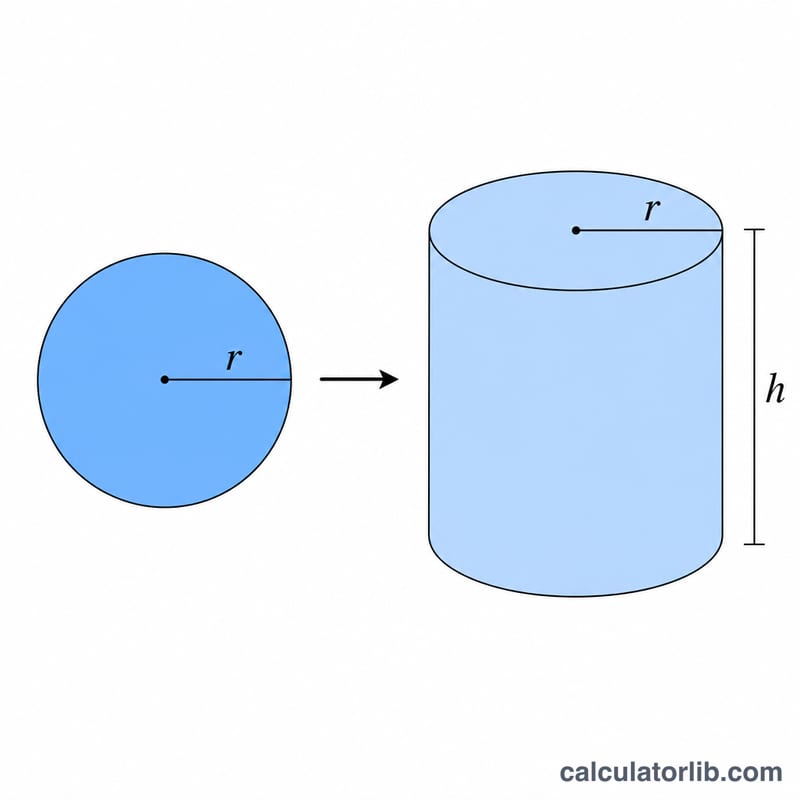
This calculator takes a flat circle — defined by its radius — and "extrudes" it through a given height to form a cylinder, then reports the resulting volume. It is handy whenever you know the size of a circular cross-section (a pipe, tank, can, or column) and the length or depth it spans. The math is universal and works with any consistent unit (cm, m, inches, feet); the answer is simply in those units cubed.
How to use it
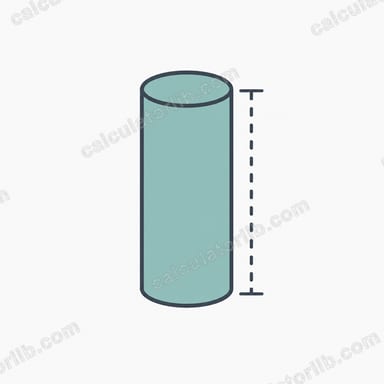
Enter the radius (r) of the circular base and the height (h) of the cylinder. The tool computes the circle's area and multiplies it by the height to give the total volume. If you only know the diameter, divide it by two first to get the radius.
The formula explained
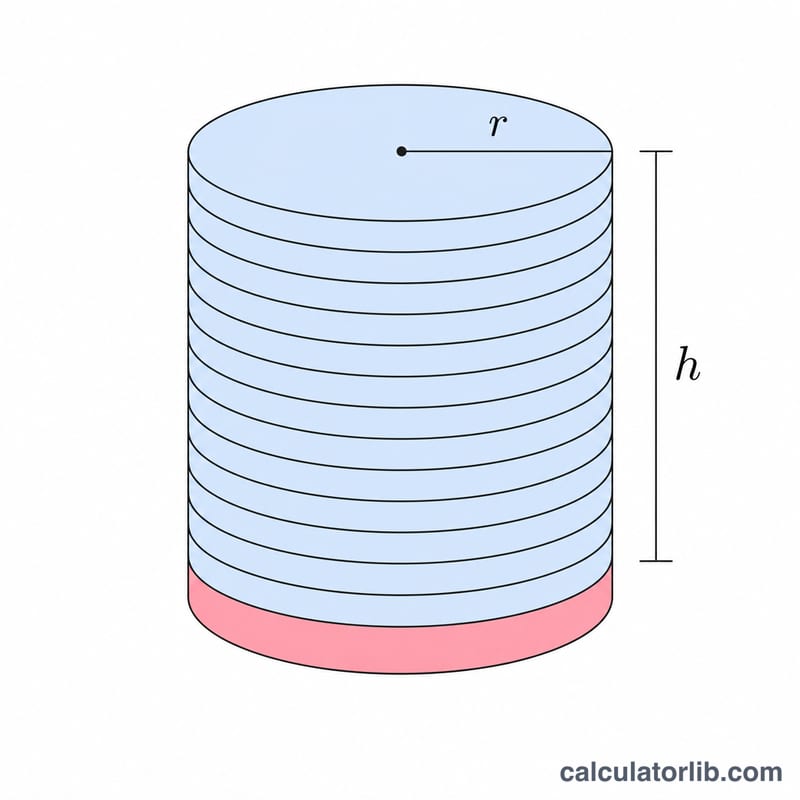
The volume of a cylinder is the area of its circular base times its height. The base area of a circle is \(A = \pi r^{2}\), so the full equation is:
$$V = \pi r^{2} h$$
Here \(\pi \approx 3.14159\), \(r\) is the radius, and \(h\) is the height. Because area scales with the square of the radius, doubling the radius quadruples the volume, while doubling the height only doubles it.
Worked example
Suppose a cylinder has a radius of 5 cm and a height of 10 cm. First find the base area: $$A = \pi \times 5^{2} = \pi \times 25 \approx 78.54 \text{ cm}^{2}.$$ Then multiply by height: $$V = 78.54 \times 10 \approx 785.40 \text{ cm}^{3}.$$ So the cylinder holds about 785.4 cubic centimeters.
FAQ
What if I only have the diameter? Halve it to get the radius (\(r = d \div 2\)), then enter that value.
What units does the result use? Whatever unit you input — the volume is in cubic units of that same measure (e.g. radius and height in meters give cubic meters).
Can I get capacity in liters? Compute the volume in cubic centimeters, then divide by 1000 — 1 liter equals \(1000 \text{ cm}^{3}\).