
What this calculator does
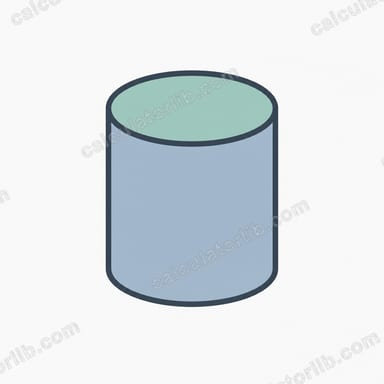
The Cubic Yards in a Cylinder Calculator finds the volume of any cylindrical shape — a column footing, a round tank, a sonotube, a silo, or a stack of material — and reports it in cubic yards. Concrete, gravel, sand, mulch and soil are commonly sold by the cubic yard, so this tool is handy for ordering the right amount of material.
How to use it
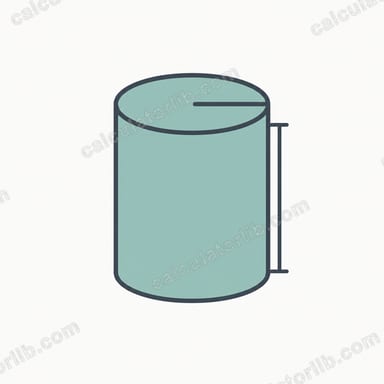
Measure the diameter (the full width across the circular face) and the height or depth of the cylinder. Pick the unit you measured in — feet, inches, yards, or meters. The calculator converts your measurements to yards, applies the cylinder volume formula, and shows the result in both cubic yards and cubic feet.
The formula explained
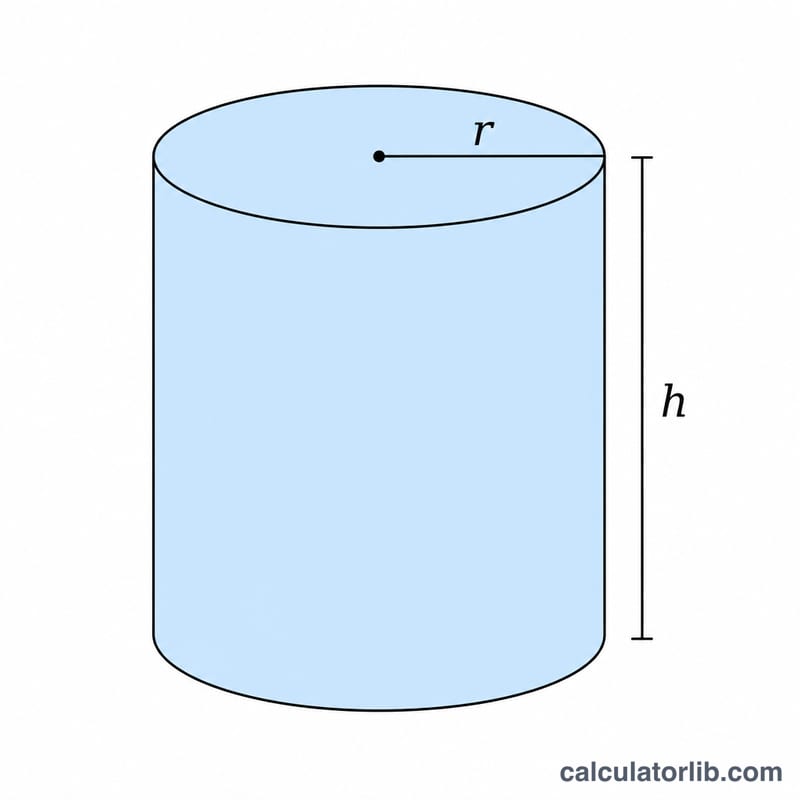
A cylinder's volume is the area of its circular base times its height: $$V = \pi \cdot r^{2} \cdot h.$$ The radius \(r\) is half the diameter. To get cubic yards directly, the radius and height are converted to yards before multiplying. Because 1 yard = 3 feet = 36 inches = 0.9144 meters, the calculator scales each measurement accordingly. One cubic yard equals 27 cubic feet.
Worked example
Suppose you pour a round concrete column 3 feet in diameter and 9 feet tall. The radius is 1.5 ft = 0.5 yd, and the height is 9 ft = 3 yd. $$V = \pi \times 0.5^{2} \times 3 = \pi \times 0.25 \times 3 \approx 2.356 \text{ cubic yards}$$ (about 63.6 cubic feet). You would order roughly 2.4 yd³ of concrete to be safe.
FAQ
Do I enter radius or diameter? Enter the diameter — the full width across the circle. The calculator halves it automatically.
Why cubic yards? Bulk materials such as concrete, gravel and topsoil are priced and delivered by the cubic yard, so this is the unit suppliers expect.
How many cubic feet are in a cubic yard? Exactly 27 cubic feet equal one cubic yard.