
What Is a Cubic Yards Calculator?
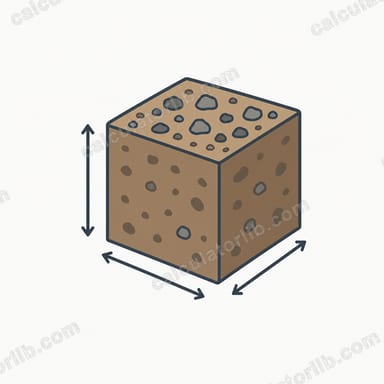
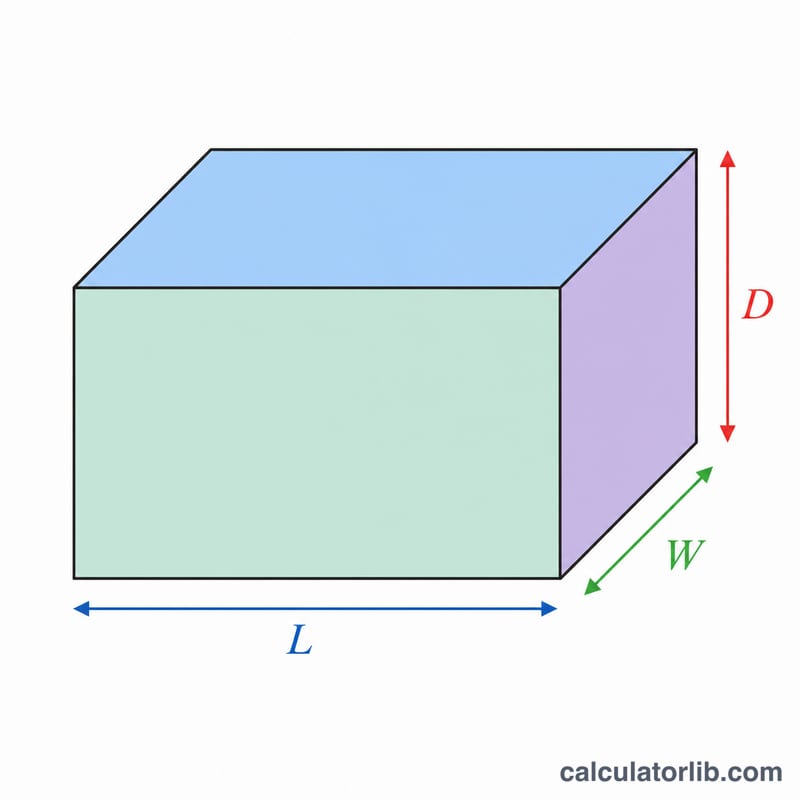
A cubic yards calculator converts the dimensions of a space — its length, width, and depth — into a volume measured in cubic yards. Cubic yards are the standard unit used by suppliers when selling bulk materials like concrete, topsoil, mulch, sand, and gravel. Because most projects are measured in feet, this tool handles the conversion automatically: there are 27 cubic feet in a single cubic yard.
How to Use It
Enter the three measurements of your area in feet. For depth, convert inches to feet first (for example, 6 inches = 0.5 feet). The calculator multiplies the three values to get cubic feet, then divides by 27 to give cubic yards. When ordering materials, it is common to round up and add 5–10% extra for compaction and waste.
The Formula Explained
The math is simple multiplication and one division:
$$\text{Cubic Yards} = \dfrac{\text{Length} \times \text{Width} \times \text{Depth}}{27}$$
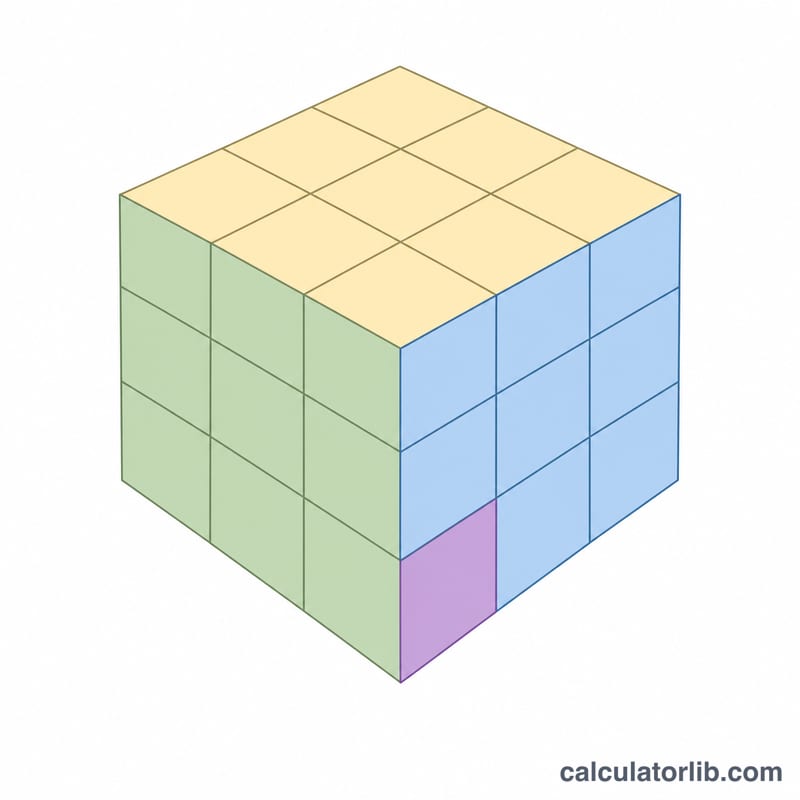
The product of length, width, and depth gives the volume in cubic feet. Dividing by 27 (since \(3\,\text{ft} \times 3\,\text{ft} \times 3\,\text{ft} = 27\,\text{ft}^3\) make up one cubic yard) converts that figure to cubic yards.
Worked Example
Suppose you are pouring a concrete slab that is 12 feet long, 10 feet wide, and 4 inches (0.333 ft) deep. The volume is $$12 \times 10 \times 0.333 = 40 \text{ cubic feet}.$$ Dividing by 27 gives about \(1.48\) cubic yards. You would likely order 1.5 to 1.6 cubic yards to allow for spillage.
FAQ
How many cubic feet are in a cubic yard? Exactly 27 cubic feet.
How do I convert inches of depth to feet? Divide the inches by 12 — for example, \(3 \div 12 = 0.25\) feet.
Should I round up my order? Yes. Bulk materials are sold in whole or half cubic yards, and a small buffer prevents running short mid-project.