
What this calculator does
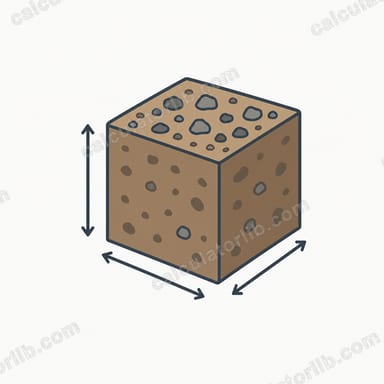
The Cubic Yards to Tons Calculator converts a volume of material (in cubic yards) into an estimated weight in US (short) tons. This is essential for ordering bulk landscaping and construction materials such as gravel, sand, topsoil, mulch, crushed stone, and concrete, which are sold by volume but often priced or hauled by weight.
How to use it
Enter the number of cubic yards you need. Pick a material from the dropdown to load a typical density, or choose "Custom density" and type your own value in tons per cubic yard. The calculator multiplies the two together and shows the result in tons (and pounds). Always confirm density with your supplier, since moisture content and compaction can change the real weight.
The formula explained
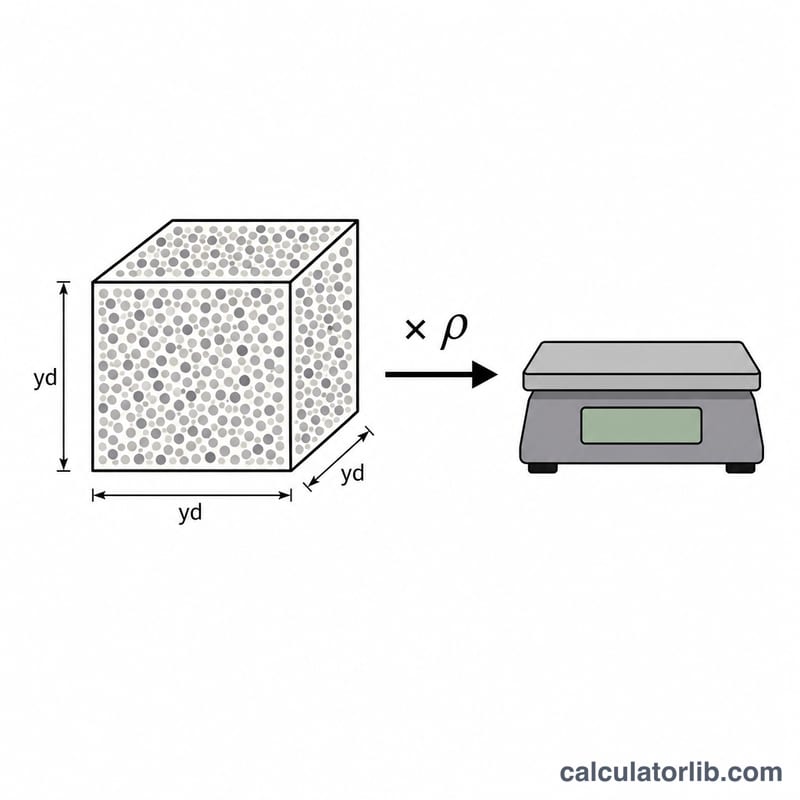
The conversion is simply $$\text{Tons} = \text{Volume (yd}^3) \times \text{Density}$$, where density is expressed in tons per cubic yard. Density is the bridge between volume and weight: dense materials like concrete (~2.0 t/yd³) weigh far more per yard than light materials like wood mulch (~1.0 t/yd³). One US short ton equals 2,000 pounds.
Worked example
Suppose you need 12 cubic yards of gravel with a density of 1.4 tons per cubic yard. The weight is $$12 \times 1.4 = 16.8 \text{ tons}$$, or \(16.8 \times 2{,}000 = 33{,}600\) pounds. That tells you whether one truck can carry the load.
FAQ
What density should I use? Typical values: dry gravel/sand ~1.4, topsoil ~1.35, crushed stone ~1.6, concrete ~2.0, mulch ~1.0 tons per cubic yard. Wet material weighs more.
Is this metric or short tons? Results are in US short tons (2,000 lb). For metric tonnes, divide pounds by 2,204.62.
Why is my supplier's weight different? Moisture, particle size, and compaction all affect real density, so treat this as a close estimate and confirm with the quarry or yard.