
What Is a Newton Meter Torque Calculator?
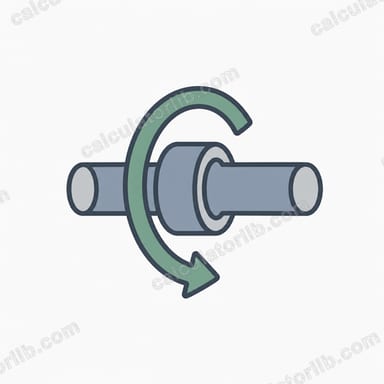
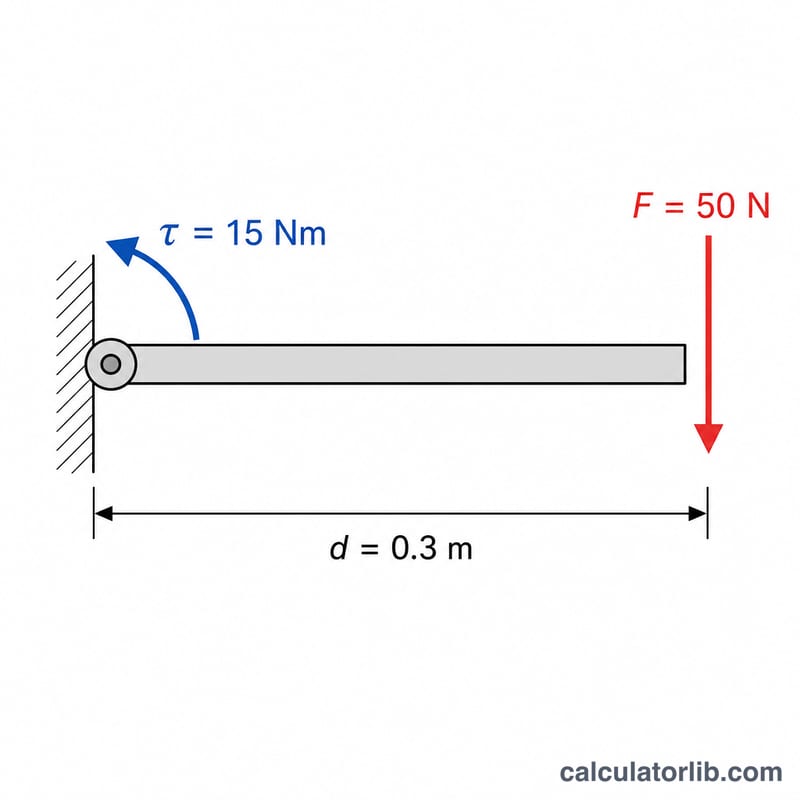
Torque is the rotational equivalent of force — it measures the turning effect produced when a force is applied at a distance from a pivot point. This calculator works out torque in newton-metres (Nm) from the applied force in newtons (N) and the length of the lever arm in metres (m). It is a universal physics and engineering tool used for tightening bolts, sizing motors, balancing levers and analysing rotating machinery.
How to Use It
Enter the force in newtons and the perpendicular distance (lever arm) in metres, then read off the torque. For example, pushing with 100 N on a 0.5 m wrench produces 50 Nm. If your force is given in kilograms-force, multiply by 9.81 to convert to newtons first. The distance must be measured perpendicular to the line of the force for the result to be exact.
The Formula Explained
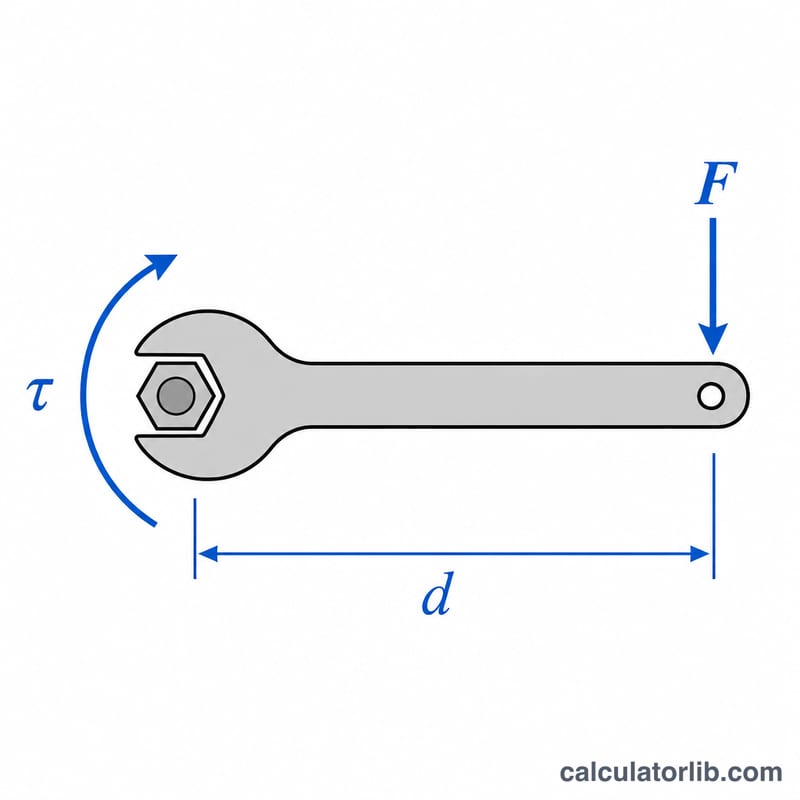
The equation is $$\tau = F \times d$$ where \(\tau\) is torque in newton-metres, \(F\) is force in newtons, and \(d\) is the distance from the axis of rotation in metres. Because one newton-metre is one newton applied one metre from the pivot, the units combine directly. A larger force or a longer lever arm both increase torque, which is why long-handled wrenches loosen stubborn bolts more easily.
Worked Example
A mechanic applies 250 N at the end of a 0.4 m wrench. $$\text{Torque} = 250 \times 0.4 = 100 \text{ Nm}$$ To reach a target of 150 Nm with the same wrench, the force needed would be \(150 \div 0.4 = 375\) N.
FAQ
Is a newton-metre the same as a joule? Numerically yes (1 Nm = 1 J), but torque and energy are physically different quantities, so torque is always written as Nm, not joules.
What if the force is not perpendicular? Use the perpendicular component of the force, or \(\tau = F \times d \times \sin(\theta)\), where \(\theta\) is the angle between the force and the lever arm.
How do I convert Nm to foot-pounds? Multiply newton-metres by 0.7376 to get foot-pounds (\(\text{lb}\cdot\text{ft}\)).