
What Is the Nm to Joules Calculator?
This tool converts work measured in newton-metres (N·m) into energy measured in joules (J). In the SI system the newton-metre of work and the joule are identical: one newton-metre of work done equals exactly one joule of energy. So the conversion is a clean 1:1 mapping — enter a value in N·m and you get the same number in joules.
How to Use It
Type the amount of work in newton-metres into the input box and read the equivalent energy in joules. This is useful in physics homework, mechanical engineering, and energy calculations where work and energy quantities need to be expressed in joules.
The Formula Explained
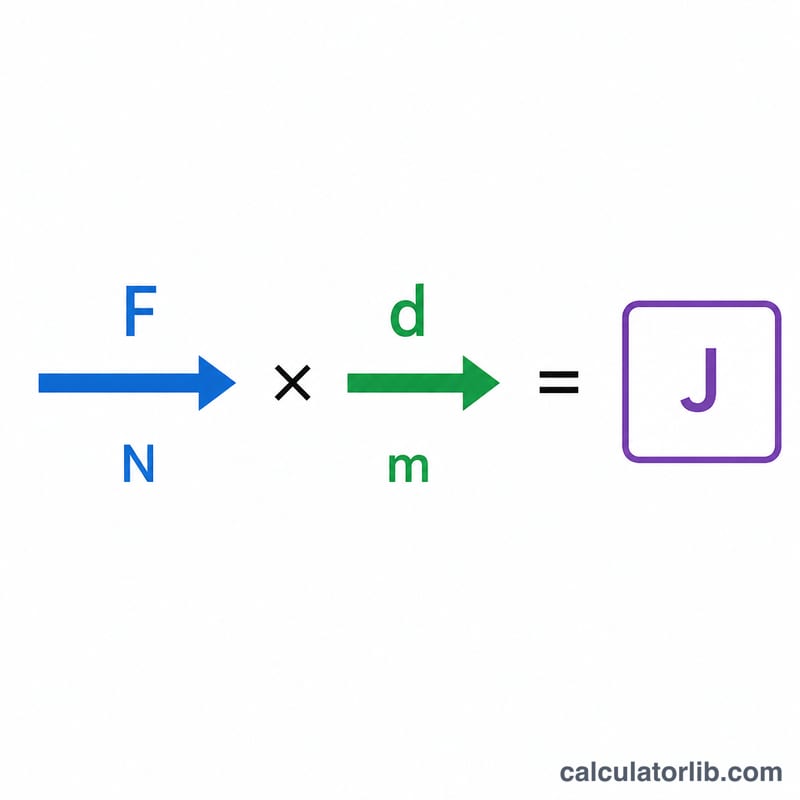
Work is defined as force multiplied by the distance over which it acts: \(W = F \times d\). Force is measured in newtons (N) and distance in metres (m), so work comes out in newton-metres (N·m). By definition, $$E\ (\text{J}) = \text{Newton-metres (N}\cdot\text{m)}$$ which is why the calculator returns the same numeric value. Note: torque is also expressed in N·m, but torque is not energy — this 1:1 conversion only applies to work/energy.
Worked Example
Suppose you push a box with a force of 50 N over a distance of 4 m. The work done is $$W = 50 \times 4 = 200\ \text{N}\cdot\text{m},$$ which equals 200 J of energy. Entering 200 N·m therefore returns 200 joules.
FAQ
Is a newton-metre the same as a joule? For work and energy, yes — \(1\ \text{N}\cdot\text{m} = 1\ \text{J}\). For torque, the unit is also N·m but it does not convert to joules of energy.
Why are the input and output numbers identical? Because the joule is defined as the work done by a force of one newton acting over one metre, the values are equal by definition.
Can I convert joules back to N·m? Yes, the relationship is reversible: any value in joules of work is the same number of newton-metres.