Multiply the number of quarters by $0.25: 10 quarters = $2.50, 27 quarters = $6.75, 40 quarters (one standard roll) = $10 and 100 quarters = $25.
Quarters to dollars chart
| Quarters | Dollars |
|---|---|
| 1 quarter | $0.25 |
| 2 quarters | $0.50 |
| 3 quarters | $0.75 |
| 4 quarters | $1.00 |
| 5 quarters | $1.25 |
| 8 quarters | $2.00 |
| 10 quarters | $2.50 |
| 12 quarters | $3.00 |
| 16 quarters | $4.00 |
| 20 quarters | $5.00 |
| 25 quarters | $6.25 |
| 27 quarters | $6.75 |
| 30 quarters | $7.50 |
| 37 quarters | $9.25 |
| 38 quarters | $9.50 |
| 40 quarters | $10.00 |
| 50 quarters | $12.50 |
| 60 quarters | $15.00 |
| 75 quarters | $18.75 |
| 80 quarters | $20.00 |
| 100 quarters | $25.00 |
| 200 quarters | $50.00 |
What Is the Quarters to Dollars Calculator?
This calculator converts a count of US quarter coins into their total value in dollars. In the United States, a quarter is worth 25 cents, which equals $0.25. So a roll of quarters or a jar full of them can quickly be turned into a dollar amount. This tool works for any whole or partial count and is handy for counting coin rolls, piggy banks, laundry change, or vending machine reserves.
How to Use It
Enter the number of quarters you have into the input field and the calculator instantly multiplies that count by $0.25 to show the total value in dollars. There are no other settings — just type and read off the result.
The Formula Explained
The conversion is a simple multiplication:
$$\text{Dollars} = \text{Number of Quarters} \times 0.25$$
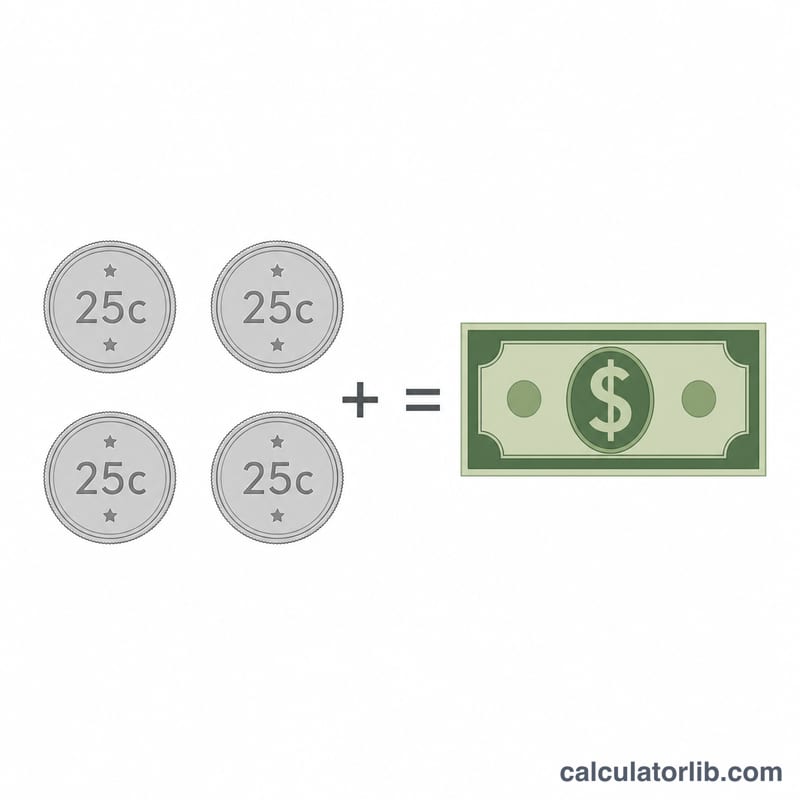
Because four quarters make one dollar, you can also think of it as dividing the number of quarters by 4. Both methods give the same answer. For example, \(40 \div 4 = \$10\), which matches \(40 \times 0.25 = \$10\).
Worked Example
Suppose you emptied a jar and counted 137 quarters. Multiply: $$137 \times 0.25 = \$34.25$$ So those 137 quarters are worth thirty-four dollars and twenty-five cents.
US Coin Value Conversion Table
Every US quarter dollar has a face value of exactly $0.25, so the conversion is a simple multiplication:
$$\text{Dollars} = \text{Number of Quarters} \times 0.25$$
The table below lists the counts people most often need — single coins, a standard US bank roll of 40 quarters, and larger jar or box quantities.
| Quarters | Value in dollars | Note |
|---|---|---|
| 1 | $0.25 | One quarter |
| 2 | $0.50 | Half dollar equivalent |
| 4 | $1.00 | One dollar |
| 10 | $2.50 | |
| 20 | $5.00 | Half a roll |
| 40 | $10.00 | One standard US bank roll |
| 100 | $25.00 | 2.5 rolls |
| 200 | $50.00 | 5 rolls |
| 400 | $100.00 | 10 rolls |
| 1,000 | $250.00 | 25 rolls |
Worked example — a coin jar holds 340 quarters:
$$\text{Dollars} = 340 \times 0.25 = \$85.00$$
That is $85.00, or 8 full rolls of 40 (=$80.00) with 20 loose quarters left over.
One quarter in other US denominations
| Equivalent of 1 quarter | Count |
|---|---|
| Pennies (1¢) | 25 |
| Nickels (5¢) | 5 |
| Dimes (10¢) | 2.5 |
| Quarters in $1.00 | 4 |
| Quarters in $5.00 | 20 |
All values on this page refer to United States coinage and to face value only. Collector, silver-content or error coins can be worth far more than face value — pre-1965 US quarters, for example, contain 90% silver and trade well above $0.25.
US Coin Roll and Denomination Reference
US banks wrap circulating coins in standard quantities, so knowing the roll contents lets you value a pile of coins without counting every piece. These are the standard US roll sizes and face values:
| Coin | Face value each | Coins per roll | Roll face value |
|---|---|---|---|
| Penny (cent) | $0.01 | 50 | $0.50 |
| Nickel | $0.05 | 40 | $2.00 |
| Dime | $0.10 | 50 | $5.00 |
| Quarter | $0.25 | 40 | $10.00 |
| Half dollar | $0.50 | 20 | $10.00 |
| Dollar coin | $1.00 | 25 | $25.00 |
Rolls, boxes and quarter quantities
| Quantity | Quarters | Face value |
|---|---|---|
| 1 roll | 40 | $10.00 |
| 5 rolls | 200 | $50.00 |
| 1 box (50 rolls) | 2,000 | $500.00 |
Quarter specifications (US Mint)
Since 1965 the circulating US quarter has been a copper–nickel clad coin: outer layers of 75% copper / 25% nickel bonded to a pure copper core, giving an overall composition of about 8.33% nickel, balance copper.
| Specification | Value |
|---|---|
| Face value | $0.25 |
| Weight | 5.670 g (0.200 oz) |
| Diameter | 24.26 mm (0.955 in) |
| Thickness | 1.75 mm |
| Edge | Reeded (119 reeds) |
| Composition | Cupronickel clad copper |
Weighing instead of counting
Because the nominal weight is fixed, you can estimate a count from total mass:
$$\text{Quarters} = \frac{ {\text{Total mass in grams}}}{5.670}$$
A bag weighing 1,134 g contains about \(1134 \div 5.670 = 200\) quarters, or $50.00. A full roll of 40 quarters weighs about \(40 \times 5.670 = 226.8\) g of coin, plus the paper wrapper. Treat weight-based counts as estimates: worn circulated coins lose a small amount of mass, and mint tolerance for the quarter is ±0.227 g per coin.
FAQ
How many quarters are in a dollar? Four. Each quarter is $0.25, and \(4 \times \$0.25 = \$1.00\).
How much is a standard roll of quarters worth? A standard US bank roll holds 40 quarters, which equals $10.00.
Does this work for older or collectible quarters? This calculator uses face value only ($0.25 each). Rare or silver quarters may be worth more to collectors, but their spendable value is still 25 cents.