
What Is the Cubic Feet to Pounds Calculator?
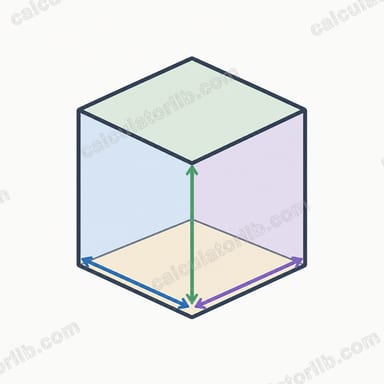
This tool converts a volume measured in cubic feet (ft³) into a weight measured in pounds (lb). Because volume and weight describe two different physical properties, the conversion depends on the density of the material you are measuring — how much mass is packed into each cubic foot. Once you supply that density, the calculator returns an instant weight estimate.
How to Use It
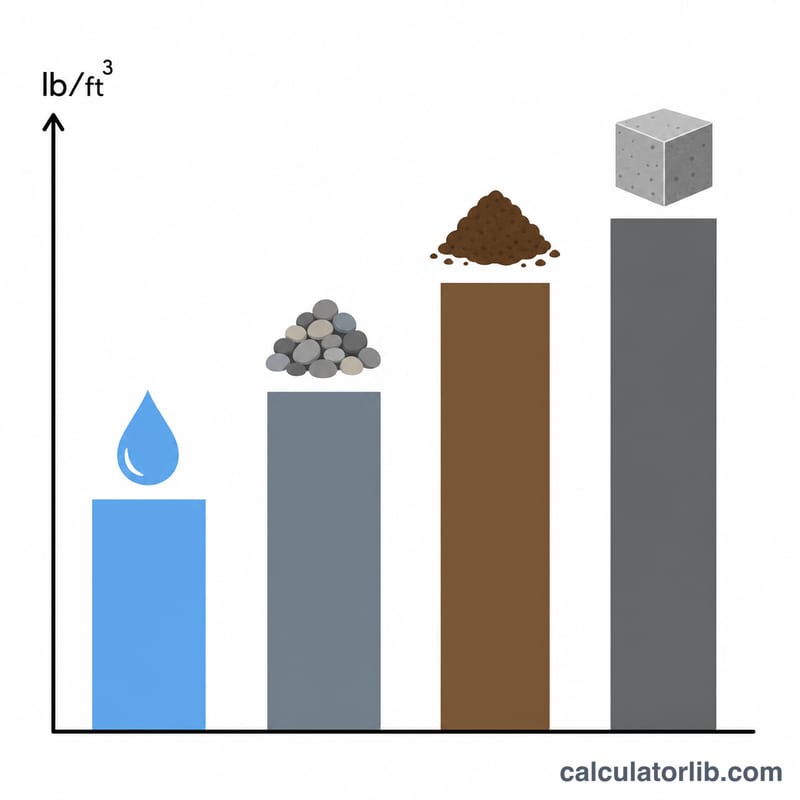
Enter the volume in cubic feet, then enter the density of your material in pounds per cubic foot (lb/ft³). Press calculate and the tool multiplies the two values. For reference, fresh water is about 62.4 lb/ft³, dry sand around 100 lb/ft³, gravel roughly 105 lb/ft³, and concrete near 150 lb/ft³.
The Formula Explained
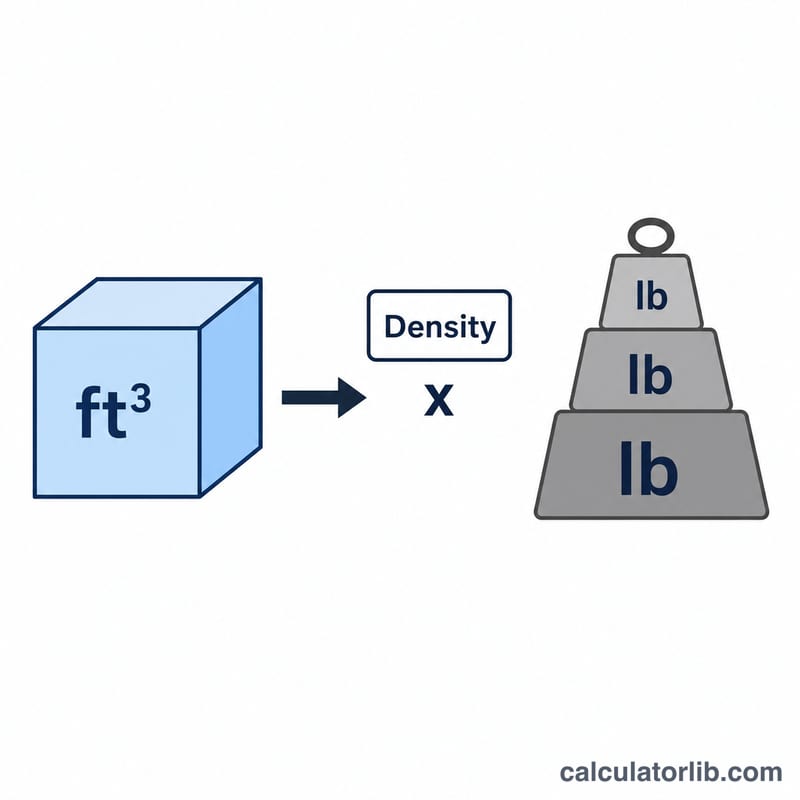
The conversion uses a simple relationship: $$\text{Pounds} = \text{Volume (ft}^3\text{)} \times \text{Density (lb/ft}^3\text{)}$$ Volume tells you how much space the material occupies, and density tells you the weight of one cubic foot. Multiplying them gives the total weight. Higher-density materials like metal or concrete weigh far more per cubic foot than light materials like foam or mulch.
Worked Example
Suppose you have a 10 ft³ container filled with water. Water has a density of 62.4 lb/ft³. The weight is $$10 \times 62.4 = 624 \text{ pounds}$$ If you instead filled it with dry sand at 100 lb/ft³, the weight would be \(10 \times 100 = 1{,}000\) pounds.
FAQ
Why do I need the density? A cubic foot of feathers and a cubic foot of lead occupy the same space but weigh very differently. Density bridges the gap between volume and weight.
Where do I find a material's density? Material density tables online list lb/ft³ values for water, soil, sand, gravel, concrete, wood and metals. Use the value that matches your specific material and moisture content.
Is this exact? It is as accurate as your density figure. Real-world materials vary with compaction, moisture and temperature, so treat the result as a close estimate.