What This Calculator Does
This calculator finds the volume of a cylinder expressed in cubic feet (ft³). You provide the cylinder's diameter and height in feet, and it returns the total internal volume — handy for sizing tanks, pipes, silos, columns, water heaters, and concrete pours. It works for any units of measurement as long as they are in feet; if your dimensions are in inches, divide by 12 first.
How to Use It
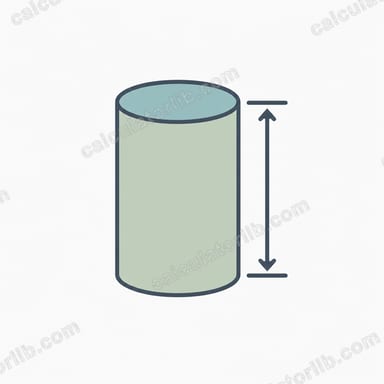
Enter the diameter across the circular face of the cylinder and the height (or length) of the cylinder, both in feet. Click calculate to see the volume in cubic feet along with the computed radius. For a tank measured in inches, convert each measurement to feet first (inches ÷ 12).
The Formula Explained
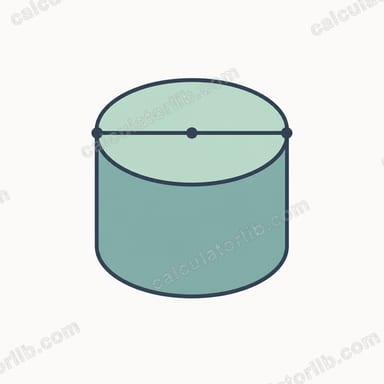
A cylinder's volume equals the area of its circular base multiplied by its height. The base area of a circle is \(\pi r^2\), where \(r\) is the radius. So the full formula is $$V = \pi \times r^2 \times h$$ Because diameter is easier to measure than radius, this tool takes the diameter and halves it: \(r = d \div 2\).

Worked Example
Suppose a cylindrical tank has a diameter of 2 ft and a height of 5 ft. The radius is \(2 \div 2 = 1\) ft. The volume is $$V = \pi \times 1^2 \times 5 = \pi \times 5 \approx 15.708 \text{ cubic feet}.$$ That means the tank holds about 15.71 ft³.
Cubic Feet Conversion Table
Use these factors to convert a volume in cubic feet (ft³) into other common units. The gallon figure is the US liquid gallon.
| From | To | Factor |
|---|---|---|
| 1 cubic foot | US gallons | 7.4805 |
| 1 cubic foot | Liters | 28.3168 |
| 1 cubic foot | Cubic inches | 1,728 |
| 1 cubic foot | Cubic yards | 0.037037 (1/27) |
| 1 cubic foot | Cubic meters | 0.0283168 |
The calculator expects diameter and height in feet. To convert inches to feet, divide by 12: \(\text{feet} = \text{inches} \div 12\).
| Diameter (in) | Diameter (ft) |
|---|---|
| 6 in | 0.5 ft |
| 12 in | 1 ft |
| 18 in | 1.5 ft |
| 24 in | 2 ft |
| 36 in | 3 ft |
| 48 in | 4 ft |
Cylinder Volume for Common Sizes
Each volume is computed with \(V = \pi \left(\frac{d}{2}\right)^2 h\), where \(d\) is the diameter and \(h\) is the height, both in feet.
Worked example (2 ft × 5 ft): the radius is \(2 / 2 = 1\) ft, so \(V = \pi \times 1^2 \times 5 = 5\pi \approx 15.708\) ft³. In US gallons that is about \(15.708 \times 7.4805 \approx 117.5\) gal.
Because the diameter is squared, doubling the diameter quadruples the volume (for the same height), while doubling the height only doubles it. For example, going from 1 ft × 3 ft (2.356 ft³) to 2 ft × 3 ft gives \(4 \times 2.356 = 9.425\) ft³.
Practical Tips for Using Your Volume Result
- Concrete pours: add about 5-10% extra to cover spillage, uneven ground and slightly over-dug holes.
- Ordering concrete: concrete is usually sold by the cubic yard, so divide cubic feet by 27. For example, a 3 ft × 6 ft cylinder of 42.412 ft³ is \(42.412 / 27 \approx 1.571\) yd³ before adding extra.
- Tank capacity: measure internal dimensions (inside diameter and inside height), not outside ones, because wall thickness reduces the usable volume.
- Liquid tanks: leave headspace for expansion, foaming or sloshing instead of filling to the full calculated volume.
- Ordering materials: round up to the next whole unit (bag, yard, drum) so you do not come up short.
- Check your units: convert inches to feet (÷12) before entering values, and measure diameter across the widest point through the center.
This is general information to help you plan; for structural, engineering or safety-critical projects, consult a qualified professional.
FAQ
How do I convert cubic feet to gallons? Multiply cubic feet by 7.48 to get US gallons. The example above (15.708 ft³) is about 117.5 gallons.
My measurements are in inches — what do I do? Divide each measurement by 12 to convert to feet before entering them, since this calculator expects feet.
Does it matter whether I call it height or length? No. For a horizontal cylinder, the "height" field is simply the length along the axis; the formula is the same.