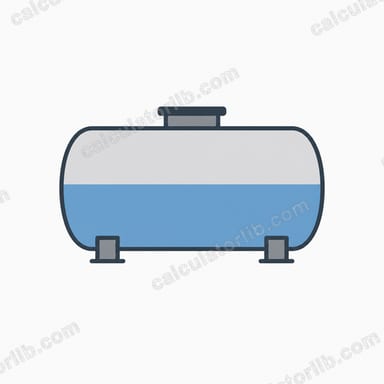
What is the Cylinder Volume in Liters Calculator?
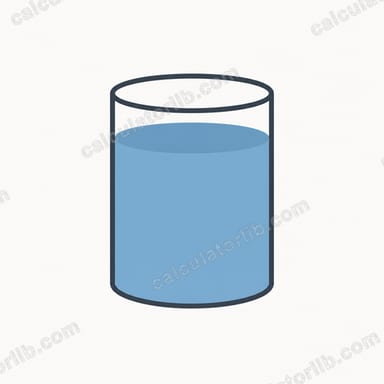
This calculator finds how much liquid a cylindrical container can hold, expressed in liters. You enter the cylinder's radius and height in centimeters, and it computes the volume using the standard geometry formula and converts the result to liters. It is useful for tanks, pipes, drums, water bottles, aquariums, and any cylindrical vessel.
How to use it
Measure the inside radius of the cylinder (half of the diameter) and its height, both in centimeters. Enter the two values and the calculator instantly returns the capacity in liters, plus the equivalent volume in cubic centimeters. If you only know the diameter, divide it by 2 to get the radius.
The formula explained
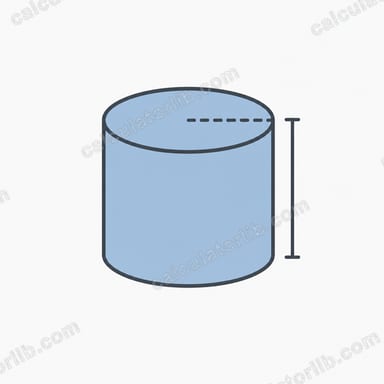
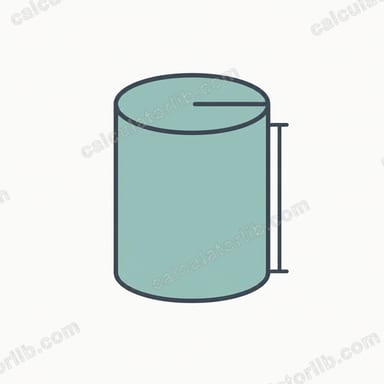
The volume of a cylinder is the area of its circular base multiplied by its height: $$V = \pi \times r^{2} \times h.$$ With \(r\) and \(h\) in centimeters, \(V\) comes out in cubic centimeters (cm³). Because 1 liter equals exactly 1000 cm³, dividing by 1000 converts the result into liters: $$\text{Liters} = \pi \times r^{2} \times h \div 1000.$$

Worked example
Suppose a tank has a radius of 10 cm and a height of 20 cm. The volume is $$\pi \times 10^{2} \times 20 = \pi \times 100 \times 20 = 6283.19 \text{ cm}^{3}.$$ Dividing by 1000 gives about 6.283 liters of capacity.

Cylinder Capacity for Common Sizes
The calculator uses \(V_{\text{L}} = \frac{\pi r^2 h}{1000}\), with radius and height in centimeters. The table shows typical cylinders, with volume in cm³ and in liters (1 L = 1000 cm³).
| Example object | Radius (cm) | Height (cm) | Volume (cm³) | Volume (L) |
|---|---|---|---|---|
| Drink can (approx.) | 4 | 12 | 603.19 | 0.603 |
| Small container | 5 | 10 | 785.40 | 0.785 |
| Bucket-sized cylinder | 10 | 20 | 6,283.19 | 6.283 |
| Drum (200–250 L class) | 30 | 90 | 254,469.00 | 254.469 |
| Large tank | 50 | 100 | 785,398.16 | 785.398 |
Worked check for r = 10 cm, h = 20 cm: \(\pi \times 10^2 \times 20 = 2000\pi \approx 6283.19\) cm³, and \(6283.19 / 1000 \approx 6.283\) L.
Scaling: volume grows with the square of the radius but only linearly with height. Starting from r = 10 cm, h = 20 cm (6.283 L):
- Doubling the radius to 20 cm gives \(\pi \times 20^2 \times 20 / 1000 \approx 25.133\) L, which is 4 times as much.
- Doubling the height to 40 cm gives \(\pi \times 10^2 \times 40 / 1000 \approx 12.566\) L, which is 2 times as much.
Note that the radius is half the diameter. If you measure across the cylinder, divide by 2 first. Real containers have wall thickness, so use the inner radius and inner height to get usable capacity.
Volume Unit Conversions
| Volume unit | Equivalent |
|---|---|
| 1 liter (L) | 1000 cm³ = 1 dm³ = 0.001 m³ |
| 1 milliliter (mL) | 1 cm³ |
| 1 liter | ≈ 0.264172 US gallons |
| 1 liter | ≈ 0.219969 imperial (UK) gallons |
| 1 liter | ≈ 33.814 US fluid ounces |
| Length unit | In centimeters |
|---|---|
| 1 millimeter (mm) | 0.1 cm |
| 1 meter (m) | 100 cm |
| 1 inch (in) | 2.54 cm |
| 1 foot (ft) | 30.48 cm |
Convert all lengths to centimeters before entering them. For example, a cylinder 8 in across has a diameter of \(8 \times 2.54 = 20.32\) cm, so its radius is 10.16 cm.
To convert the result, multiply liters by the factor above. For example, 6.283 L × 0.264172 ≈ 1.660 US gallons.
FAQ
Do I use radius or diameter? Use the radius. If you measured the diameter, halve it first.
What if my measurements are in millimeters? Divide each measurement by 10 to convert mm to cm before entering it.
Is this the inside or outside volume? Use the internal dimensions to get the true holding capacity; using outside dimensions slightly overestimates capacity because it ignores wall thickness.