
What Is a Cuboid Surface Area Calculator?
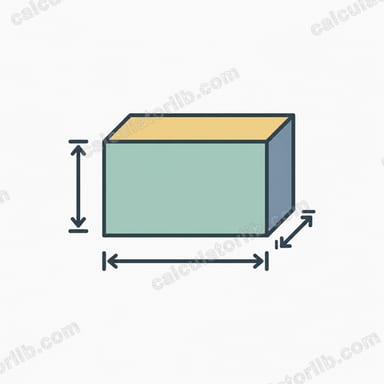
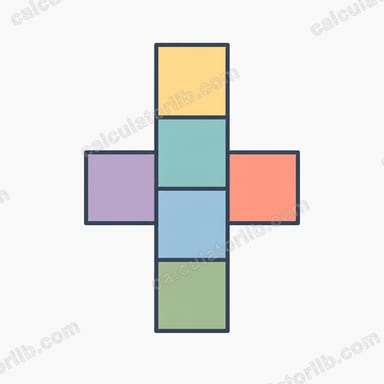
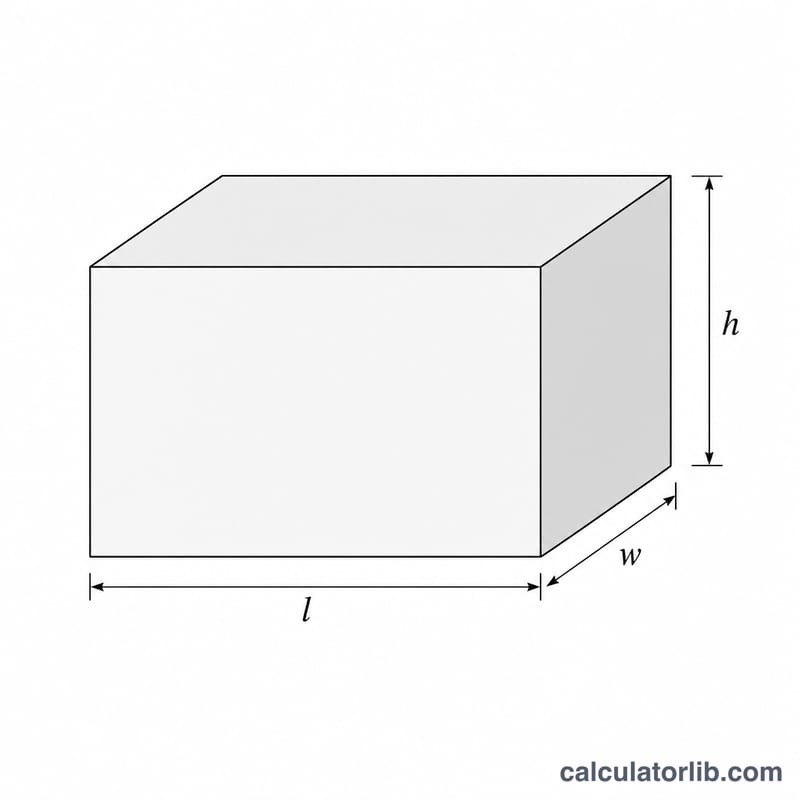
A cuboid (also called a rectangular box or rectangular prism) is a three-dimensional solid bounded by six rectangular faces. This calculator finds the total surface area — the combined area of all six faces — from the length, width, and height. The surface area tells you how much material is needed to cover or wrap the box, how much paint a wall-like surface requires, or how much packaging a product needs.
How to Use It
Enter the length, width, and height of the cuboid in the same unit (centimeters, inches, meters, etc.). The result is given in square units. The calculator also shows the volume (in cubic units) and the space diagonal as helpful extras.
The Formula Explained
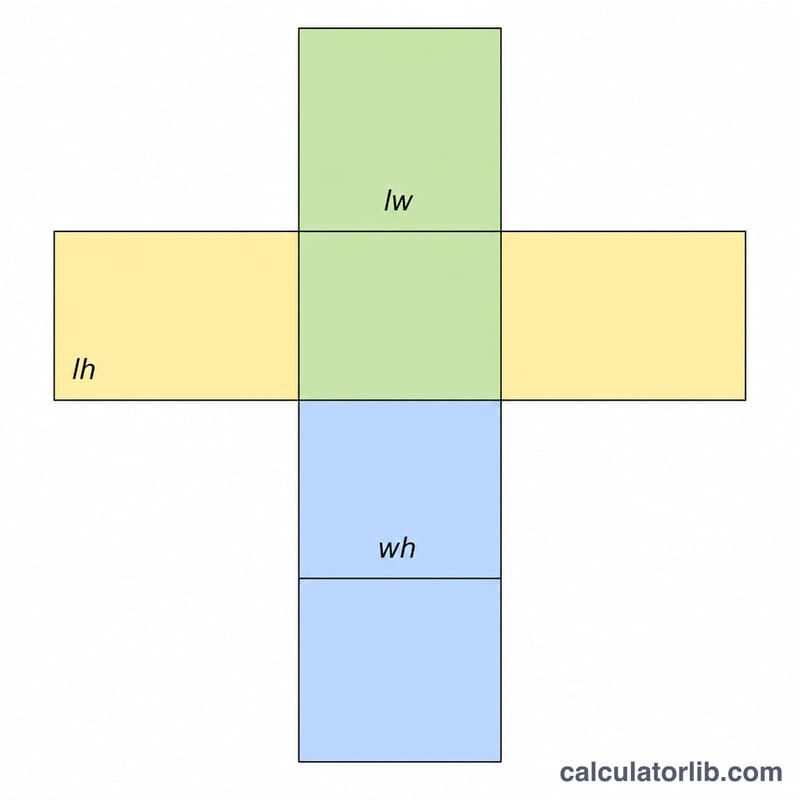
A cuboid has three pairs of identical opposite faces. The pairs have areas \(lw\), \(lh\), and \(wh\). Adding one of each gives the area of three faces; doubling accounts for the matching opposite faces:
$$SA = 2(lw + lh + wh)$$
If all three dimensions are equal (\(l = w = h = a\)), the cuboid becomes a cube and the formula reduces to \(SA = 6a^2\).
Worked Example
Suppose a box measures \(5 \times 4 \times 3\) units. Then:
\(lw = 5 \times 4 = 20\), \(lh = 5 \times 3 = 15\), \(wh = 4 \times 3 = 12\). Sum = 47.
$$SA = 2 \times 47 = 94 \text{ square units}.$$
Its volume is \(5 \times 4 \times 3 = 60\) cubic units, and the space diagonal is \(\sqrt{25 + 16 + 9} = \sqrt{50} \approx 7.07\) units.
FAQ
Does unit matter? Use the same length unit for all three inputs; the surface area comes out in the square of that unit and volume in its cube.
What if it's a cube? Enter the same value for length, width, and height — the formula automatically gives \(6 \times \text{side}^2\).
What is the space diagonal? It is the longest straight line through the box, from one corner to the opposite corner, computed as \(\sqrt{l^2 + w^2 + h^2}\).