
What this calculator does
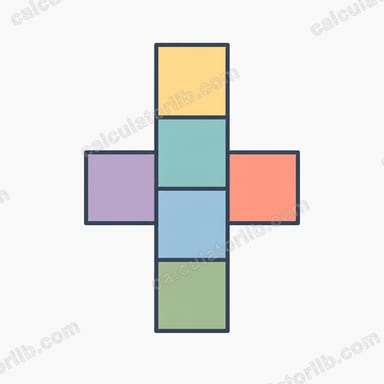
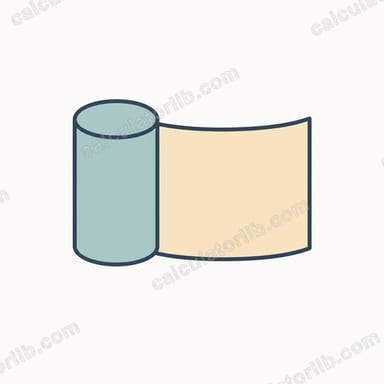
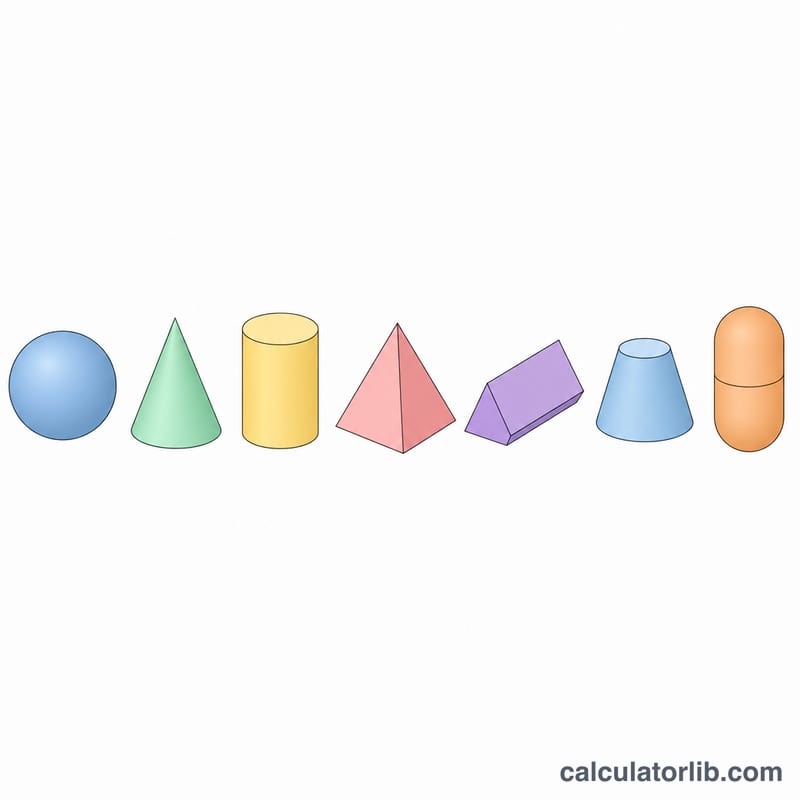
This tool computes the surface area of eleven common three-dimensional solids: sphere, cube, cylinder, cone, conical frustum, square pyramid, rectangular prism (cuboid), triangular prism, hemisphere, capsule and spherical cap. For each shape it reports the total surface area and, where they are separately defined, the lateral (side) surface area and the bottom (base) surface area. All inputs use one chosen length unit and results are returned in that unit squared.
How to use it
Pick a shape from the dropdown, enter the dimensions that shape needs, choose a length unit (km, m, cm, mm, mi, yd, ft, in), and select how many significant figures to round to (or "auto" for full precision). Because every length for a given shape shares the same unit, areas come out directly in that unit squared — no conversion is needed.
The formula
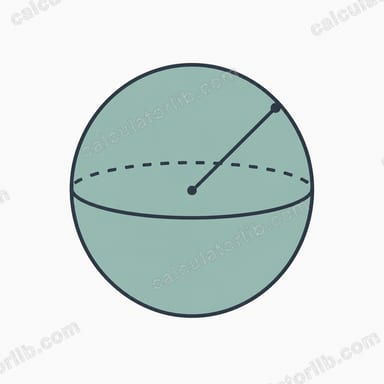
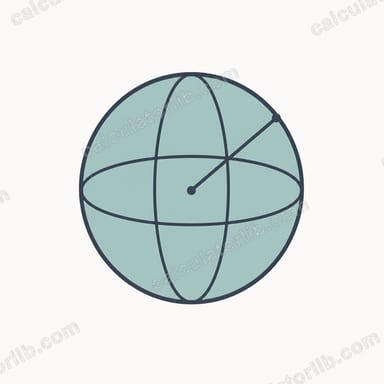
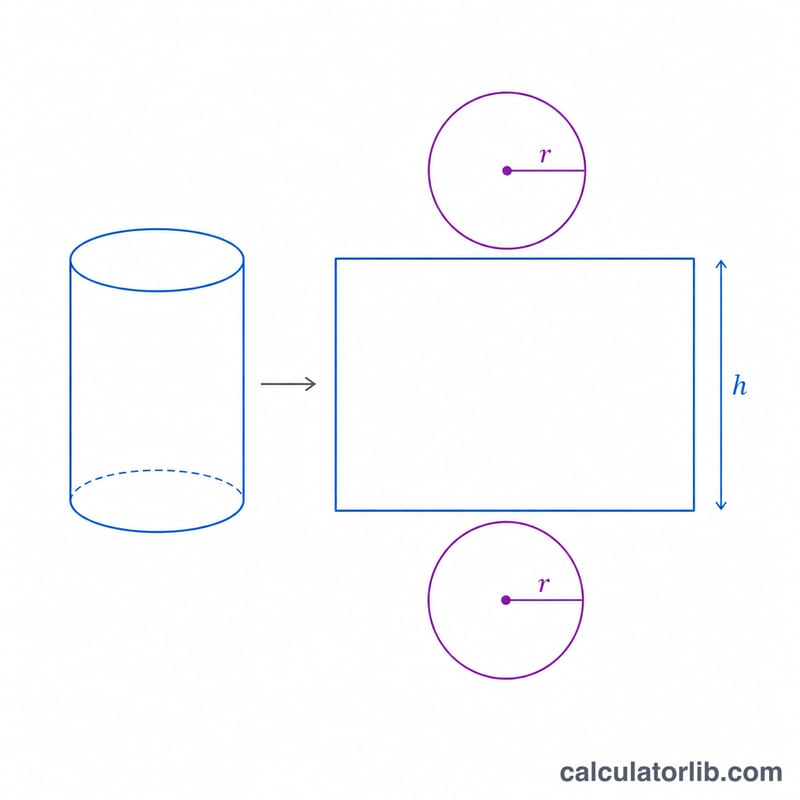
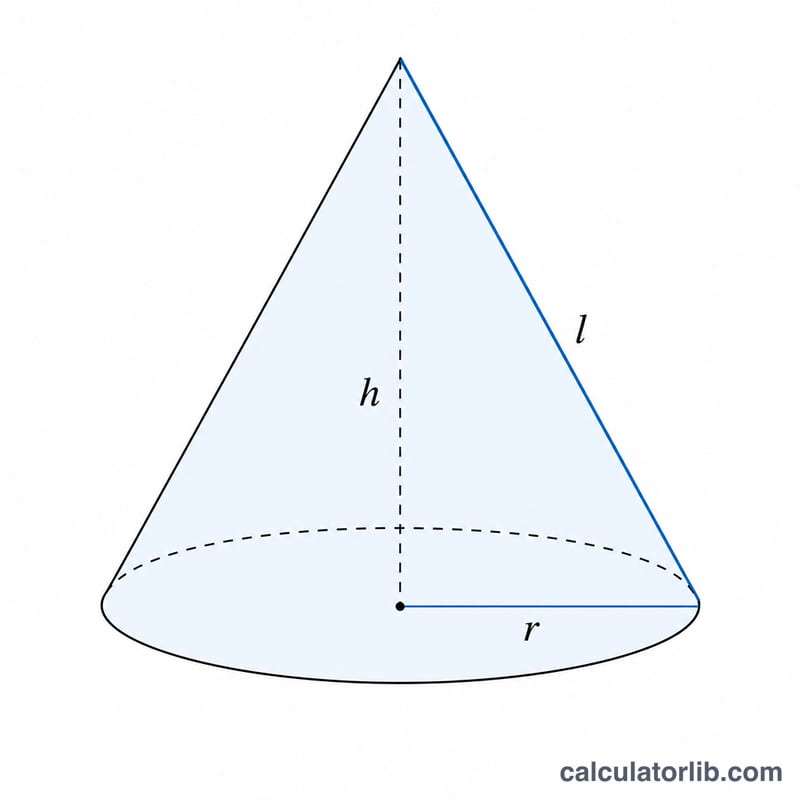
Surface area is built from a base and the surrounding lateral faces, so in general $$S_{tot} = S_{lat} + S_{bot}$$ For curved solids the lateral part uses \(\pi\). For example a cone of radius \(r\) and height \(h\) has slant length \(l = \sqrt{r^2+h^2}\), lateral area \(\pi r l\) and base \(\pi r^2\). A sphere has only a single closed surface, \(4\pi r^2\), with no separate base. A triangular prism uses Heron's formula for its two triangular ends.
Worked example
Square pyramid with base side \(a = 5\) cm and height \(h = 8\) cm. The face slant height is $$l = \sqrt{8^2 + 2.5^2} = \sqrt{70.25} = 8.38153$$ Base \(S_{bot} = 25\) cm². Lateral $$S_{lat} = 2\cdot 5\cdot 8.38153 = 83.8153 \text{ cm}^2$$ Total $$S_{tot} = 25 + 83.8153 = 108.815 \text{ cm}^2$$
FAQ
What is lateral surface area? It is the area of the side faces only, excluding the top and bottom bases.
Why does a sphere show no bottom area? A sphere is a single closed surface with no flat base, so only the total is meaningful. The same applies to the curved capsule.
What if my triangle sides are invalid? The three sides of a triangular prism base must satisfy the triangle inequality (each side less than the sum of the other two); otherwise no real triangle exists and the calculator reports an error.