What this calculator does
The Animal Gestation Due Date Calculator estimates when an animal is likely to give birth (or when eggs are likely to hatch) based on the breeding or setting date and a species-typical gestation or incubation length. It can also run in reverse: enter a target due date and it tells you the breeding date you would need. The biology of gestation is the same everywhere, so this tool is universal and not tied to any country or region.
How to use it
Pick the animal from the dropdown. The gestation period field auto-fills with that species' average length in days (for example 283 days for a cow), which you can override with your own value. Choose whether the date you are entering is the Breeding Date or the Due Date, enter the date, and the calculator does the rest. The helper note beside each option lists the typical day range, since individual animals vary.
The formula explained
This is pure calendar arithmetic. In breeding-date mode the result is simply the breeding date plus the gestation period in days:
$$\text{Due Date} = \text{Breeding Date} + \text{Gestation (days)}$$
In due-date mode the result is the due date minus the gestation period:
$$\text{Breeding Date} = \text{Due Date} - G$$
The math correctly accounts for varying month lengths and leap years by counting actual calendar days rather than adding months.
Worked example
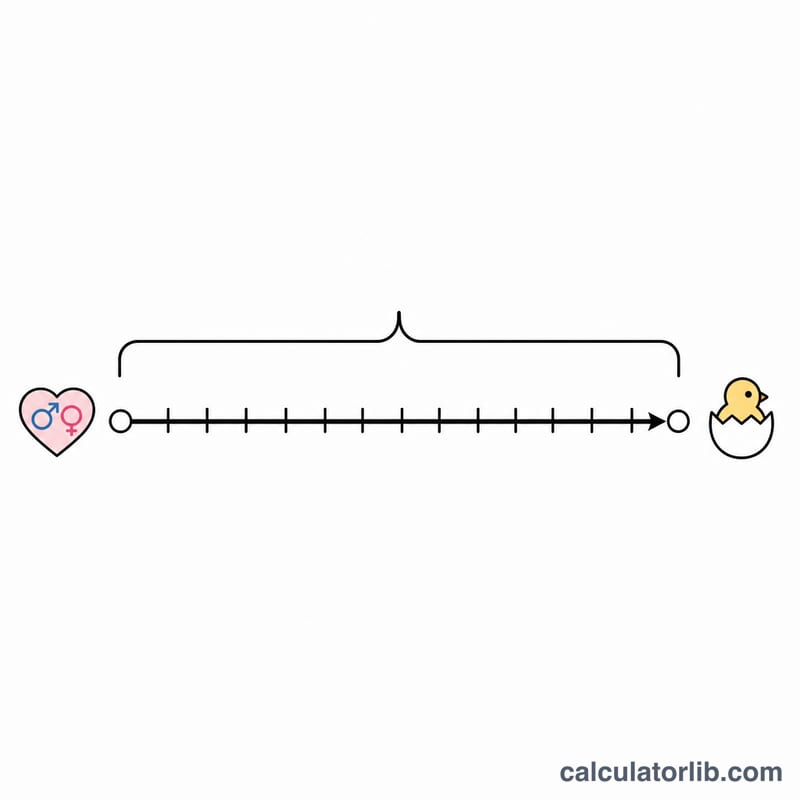
A cow is bred on 15 June 2026 with the default 283-day gestation. Adding 283 days lands on 25 March 2027. That period equals 40 weeks plus 3 days. Running it in reverse — due date 25 March 2027 minus 283 days — returns 15 June 2026, confirming the result.
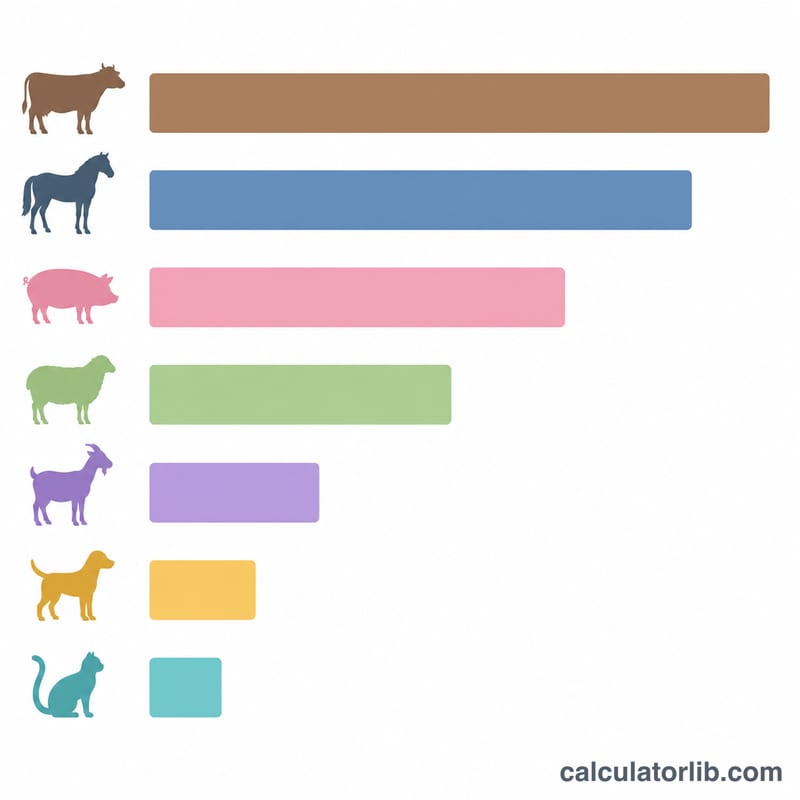
Average Gestation and Incubation Periods by Species
The table lists typical average values, counted from the breeding date (or from the start of incubation for eggs). Individual animals vary, so treat each figure as a midpoint, not a guarantee. Weeks are rounded from the average in days, using \(W = \lfloor \text{days}/7 \rfloor\) and \(D = \text{days} \bmod 7\).
| Species | Average (days) | Typical range (days) | Approx. weeks / months |
|---|---|---|---|
| Cow | 283 | — | 40 weeks 3 days (about 9 months) |
| Horse (mare) | 340 | — | 48 weeks 4 days (about 11 months) |
| Sheep (ewe) | 150 | — | 21 weeks 3 days (about 5 months) |
| Goat (doe) | 150 | — | 21 weeks 3 days (about 5 months) |
| Pig (sow) | 114 | — | 16 weeks 2 days (about 3 months, 3 weeks, 3 days) |
| Dog | 63 | 58–72 | 9 weeks (about 2 months) |
| Cat | 65 | — | about 9 weeks |
| Rabbit | 31 | — | 4 weeks 3 days |
| Guinea pig | about 68 | 59–72 | about 9 weeks 5 days |
| Hamster (Syrian) | about 16 | 16–19 | about 2 weeks 2 days (dwarf species are often slightly longer) |
| Chicken (egg incubation) | 21 | — | 3 weeks |
| Quail (Japanese, egg incubation) | 16 | — | 2 weeks 2 days (other quail species can take longer) |
Egg incubation is the time from setting the eggs to hatching, and it depends on correct temperature and humidity. A mammal's gestation is measured from breeding, which is not exactly the same as conception (see below).
Interpreting Your Due Date
The calculator adds an average gestation length to your breeding date: \(\text{Due Date} = \text{Breeding Date} + \text{Gestation (days)}\). The result is a midpoint estimate, not a fixed deadline. Many healthy births happen several days before or after it, and the ranges in the table above show the usual window for each species. Horses have an especially wide window, and normal foalings can occur weeks either side of 340 days.
Factors that shift timing
- Breed: Breeds within a species can differ. Draft and light horse breeds, beef and dairy cattle, and small and large dog breeds do not all average the same length.
- Litter size: Larger litters tend to arrive slightly earlier in species such as dogs, pigs and rabbits, while single or very small litters may run a little longer.
- Parity: First-time mothers can differ from experienced ones, and some species show small, consistent differences.
- Sex of the offspring: In cattle, bull calves are often carried a day or two longer than heifer calves on average.
- Season: Daylight and temperature can affect gestation, for example in mares, where the time of year of conception is associated with shorter or longer pregnancies.
- Uncertain breeding date: With multiple matings or a breeding window spread over several days, the true date could be any of them. If unsure, use the first and last dates to estimate a range.
Breeding date vs. conception or ovulation date
A breeding date is when mating or insemination occurred. Conception happens afterwards, when an egg is fertilised. In dogs, sperm can survive for several days and the eggs are fertilised only after ovulation and maturation, so the interval from a single mating to birth can vary by several days even though the interval from ovulation is more consistent (about 63 days). In cats, mating triggers ovulation, which follows within a day or two. In other species, ovulation timing relative to breeding also varies. For this reason, a calculator based on the breeding date is less precise than one based on a confirmed ovulation date.
Confirming timing
A veterinary exam, ultrasound, hormone testing or imaging can confirm pregnancy and refine the expected date. This article gives general information only and is not individual veterinary advice. If an animal passes the end of its normal window, or shows signs of distress, contact a veterinarian rather than relying on the calculated date.
FAQ
How accurate is this? The defaults are standard veterinary averages. Real gestation varies by breed, litter size, and individual, so use the displayed range as a guide and confirm with a vet or ultrasound.
Does it work for birds? Yes. For chickens and quail the "gestation period" is the incubation period (about 21 and 16 days respectively), and the same date math applies.
Can I use my own gestation length? Absolutely — just type any whole number of days greater than zero into the Gestation Period field after selecting the animal.