
What Is the IVF Due Date Calculator?
For pregnancies conceived through in vitro fertilization (IVF), the conception date is known precisely — making the due date estimate more accurate than for natural conception. This calculator works backward from the exact embryo transfer date and the age of the embryo when it was transferred to project a 40-week gestation due date.
How to Use It
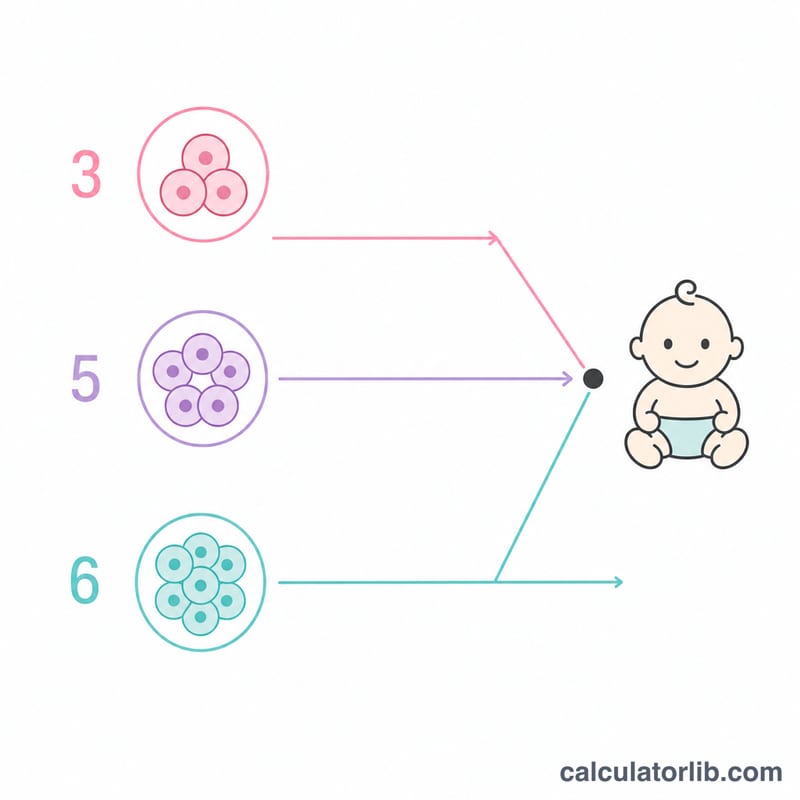
Enter the date your embryo was transferred and select the embryo's age at transfer: a Day-3 cleavage-stage embryo, a Day-5 blastocyst, or a Day-6 blastocyst. The calculator adds the appropriate number of days to estimate your due date and also shows the equivalent last menstrual period (LMP) date used in standard pregnancy tracking.
The Formula Explained
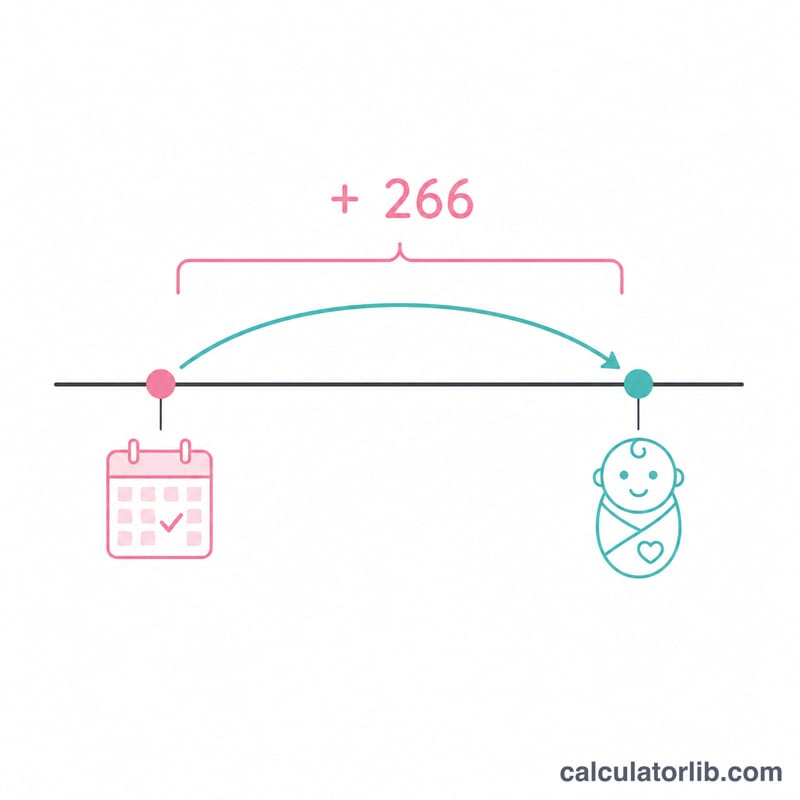
A full-term pregnancy averages 266 days from conception (ovulation/fertilization). In IVF, fertilization happens in the lab, so we count from there. The embryo's age at transfer is subtracted because those days have already passed: $$\text{Due Date} = \text{Transfer Date} + \left(266 - \text{Embryo Age}\right)\ \text{days}$$ A Day-5 blastocyst therefore adds \(266 - 5 = 261\) days.
Worked Example
Suppose your Day-5 blastocyst was transferred on January 1, 2024. We add 261 days: January 1 + 261 days lands on September 18, 2024 — your estimated due date. The equivalent LMP would be 280 days earlier, around December 12, 2023.
FAQ
Is the due date exact? No. It is an estimate; only about 4% of babies arrive on the exact due date. Most full-term births occur within two weeks either side.
Why is IVF more accurate? Because the conception date is known to the day, eliminating the uncertainty of estimating ovulation in natural conception.
Does frozen vs fresh transfer matter? No — what matters is the embryo's age (Day-3, 5, or 6) at the moment of transfer, not whether it was frozen beforehand.