
What This Calculator Does
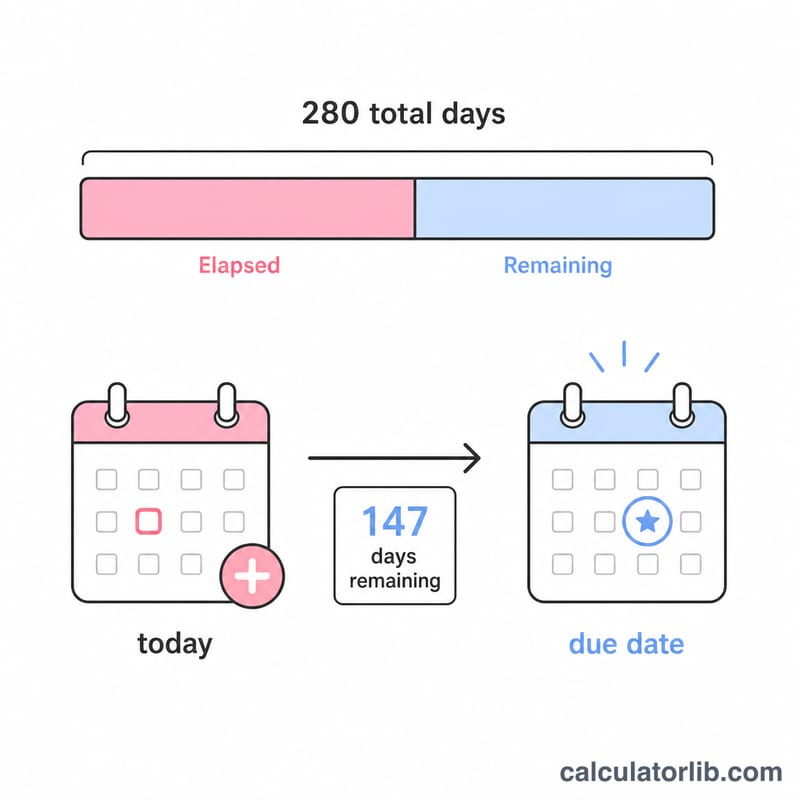
This tool converts how far along you are in your pregnancy into an estimated due date (EDD). It assumes a standard full-term pregnancy of 40 weeks, or 280 days, counted from the first day of your last menstrual period. Enter your current gestational age in weeks and extra days, and it tells you how many days are left and projects a due date by adding those days to today.
How to Use It
Enter the number of completed weeks pregnant (0–42) and any additional days (0–6). The calculator subtracts your progress from 280 days to find the days remaining, then converts that into weeks and days and an estimated due date.
The Formula Explained
A 40-week pregnancy equals 280 days. Days already pregnant = \(\text{weeks} \times 7 + \text{days}\). Days remaining = \(280 - \text{days pregnant}\). The due date is today's date plus the days remaining. If you are already at or past 40 weeks, days remaining is shown as 0.
$$\text{Due Date} = \text{Today} + (280 - \text{weeks} \times 7 - \text{days})\ \text{days}$$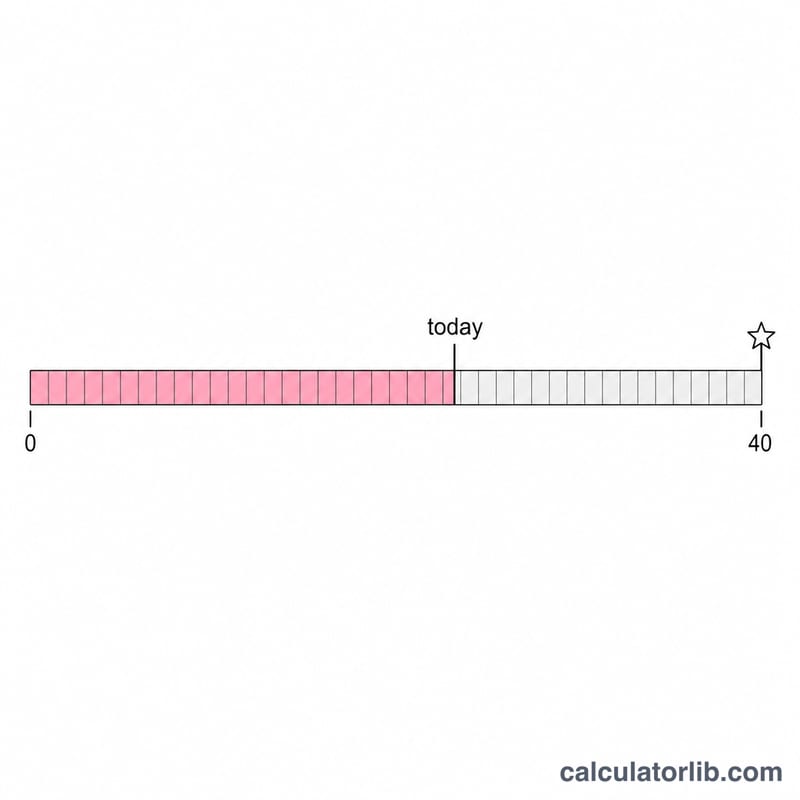
Worked Example
Suppose you are 12 weeks and 0 days pregnant. Days pregnant = \(12 \times 7 + 0 = 84\) days. Days remaining =
$$280 - 84 = 196\ \text{days}$$which is 28 weeks and 0 days. Adding 196 days to today gives your estimated due date.
FAQ
Is this medically accurate? It is an estimate based on the standard 280-day rule. Only about 5% of babies arrive exactly on the due date; your provider's ultrasound dating is more precise.
Why 280 days? Naegele's rule counts 40 weeks (280 days) from the first day of the last menstrual period.
What if I'm past 40 weeks? Days remaining shows 0 and the due date is today, since the estimated term has been reached.