
What the Bedtime Calculator does
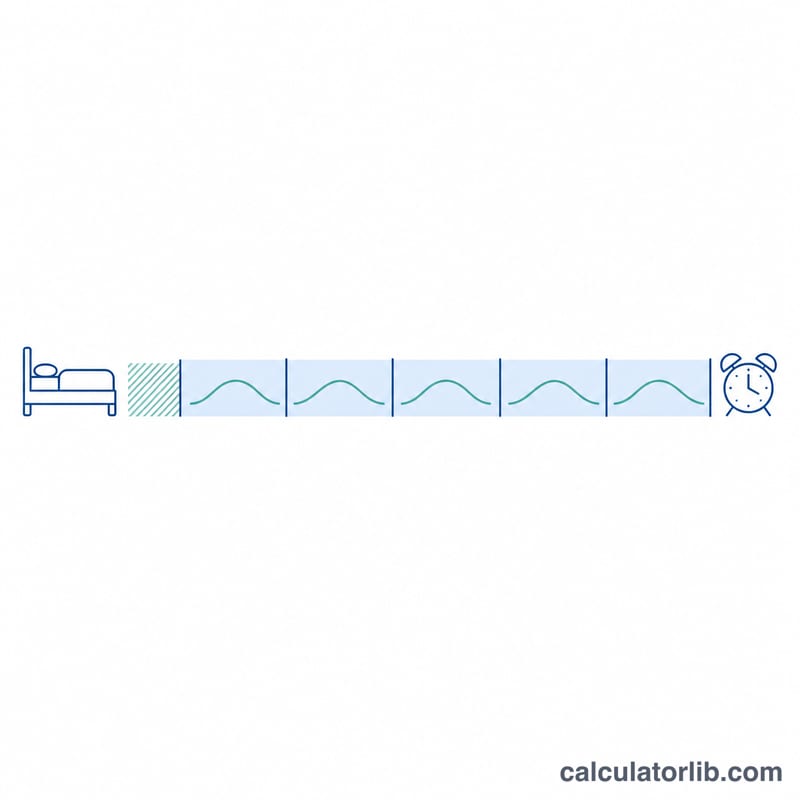
This tool tells you the best times to fall asleep so you wake up at the end of a complete sleep cycle rather than in the middle of deep sleep. Waking between cycles helps you feel refreshed instead of groggy. Enter your target wake-up time and the calculator works backward through full 90-minute cycles, adding a buffer for the time it takes you to drift off.
How to use it
Pick your wake-up hour, minute and AM/PM, then set how many minutes you usually need to fall asleep (15 minutes is the common default). The result shows four recommended bedtimes corresponding to 6, 5, 4 and 3 complete sleep cycles — roughly 9, 7.5, 6 and 4.5 hours of sleep. Most adults do best with 5–6 cycles.
The formula explained
A typical sleep cycle lasts about 90 minutes. To wake at the end of a cycle, your total time asleep should be a multiple of 90 minutes. We also add the time you spend falling asleep:
$$\text{bedtime} = \text{wakeTime} - (n \times 90\,\text{min} + \text{fall-asleep minutes})$$
where \(n\) is the number of cycles.
Worked example
Suppose you want to wake at 7:00 AM and take 15 minutes to fall asleep. For 6 cycles: \(6 \times 90 = 540\) minutes (9 hours) plus 15 minutes \(= 555\) minutes. Subtracting 555 minutes from 7:00 AM (420 minutes after midnight) gives \(-135\) minutes, which wraps to \(1{,}305\) minutes \(=\) 9:45 PM. So you should be in bed by 9:45 PM.
Recommended Sleep by Age
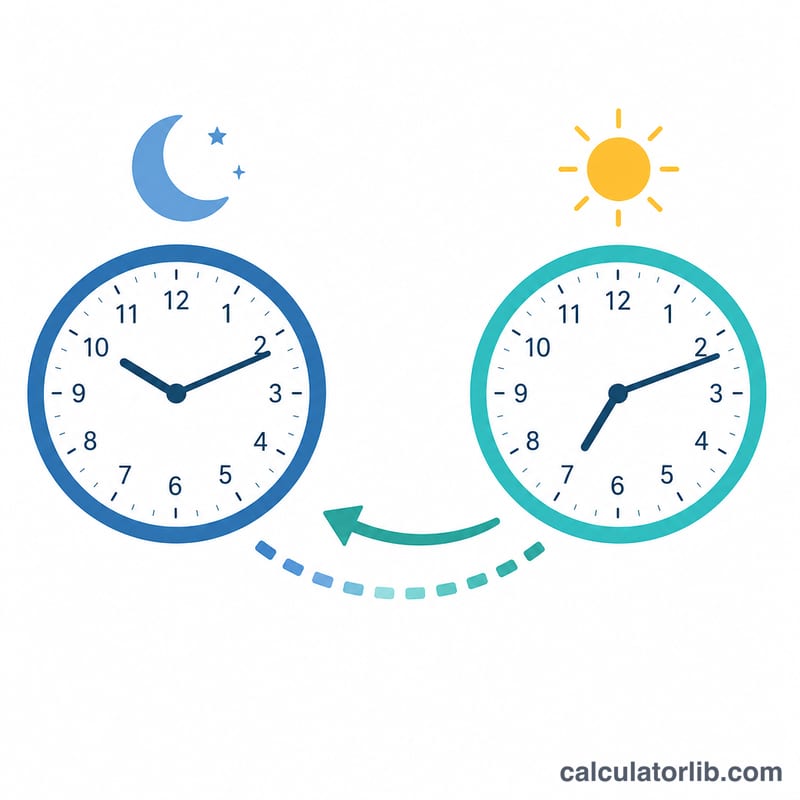
The amount of sleep a person needs changes with age. The ranges below come from the National Sleep Foundation's expert consensus recommendations for daily sleep duration (including naps). Use them to decide how many 90-minute cycles to target with the bedtime calculator.
| Age group | Age range | Recommended sleep per day |
|---|---|---|
| Newborn | 0–3 months | 14–17 hours |
| Infant | 4–11 months | 12–15 hours |
| Toddler | 1–2 years | 11–14 hours |
| Preschool | 3–5 years | 10–13 hours |
| School-age | 6–13 years | 9–11 hours |
| Teenager | 14–17 years | 8–10 hours |
| Young adult | 18–25 years | 7–9 hours |
| Adult | 26–64 years | 7–9 hours |
| Older adult | 65+ years | 7–8 hours |
Source: National Sleep Foundation sleep-duration recommendations. For most adults, six 90-minute cycles totals 9 hours and five cycles totals 7.5 hours of sleep — both fall within the recommended 7–9 hour window. This is general information, not personalized medical advice; consult a clinician about persistent sleep problems.
Bedtimes for Common Wake Times
The table shows suggested bedtimes for typical morning wake times, assuming it takes about 15 minutes to fall asleep. A 6-cycle night provides 9 hours of sleep and a 5-cycle night provides 7.5 hours; the listed bedtime already adds the 15-minute fall-asleep buffer so the cycles start when you are actually asleep.
| Wake time | Bedtime for 6 cycles (9h) | Bedtime for 5 cycles (7.5h) |
|---|---|---|
| 6:00 AM | 8:45 PM | 10:15 PM |
| 6:30 AM | 9:15 PM | 10:45 PM |
| 7:00 AM | 9:45 PM | 11:15 PM |
| 7:30 AM | 10:15 PM | 11:45 PM |
To check how many complete cycles a given bedtime actually delivers, see the sleep cycles calculator. Worked check for the 7:00 AM, 5-cycle row: \(5 \times 90 + 15 = 465\) minutes = 7 hours 45 minutes before 7:00 AM gives a bedtime of 11:15 PM.
Key Terms Explained
- Sleep cycle
- One full progression through the stages of sleep — light sleep, deep (slow-wave) sleep, and REM sleep. A cycle averages about 90 minutes, which is why bedtimes are spaced in 90-minute increments so you wake near the end of a cycle.
- Sleep latency (fall-asleep time)
- The time it takes to transition from being fully awake to asleep after lying down. A typical healthy value is 10–20 minutes; this calculator defaults to a 15-minute allowance, which is added to your target sleep duration.
- REM sleep
- Rapid Eye Movement sleep, the stage associated with vivid dreaming, memory consolidation, and learning. REM periods lengthen across the night, so the longest REM occurs in the final cycles before waking.
- Deep (slow-wave) sleep
- The deepest non-REM stage, marked by slow delta brain waves. It dominates the early cycles of the night and is most important for physical restoration and feeling refreshed.
- Sleep inertia (grogginess)
- The temporary disorientation and reduced alertness felt when waking from deep sleep. Aligning wake-up with the end of a cycle — when sleep is lightest — helps minimize sleep inertia.
FAQ
Is every sleep cycle exactly 90 minutes? No — cycles vary from about 70 to 120 minutes per person and per night. 90 minutes is a reliable average used by most sleep calculators.
How many cycles should I aim for? Five to six cycles (7.5–9 hours) suits most adults. Use the option closest to your bedtime that still allows enough sleep.
Why add the fall-asleep time? Your wake time is measured from when you actually fall asleep, so the buffer makes sure you start counting cycles at the right moment.