
What this calculator does
The Sleep Need Calculator estimates how many hours of sleep your body needs tonight to feel rested. It starts from the amount recommended for your age, then adds a recovery allowance if you have been under-sleeping (sleep debt), and finally adjusts for how physically active you are. The result is a practical nightly target rather than a fixed rule — sleep needs vary between individuals.
How to use it
Enter your age in years, the average number of hours you have actually been sleeping recently, and pick your daily activity level. Press calculate to see your recommended hours along with a breakdown showing the age baseline, the sleep-debt recovery, and the activity adjustment.
The formula explained
The calculation is:
$$\text{Sleep Need} = B + \max(0,\ B - \text{Recent Sleep})\times 0.25 + A$$
$$\text{where}\quad \left\{ \begin{aligned} B &= \text{base by } \text{Age}\ (\text{e.g. } 8.0 \text{ for } 18\text{--}64) \\ A &= \text{Activity}:\ \{-0.25,\ 0,\ +0.5\} \end{aligned} \right.$$
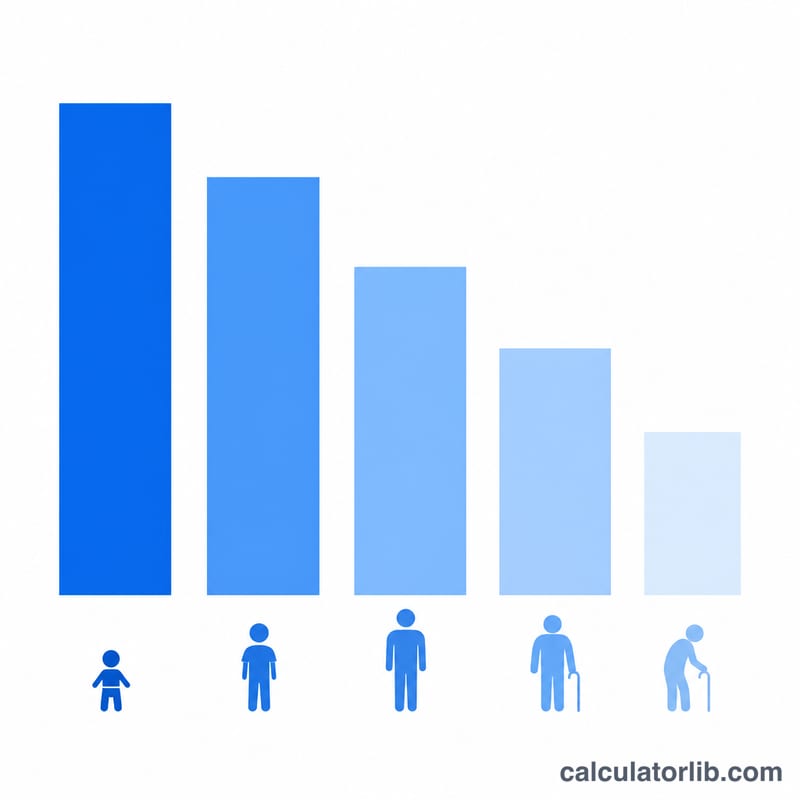
The age baseline uses the midpoints of widely cited recommendations: about 8 hours for adults (18–64), 9 for teens, 10 for school-age children, and 7.5 for those 65+. Sleep debt recovery adds 25% of any gap between that baseline and your recent average sleep, so chronic short sleep nudges the target up. Active people add 0.5 hours, while a sedentary lifestyle subtracts 0.25 hours.
Worked example
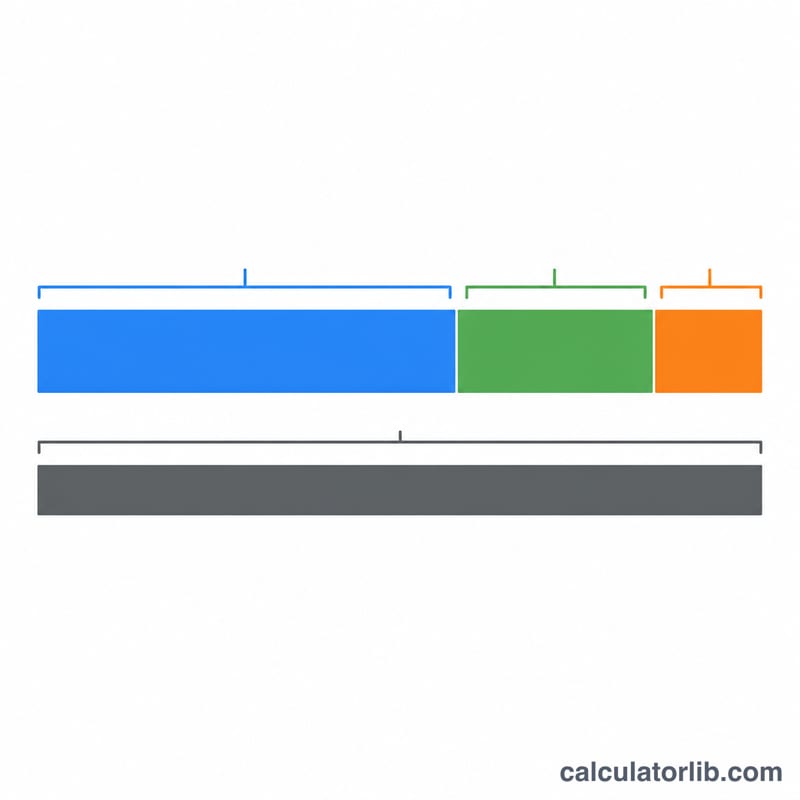
A 30-year-old (base = 8 h) who has only been sleeping 6 hours has a 2-hour deficit; recovery adds \(0.25 \times 2 = 0.5\) h. With a moderate activity level (0 adjustment), the target is $$8 + 0.5 + 0 = \textbf{8.5 hours}.$$
FAQ
Is this medical advice? No. It is an educational estimate. Persistent fatigue or insomnia should be discussed with a doctor.
Why does recent sleep matter? Sleep debt accumulates, and the body needs extra rest to recover, so the tool raises your target when you have been sleeping less than your baseline.
Can I need more than the baseline even when rested? Yes — intense physical training increases recovery demands, which is why the activity adjustment can add time.