
What is the Sleep Cycle Calculator?
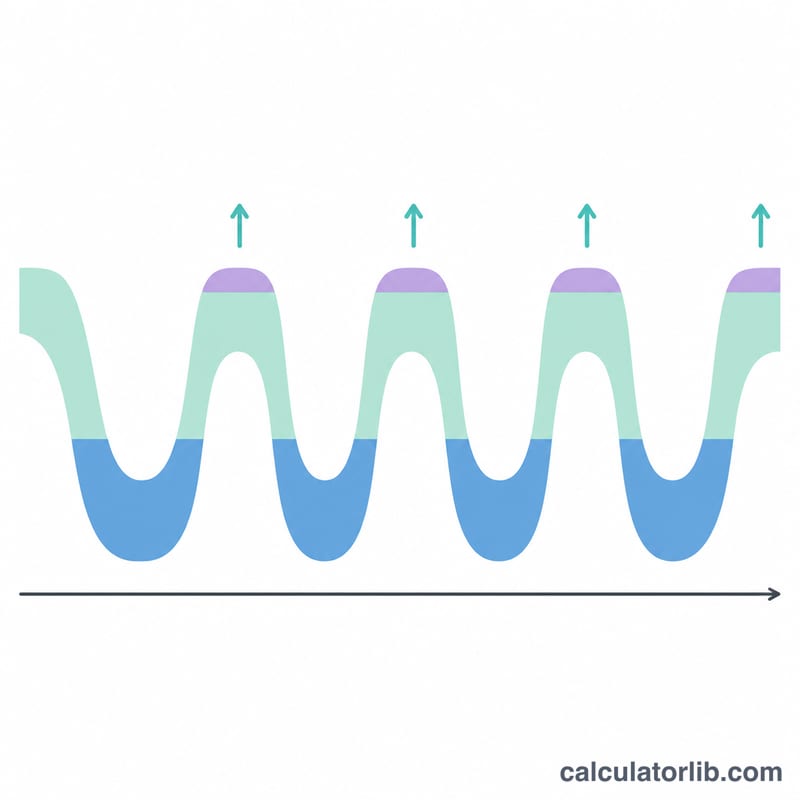
Sleep happens in repeating cycles of roughly 90 minutes, each moving through light sleep, deep sleep and REM. Waking at the end of a cycle — rather than in the middle of deep sleep — leaves you feeling refreshed instead of groggy. This calculator works out bedtimes or wake-up times that line up with the end of complete 90-minute cycles, and it accounts for the time it takes you to actually fall asleep (about 14 minutes on average).
How to use it
Pick whether you want to wake up at a fixed time (the tool gives you several good bedtimes) or you're heading to bed now (it gives you good wake-up times). Enter the target time and, optionally, how long you usually take to drift off. The calculator lists options for 6, 5, 4 and 3 cycles — aim for 5 or 6 cycles (7.5–9 hours) for most adults.
The formula
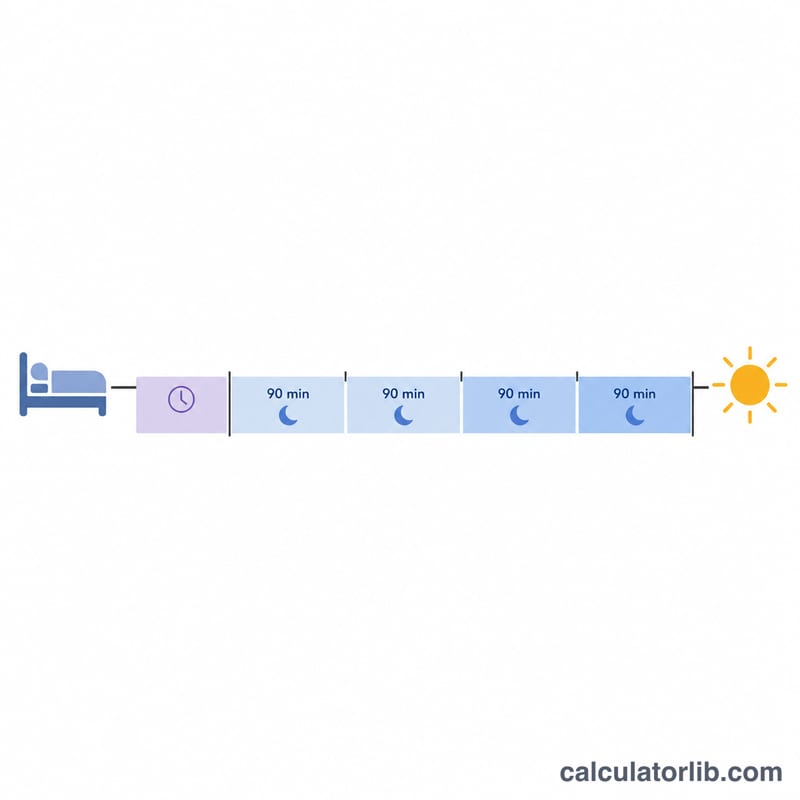
Each cycle is 90 minutes. To find a wake time we add your fall-asleep delay and n cycles to bedtime:
$$\text{wake} = \text{bedtime} + t_{\text{fall}} + n \times 90\ \text{min}$$
To find a bedtime we reverse it: $$\text{bed} = \text{wake} - t_{\text{fall}} - n \times 90\ \text{min}$$
Worked example
You want to wake at 7:00 AM and take 14 minutes to fall asleep. For 6 cycles that's \(6 \times 90 = 540\) minutes of sleep plus 14 minutes \(= 554\) minutes. 7:00 AM is 420 minutes after midnight; \(420 - 554 = -134\), which wraps to 1,306 minutes \(=\) 9:46 PM. Five cycles (7.5 h) would mean going to bed at 11:16 PM.
FAQ
Is a sleep cycle always exactly 90 minutes? No — it varies between 70 and 120 minutes by person and across the night. 90 minutes is a widely used average.
How many cycles should I aim for? Most adults do best with 5–6 complete cycles (7.5–9 hours).
Why add fall-asleep time? Cycles start once you're actually asleep, so the average 14-minute delay is added so your alarm lands at a cycle boundary.