
What is a geometric sequence?
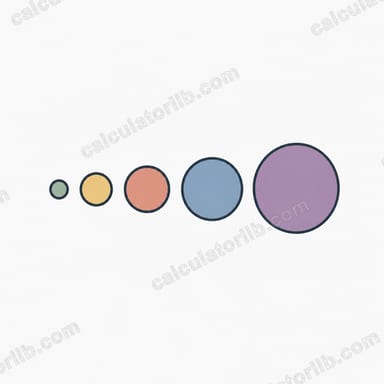
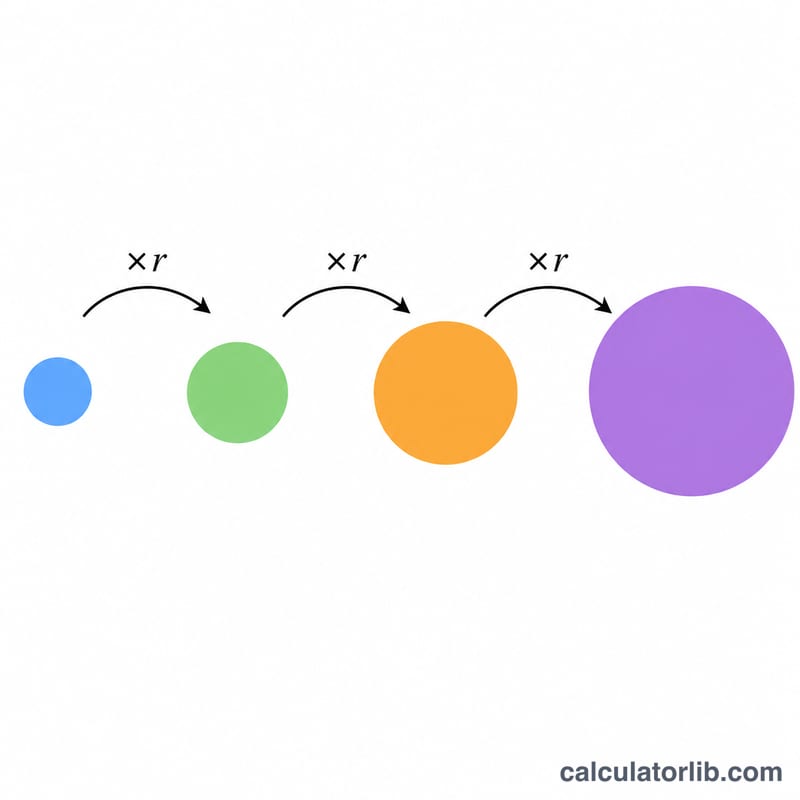
A geometric sequence is a list of numbers where each term is found by multiplying the previous term by a fixed number called the common ratio, \(r\). Starting from a first term \(a_1\), the sequence runs \(a_1, a_1 r, a_1 r^2, a_1 r^3\), and so on. Geometric sequences appear in compound interest, population growth, radioactive decay, and many physics and finance problems.
How to use this calculator
Enter three values: the first term (\(a_1\)), the common ratio (\(r\)), and the position (\(n\)) of the term you want. The calculator returns \(a_n\), the value of that specific term, along with the sum of the first \(n\) terms. The position \(n\) must be a whole number of 1 or greater.
The formula explained
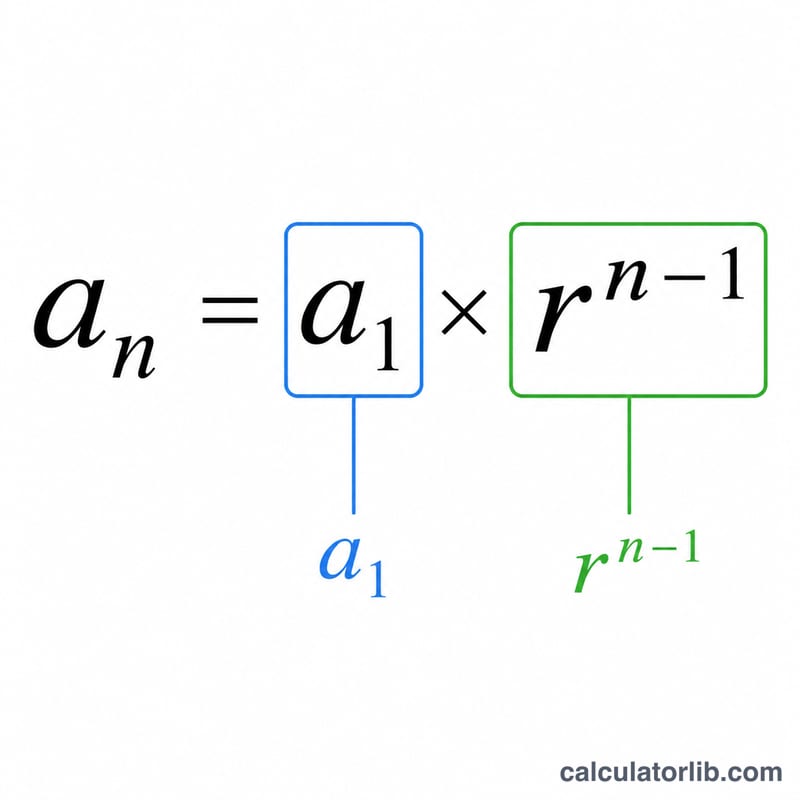
The nth term of a geometric sequence is given by:
$$a_n = a_1 \cdot r^{\,n-1}$$
The exponent is \(n-1\) because the first term (\(n = 1\)) involves no multiplication by \(r\) (\(r^0 = 1\)). Each step forward multiplies by one more factor of \(r\). The finite series sum uses $$S_n = a_1 \cdot \frac{r^n - 1}{r - 1}$$ when \(r \neq 1\); if \(r = 1\) the sum is simply \(a_1 \cdot n\).
Worked example
Suppose \(a_1 = 2\), \(r = 3\), and you want the 5th term. Then $$a_5 = 2 \cdot 3^{\,5-1} = 2 \cdot 3^4 = 2 \cdot 81 = 162.$$ The sum of the first 5 terms is $$2 \cdot \frac{3^5 - 1}{3 - 1} = 2 \cdot \frac{243 - 1}{2} = 242.$$
FAQ
What if the common ratio is negative? The calculator handles negative ratios; the terms will alternate in sign. For example \(r = -2\) gives an oscillating sequence.
Can r be a fraction? Yes. A ratio between 0 and 1 produces a decreasing (decaying) sequence, such as \(r = 0.5\).
What does n = 1 give? When \(n = 1\) the result equals the first term \(a_1\), since \(r^0 = 1\).