

What this calculator does
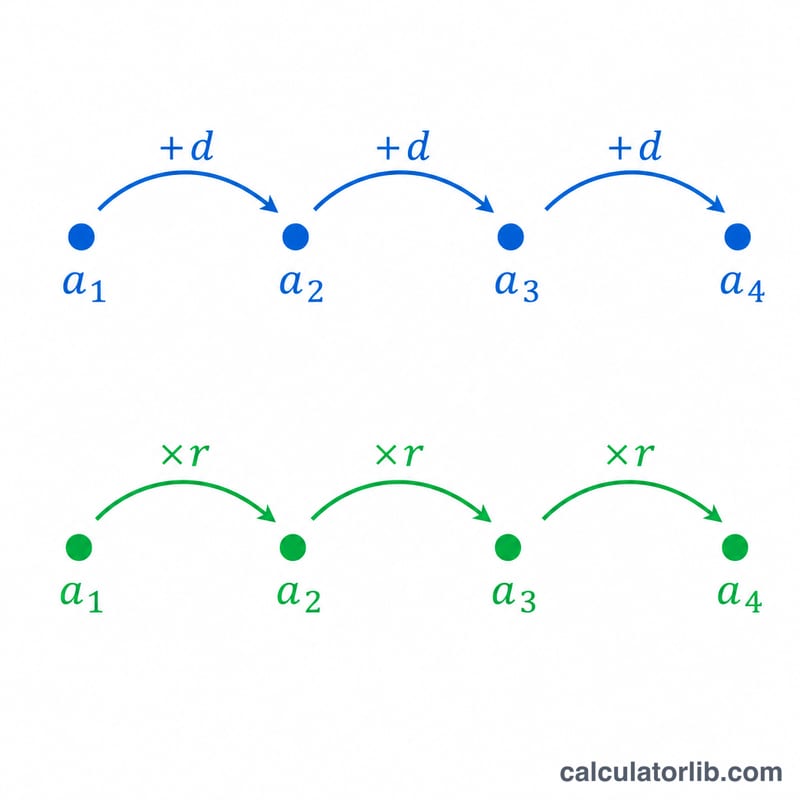
This tool takes the first few terms of a number sequence and works out the rule for its nth term. It automatically checks whether your sequence is arithmetic (each term increases by a fixed amount) or geometric (each term is multiplied by a fixed factor), then uses the matching formula to compute any term you want.
How to use it
Type your known terms separated by commas, for example 2, 5, 8, 11. Enter the position n of the term you want to find, then submit. The calculator reports the detected sequence type, the common difference or ratio, the nth-term rule, and the value of the nth term.
The formula explained
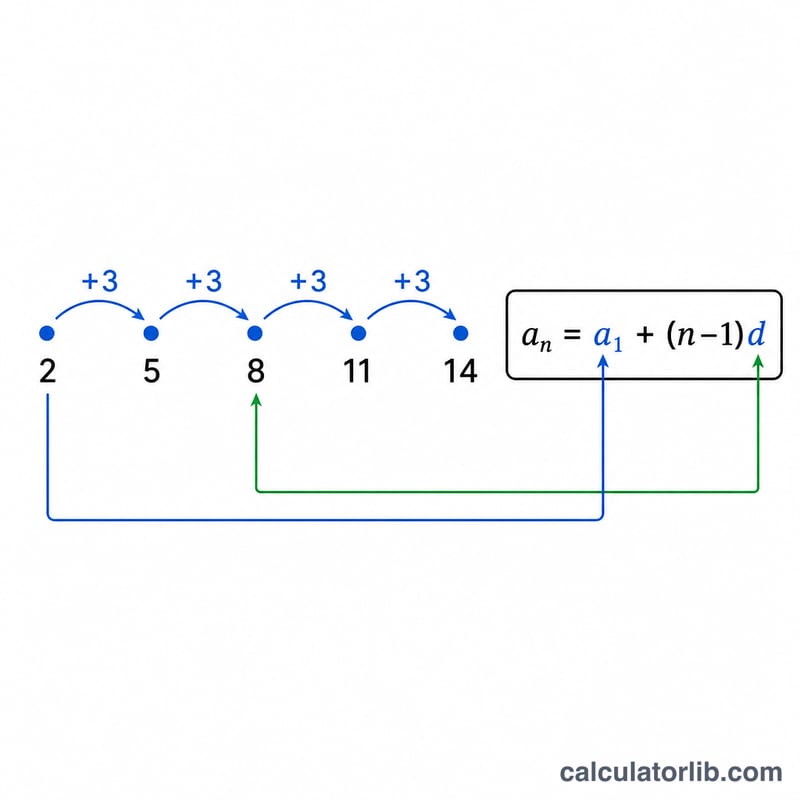
For an arithmetic sequence the gap between consecutive terms is constant. Calling that gap d and the first term a₁, the nth term is $$a_{\text{n}} = a_1 + \left(\text{n} - 1\right)\,d$$ For a geometric sequence the ratio of consecutive terms is constant. Calling that ratio r, the nth term is $$a_{\text{n}} = a_1 \cdot r^{\,\text{n} - 1}$$ The calculator first tries the constant-difference test; if that fails it tries the constant-ratio test.
Worked example
Take the sequence 2, 5, 8, 11. Each step adds 3, so it is arithmetic with \(a_1 = 2\) and \(d = 3\). The 10th term is $$a_{10} = 2 + \left(10 - 1\right) \times 3 = 2 + 27 = 29$$
FAQ
What if my sequence is neither? If the differences and ratios are not constant, the tool reports that no simple rule was found. Quadratic or Fibonacci-type sequences are not covered.
How many terms should I enter? At least two, but three or more gives a more reliable pattern check.
Can it handle decimals and negatives? Yes — for example 100, 50, 25 is geometric with \(r = 0.5\).