

What is the two-worker time together calculator?
This calculator solves the classic "work rate" word problem: if one worker can finish a job alone in a hours and another can finish the same job alone in b hours, how long will it take them to complete the job working together? The answer comes from combining their rates.
How to use it
Enter the time each worker needs to complete the job on their own. Worker A might paint a fence in 4 hours and Worker B in 6 hours. Press calculate and the tool returns the combined time plus each individual rate and the combined rate (jobs per hour).
The formula explained
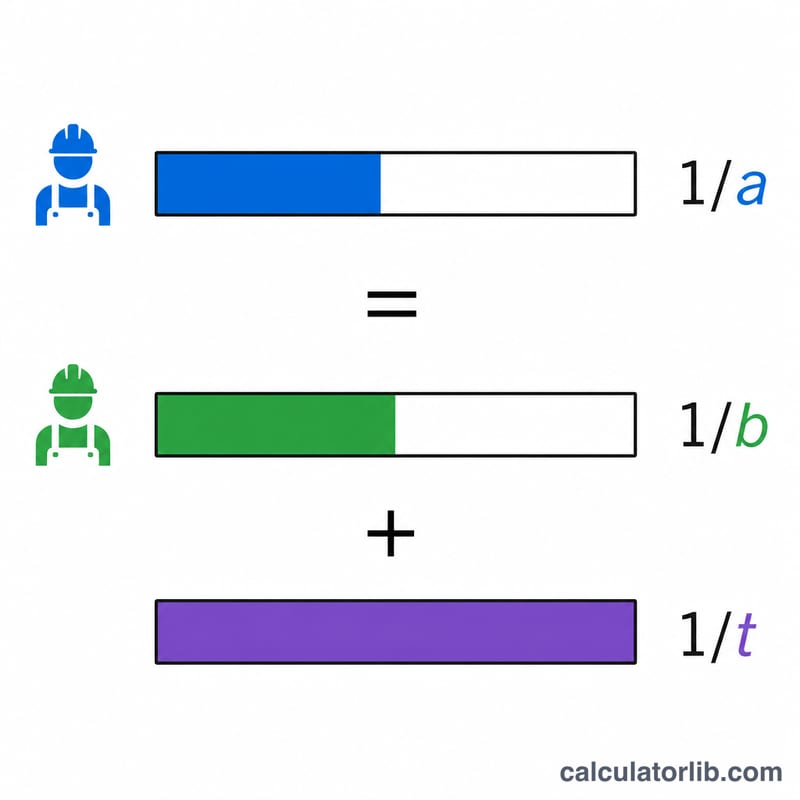
Each worker contributes a fraction of the job per hour. Worker A does \(1/a\) of the job each hour, Worker B does \(1/b\). Together their combined rate is \(1/a + 1/b\), which equals \(1/t\). Rearranging gives the convenient closed form:
$$t = \frac{a \cdot b}{a + b}$$
Because the combined rate is the sum of the parts, two people always finish faster than either alone.
Worked example
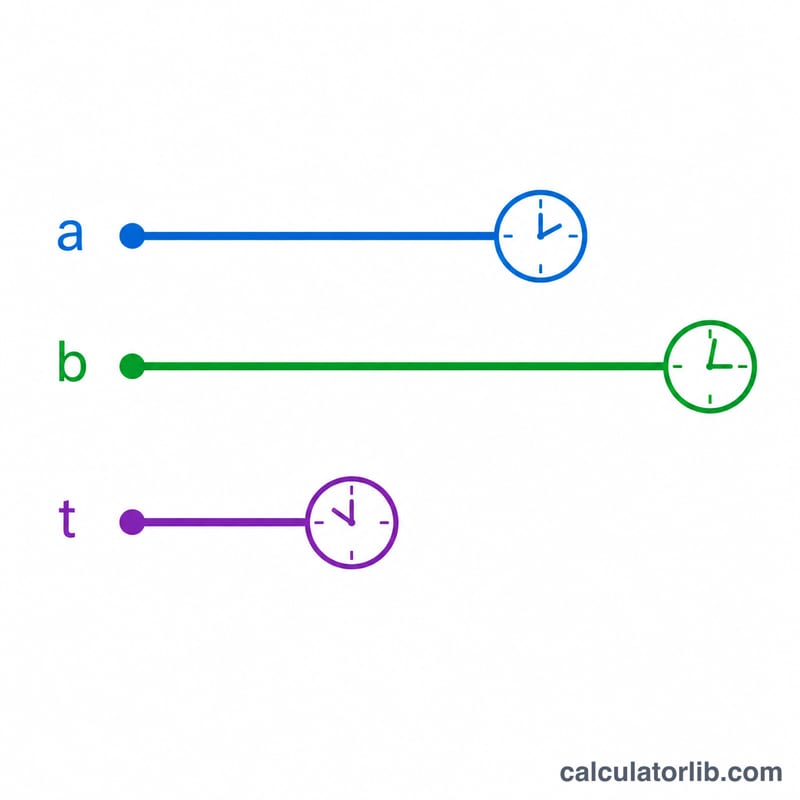
Suppose A takes 4 hours and B takes 6 hours. Then $$t = \frac{4 \times 6}{4 + 6} = \frac{24}{10} = 2.4 \text{ hours}.$$ So together they finish in 2 hours and 24 minutes — faster than the quicker worker on their own.
FAQ
Does this work for pipes filling a tank? Yes — any additive-rate problem (pipes, pumps, hoses) uses the same formula.
What if one input is zero? A time of zero means an infinitely fast worker, which is not physically meaningful, so use positive times.
Can I extend it to three workers? The same idea applies: \(1/t = 1/a + 1/b + 1/c\). This calculator covers the two-worker case.