
What is the common ratio?
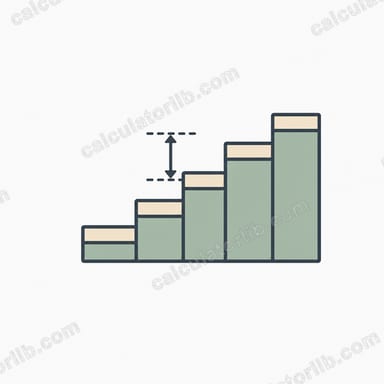
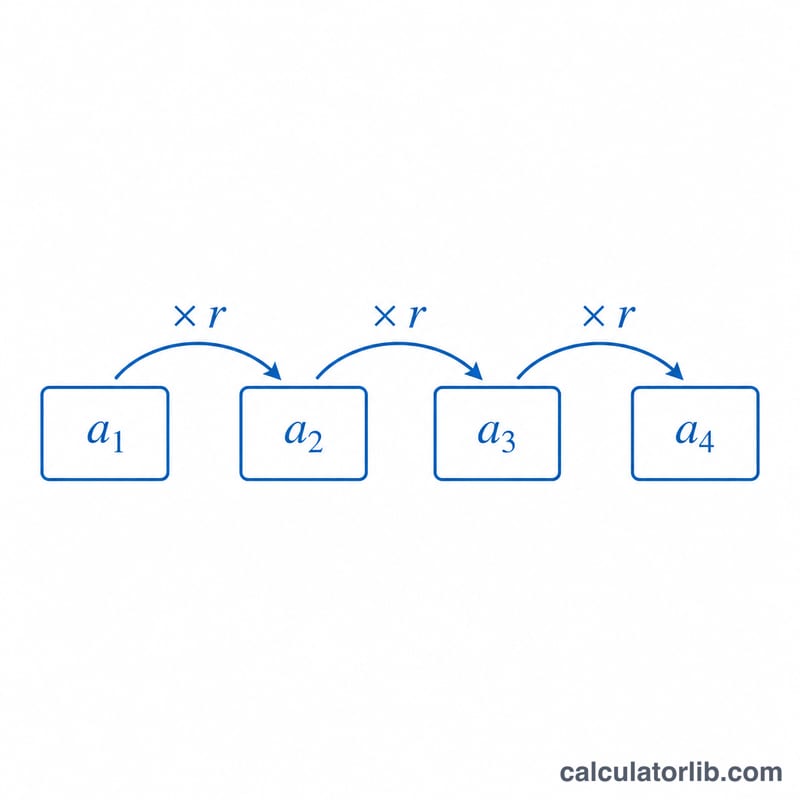
In a geometric sequence each term is found by multiplying the previous term by a fixed number called the common ratio, written \(r\). If you know any two consecutive terms you can recover \(r\) by dividing the later term by the earlier one. This calculator does exactly that for you.
How to use it
Enter a term of your sequence in the first box and the very next term in the second box. The calculator instantly returns \(r\). The terms can be positive, negative, whole numbers or decimals.
The formula explained
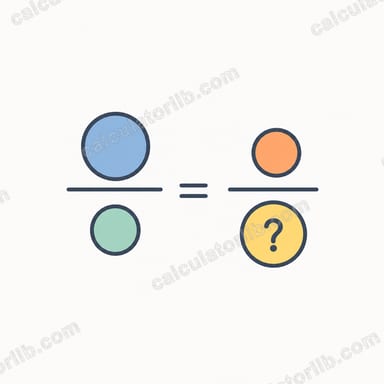
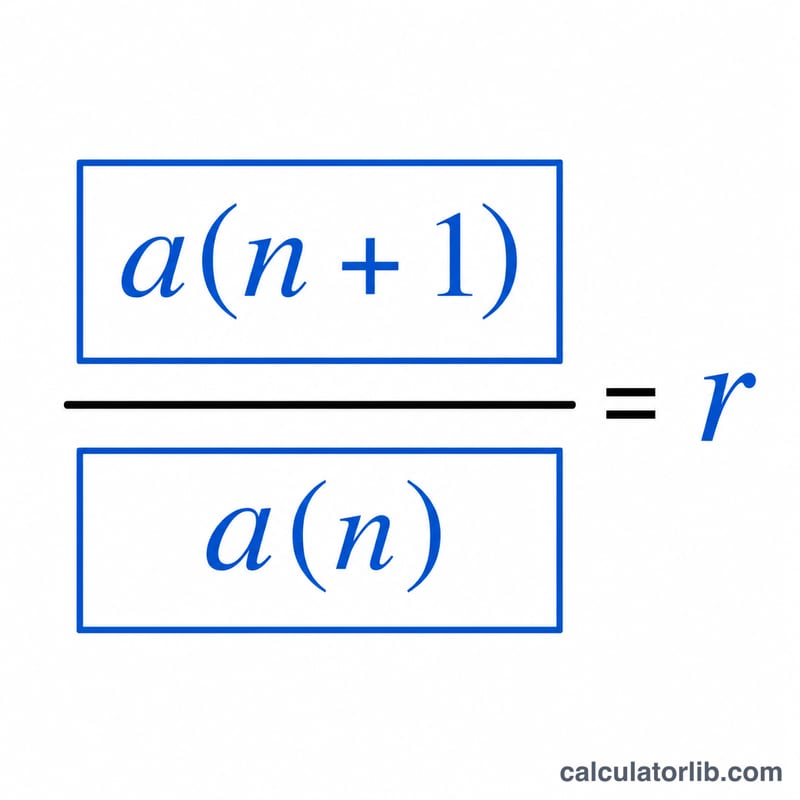
The defining property of a geometric sequence is \(a_{n+1} = r \times a_n\). Rearranging for \(r\) gives $$r = \frac{\text{Next term }(a_{n+1})}{\text{Term }(a_n)}$$ Because the ratio is constant, you can pick any neighbouring pair of terms and you will always get the same value of \(r\) (as long as the sequence is truly geometric).
Worked example
Suppose a term is 2 and the next term is 6. Then $$r = \frac{6}{2} = 3$$ So the sequence continues 2, 6, 18, 54, ... each term tripling the previous one.
FAQ
Can the ratio be negative? Yes. If terms alternate sign, such as 4 then -8, then \(r = \frac{-8}{4} = -2\), producing an alternating sequence.
What if the ratio is between -1 and 1? The sequence shrinks toward zero. For example 8 then 4 gives \(r = 0.5\).
Why must the earlier term be non-zero? Division by zero is undefined, and a genuine geometric sequence cannot contain a zero term, so the first box must not be 0.