
What this calculator does
This tool analyzes any sinusoidal function written in the standard form \(y = a\,\sin(bx - c) + d\) (it works identically for cosine). From the four coefficients a, b, c and d it instantly returns the four key transformations of the wave: amplitude, period, phase shift and vertical shift, plus the frequency.
How to use it
Enter your coefficients exactly as they appear in the function. For example, in \(y = 2\cdot\sin(3x - 1)\), set \(a = 2\), \(b = 3\), \(c = 1\), \(d = 0\). The calculator handles negative values and decimals. If your function is written as \(a\cdot\sin(b(x - h))\), simply multiply out so that \(c = b\cdot h\) before entering it.
The formula explained
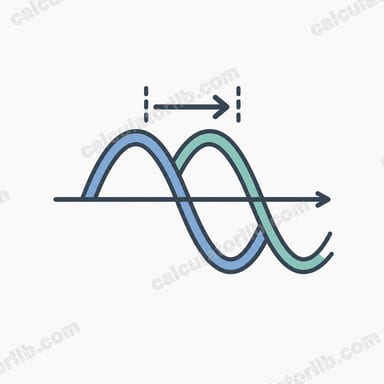
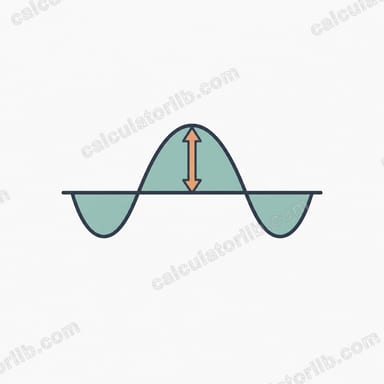
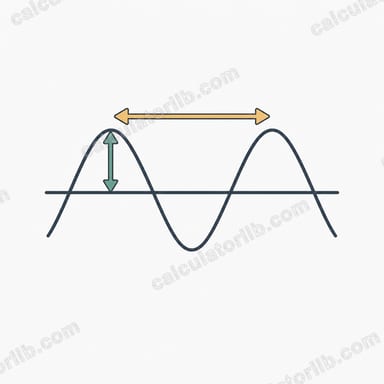
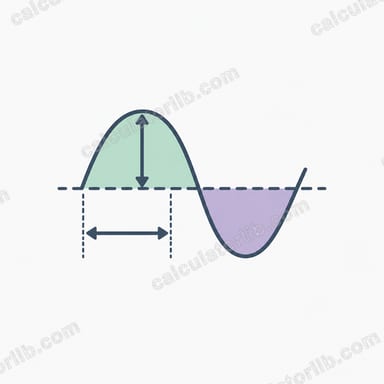
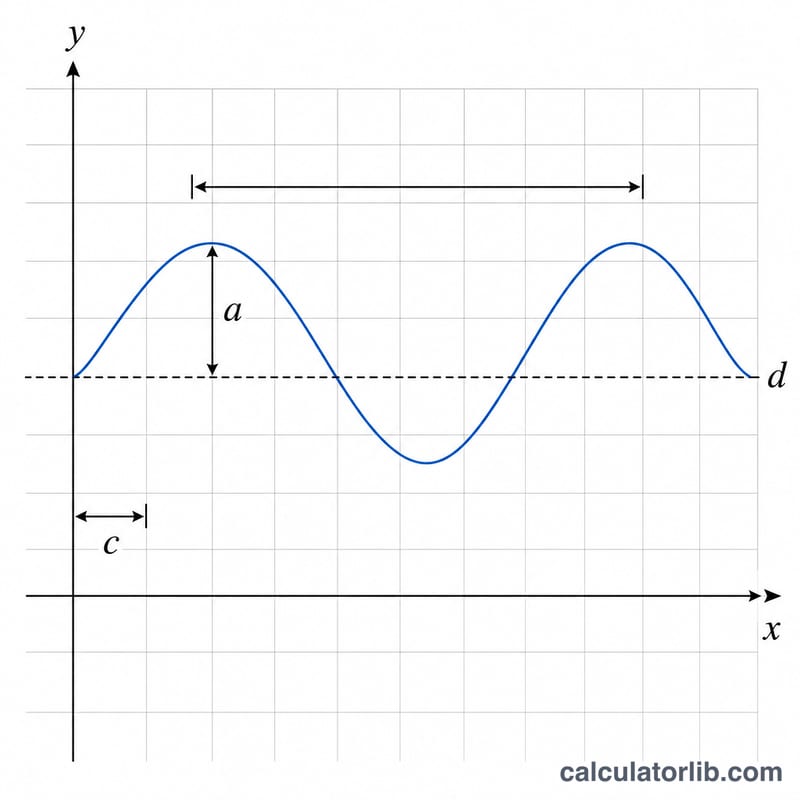
The amplitude is \(|a|\), the maximum distance the curve rises or falls from its midline. The period is \(\frac{2\pi}{|b|}\), the horizontal length of one full cycle — a larger \(|b|\) compresses the wave. The phase shift is \(\frac{c}{b}\), the horizontal displacement (positive shifts the graph right). The vertical shift \(d\) moves the midline up or down. Frequency is the reciprocal of the period.
Worked example
Take \(y = 2\cdot\sin(3x - 1)\).
$$\text{Amplitude} = |2| = 2$$$$\text{Period} = \frac{2\pi}{3} \approx 2.0944$$$$\text{Phase shift} = \frac{1}{3} \approx 0.3333 \text{ (right)}$$$$\text{Vertical shift} = 0$$So the wave oscillates 2 units about the x-axis, completing a cycle every ≈2.09 units, shifted right by about a third of a unit.
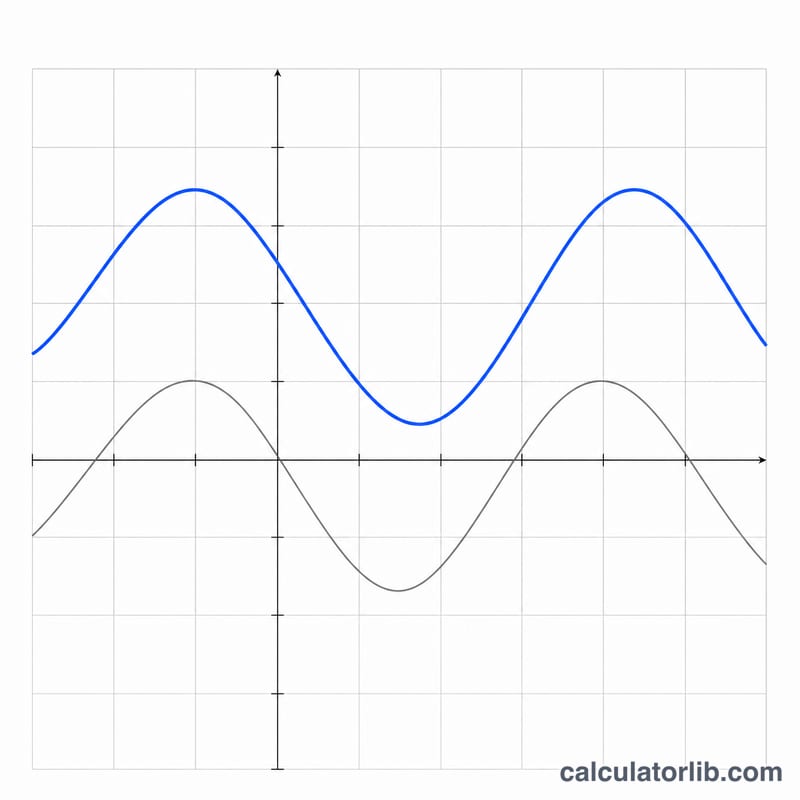
Key Terms Defined
- Amplitude \((|a|)\)
- Half the vertical distance between the maximum and minimum of the wave — the height of the peak above the midline. It always equals the absolute value of \(a\); a negative \(a\) reflects the curve across the midline but does not change the amplitude.
- Period \(\left(\tfrac{2\pi}{|b|}\right)\)
- The horizontal length of one complete cycle. Larger \(|b|\) compresses the wave (shorter period); smaller \(|b|\) stretches it (longer period).
- Phase shift \(\left(\tfrac{c}{b}\right)\)
- The horizontal displacement of the curve. A positive value shifts the graph to the right, a negative value to the left. Note it is \(c/b\), not just \(c\).
- Vertical shift / midline \((d)\)
- The horizontal line \(y = d\) about which the wave oscillates. The graph moves up for \(d>0\) and down for \(d<0\).
- Frequency \(\left(\tfrac{|b|}{2\pi}\right)\)
- The number of complete cycles per unit of \(x\); the reciprocal of the period. In physical contexts where \(x\) is time, this is measured in cycles per second (hertz).
- Angular frequency \((b)\)
- The coefficient on \(x\), expressed in radians per unit of \(x\). It relates to ordinary frequency by \(b = 2\pi f\) and determines how fast the argument of the sine advances.
- The coefficients \(a, b, c, d\)
- In \(y = a\sin(bx - c)+d\): \(a\) sets vertical stretch and amplitude, \(b\) sets horizontal compression (period/frequency), \(c\) controls the horizontal phase shift through \(c/b\), and \(d\) sets the vertical position of the midline.
More Worked Examples
Example 1: \(y = -4\cos(2x + \pi) + 1\)
Although written with cosine, the same transformation rules apply. Match it to \(a\cos(bx - c)+d\) by rewriting \(2x+\pi\) as \(2x-(-\pi)\), so \(a=-4,\ b=2,\ c=-\pi,\ d=1\).
- Amplitude: \(|a| = |-4| = 4\). The negative sign reflects the curve but the amplitude is 4.
- Period: \(\dfrac{2\pi}{|b|} = \dfrac{2\pi}{2} = \pi\).
- Phase shift: \(\dfrac{c}{b} = \dfrac{-\pi}{2} = -\dfrac{\pi}{2}\), i.e. \(\tfrac{\pi}{2}\) to the left.
- Vertical shift: \(d = 1\); the midline is \(y = 1\).
Example 2: \(y = 2\sin(0.5x - 1.5) - 3\)
Here \(a=2,\ b=0.5,\ c=1.5,\ d=-3\).
- Amplitude: \(|a| = 2\).
- Period: \(\dfrac{2\pi}{0.5} = 4\pi \approx 12.566\).
- Phase shift: \(\dfrac{1.5}{0.5} = 3\) to the right.
- Vertical shift: \(d = -3\); the midline is \(y = -3\).
Example 3: \(y = \tfrac{3}{4}\sin(3x - \tfrac{\pi}{2})\)
A fractional-amplitude case with \(a=\tfrac34,\ b=3,\ c=\tfrac{\pi}{2},\ d=0\).
- Amplitude: \(|a| = \tfrac34 = 0.75\).
- Period: \(\dfrac{2\pi}{3} \approx 2.094\).
- Phase shift: \(\dfrac{\pi/2}{3} = \dfrac{\pi}{6} \approx 0.524\) to the right.
- Vertical shift: \(d = 0\); the midline is the \(x\)-axis.
You can confirm a single output value for this curve — for instance at \(x=\tfrac{\pi}{2}\), \(y = \tfrac34\sin(3\cdot\tfrac{\pi}{2} - \tfrac{\pi}{2}) = \tfrac34\sin(\pi) = \)0.
FAQ
Does this work for cosine? Yes. Amplitude, period, phase shift and vertical shift are computed the same way for \(y = a\cdot\cos(bx - c) + d\).
Why is my phase shift positive when c is positive? With the form \(bx - c\), the shift \(\frac{c}{b}\) moves the graph to the right. If the function uses \(bx + c\), enter c as a negative number.
What if b is 0? A period of 0 is undefined for a wave, so the calculator returns 0 to avoid dividing by zero — check your coefficient.