
What Is a Phase Shift?
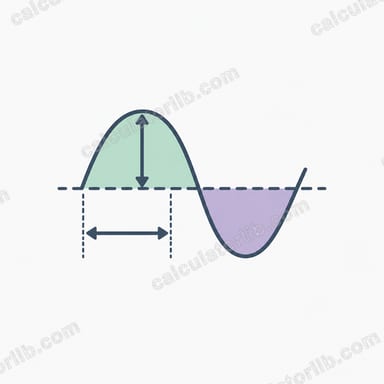
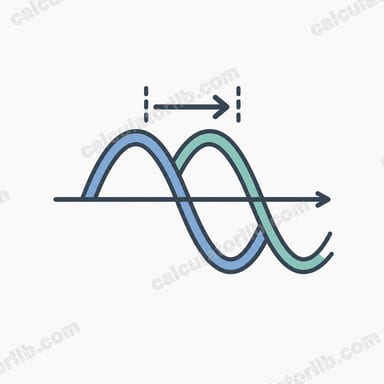
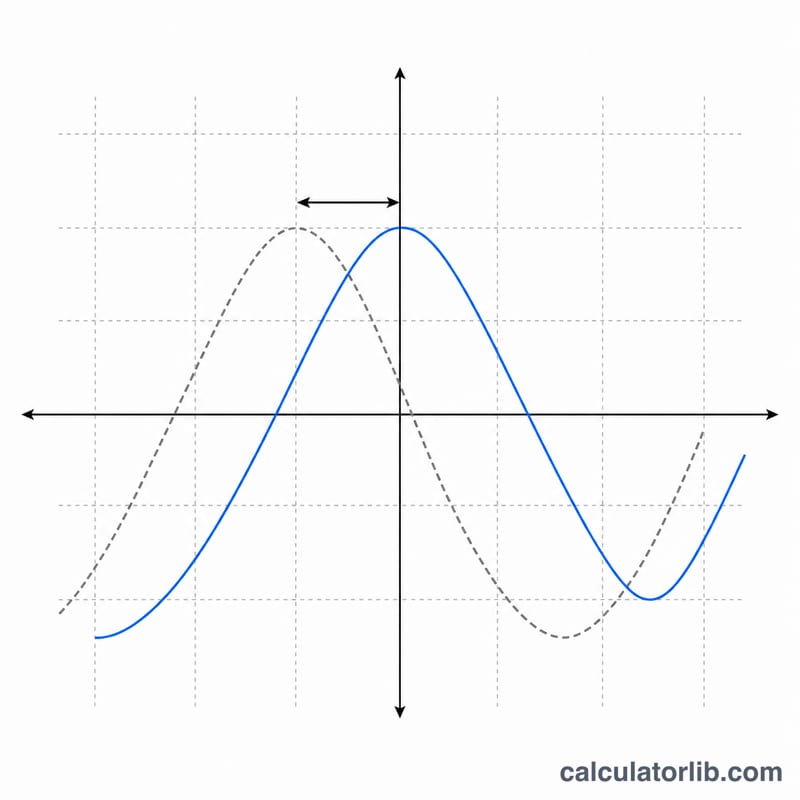
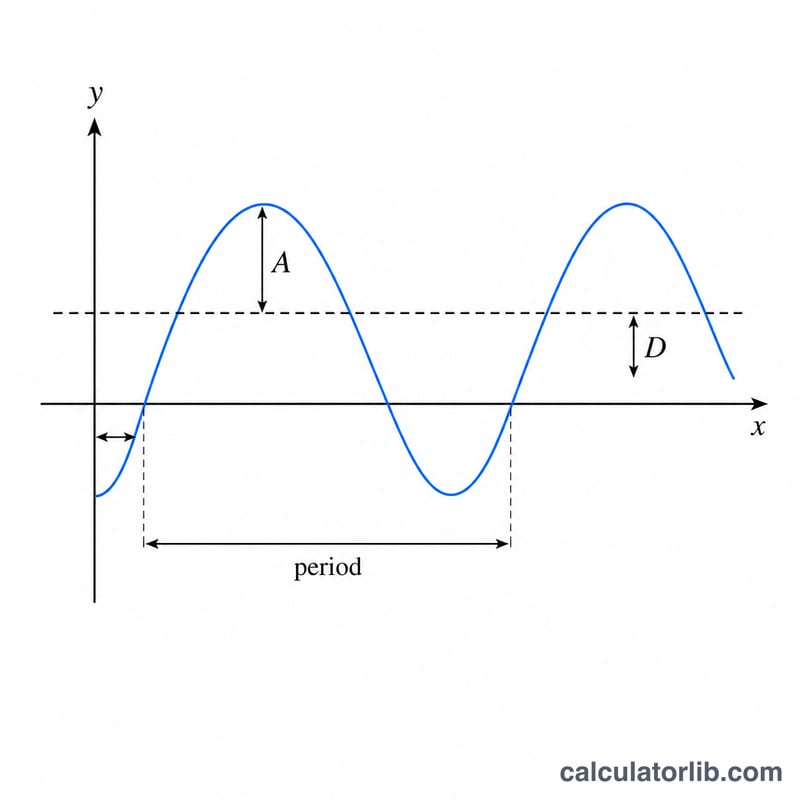
The phase shift describes how far a sine or cosine graph is moved horizontally from its standard position. For a function written in the form \(y = A\cdot\sin(Bx - C) + D\) (or with cosine), the phase shift equals \(C / B\). A positive result means the graph shifts to the right; a negative result means it shifts to the left.
How to Use This Calculator
Enter the four parameters from your equation: \(A\) (amplitude), \(B\) (the coefficient multiplying x), \(C\) (the constant subtracted inside the function), and \(D\) (the vertical shift). Make sure your equation is in the form \(Bx - C\) — if you have \(Bx + C\), simply use a negative C value. The calculator returns the phase shift along with the amplitude, period, and vertical shift.
The Formula Explained
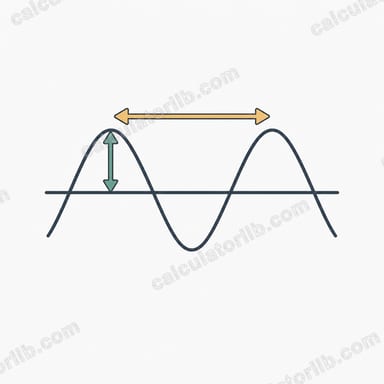
Inside the trig argument, the expression is set to zero to find the starting point of the cycle: \(Bx - C = 0\), so \(x = C/B\). That x-value is the phase shift. The period, the width of one complete wave, is \(2\pi / |B|\). The amplitude \(|A|\) measures the peak height from the midline, and D moves the entire wave up or down.
Worked Example
Consider \(y = 3\cdot\sin(2x - \pi) + 1\). Here \(A = 3\), \(B = 2\), \(C = \pi \approx 3.14159\), \(D = 1\). The phase shift is $$\frac{C}{B} = \frac{3.14159}{2} \approx 1.5708$$ (a shift of about \(\pi/2\) to the right). The period is \(2\pi / 2 = \pi \approx 3.14159\), the amplitude is 3, and the vertical shift is 1.
FAQ
What does a negative phase shift mean? It means the graph is shifted to the left by that amount.
Does this work for cosine? Yes — the phase shift formula \(C/B\) is identical for both sine and cosine functions.
What if my equation has Bx + C? Rewrite it as \(Bx - (-C)\) and enter C as a negative number.