
What is the Power Reducing Calculator?
The power-reducing identities let you rewrite squared trigonometric functions (sin²θ, cos²θ, tan²θ) using only a first-power cosine of the doubled angle, cos 2θ. This is essential when integrating trig functions, simplifying expressions, or solving equations in calculus and physics. This calculator evaluates all three reduced forms for any angle you enter, in degrees or radians.
How to use it
Enter your angle \(\theta\), choose whether it is in degrees or radians, and the calculator instantly returns \(\sin^{2}\theta\), \(\cos^{2}\theta\), \(\tan^{2}\theta\) and the intermediate value \(\cos 2\theta\). Degrees are converted to radians internally using \(\theta_{\text{rad}} = \theta_{\text{deg}} \times \pi / 180\).
The formula explained
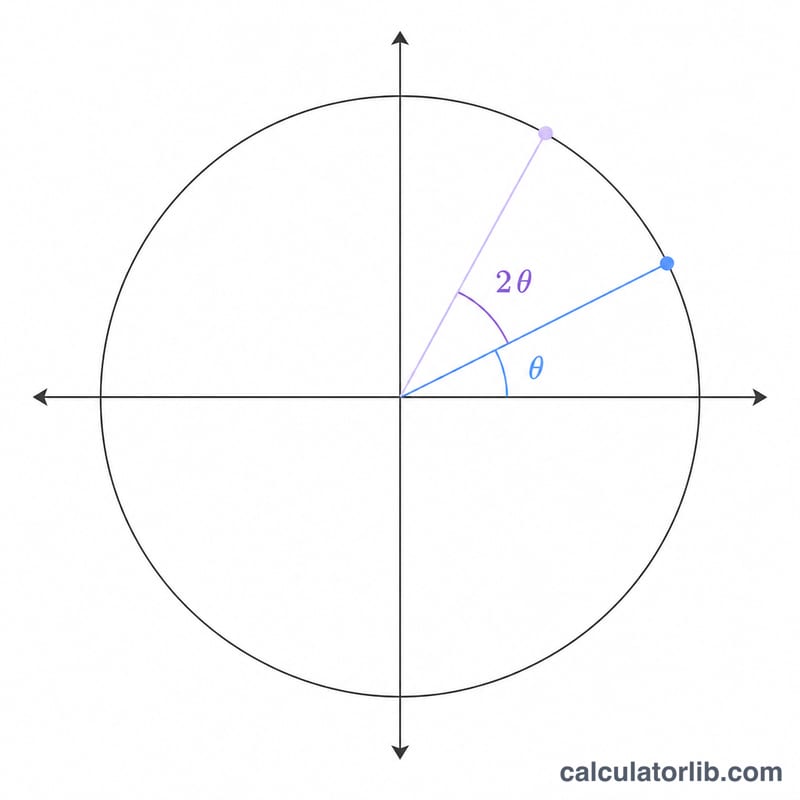
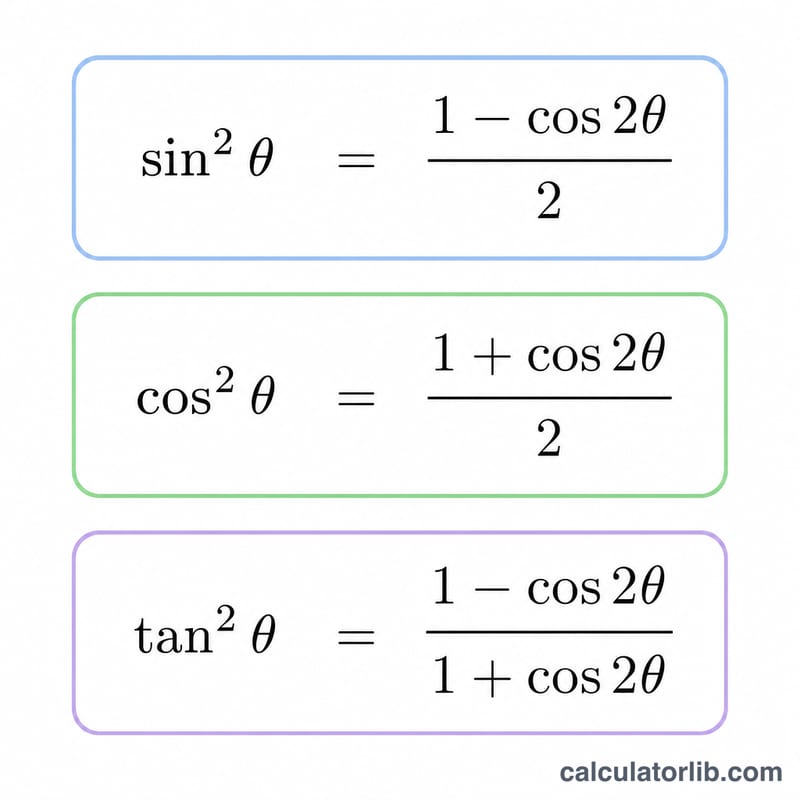
Starting from the double-angle identity \(\cos 2\theta = 1 - 2\sin^{2}\theta = 2\cos^{2}\theta - 1\), we rearrange to isolate the squared terms:
$$\sin^{2}\theta = \frac{1-\cos 2\theta}{2}, \quad \cos^{2}\theta = \frac{1+\cos 2\theta}{2}$$ and dividing the two gives $$\tan^{2}\theta = \frac{1-\cos 2\theta}{1+\cos 2\theta}.$$ The tangent form is undefined when \(1 + \cos 2\theta = 0\) (i.e. \(\theta = 90°, 270°, \ldots\)).
Worked example
Let \(\theta = 30°\). Then \(2\theta = 60°\) and \(\cos 60° = 0.5\). So $$\sin^{2}30° = \frac{1 - 0.5}{2} = 0.25, \quad \cos^{2}30° = \frac{1 + 0.5}{2} = 0.75,$$ and $$\tan^{2}30° = \frac{0.5}{1.5} \approx 0.3333.$$ These match the known exact values (\(\sin 30° = 0.5\), \(\cos 30° = \sqrt{3}/2\)).
FAQ
Why use power-reducing identities? They lower the exponent on trig functions, which makes many integrals (like \(\int \sin^{2}\theta \, d\theta\)) solvable in closed form.
What if tan²θ is undefined? When \(1 + \cos 2\theta\) equals zero the denominator vanishes, so \(\tan^{2}\theta\) has no finite value at those angles.
Are degrees or radians better? Both give the same trig result; pick radians for calculus work and degrees for geometry.